Freedom by Design: How He Lived in 5 Countries and Built the Free Visa Tool He Wished Existed
Build to Launch Friday: Meet Benjamin, the global mobility expert who turned a decade of border-crossing into a free app for everyone else
Welcome to Build to Launch Fridays, where we meet the builders turning domain expertise into AI-powered products.
Every Friday, I’m spotlighting someone from the vibe coding builders collection who’s doing exactly what I believe is the future: using AI not as just another tool, but as a true collaborator to transform curiosity, passion, and years of professional knowledge into something scalable and ownable. No VC funding, no technical co-founders, no permission required, just domain experts who decided to build.
Today, meet Benjamin — the entrepreneur who spent over a decade living in 5 countries, obtaining 6 residencies, building companies across multiple jurisdictions, and gathering the exact knowledge most people pay thousands to consultants to learn.
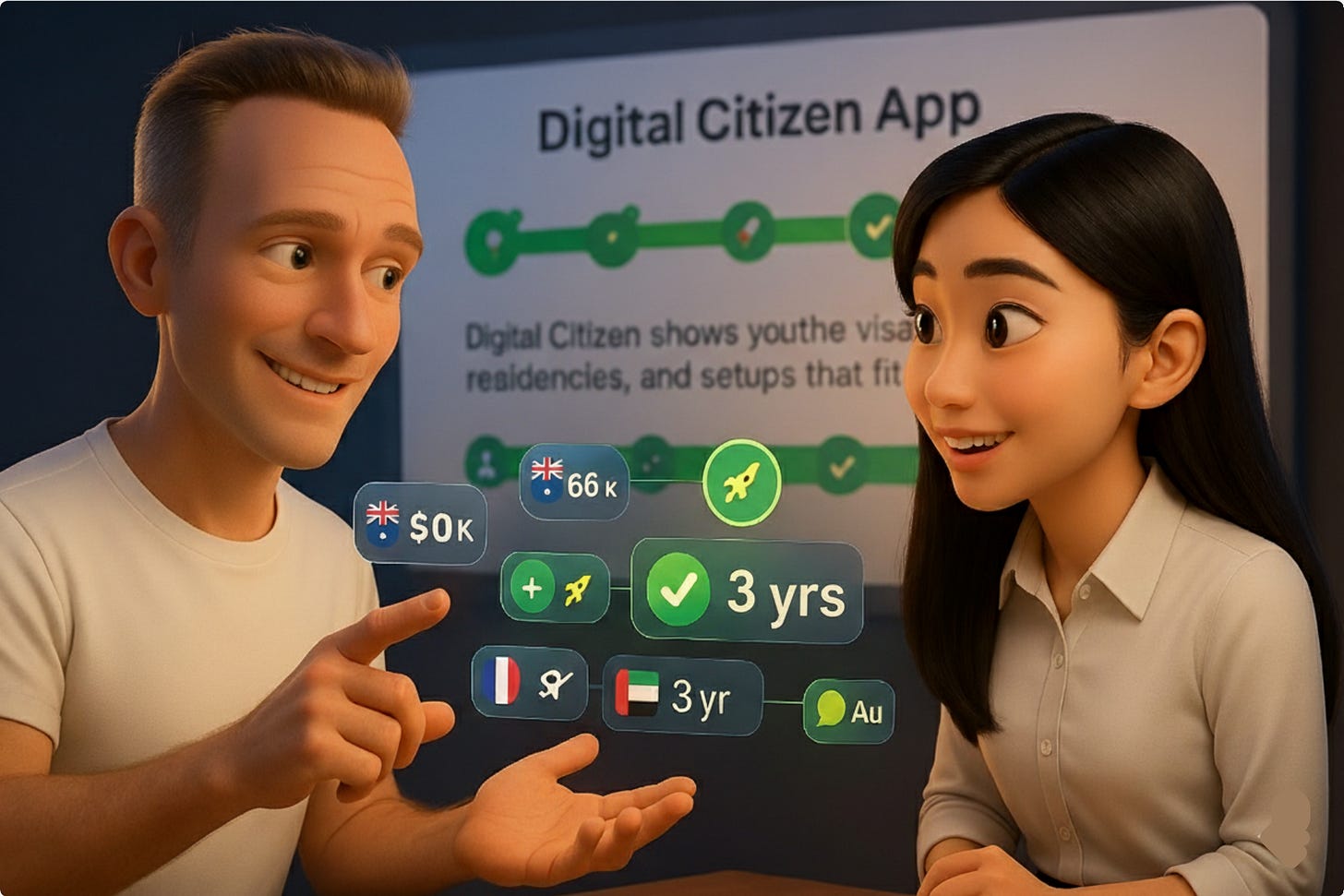
Have you ever wondered what it actually takes to move abroad? Not the glossy digital nomad Instagram version, but the real process, which visa, which bank, which documents, which requirements?
Most people pay immigration consultants thousands of dollars for this information. Or they spend months piecing together outdated forum posts and generic blog articles. Benjamin did something different. After living the multi-jurisdictional life himself — 5 countries, 6 residencies, multiple companies — he built the free tool he wished existed when he started.
No hidden agenda. No consultation upsell. Just a straightforward visa checker built from lived experience, powered by AI, and launched in 16 hours with no-code tools. This is what happens when someone who’s actually done it decides to share the playbook.
Background & Origin
You’ve lived long-term in 5 countries and hold 6 residencies around the world. Can you walk us through that journey? Which residencies did you obtain, and what motivated each move?
I’ve spent over a decade building a life across borders. 5 countries, 6 residencies. Each one taught me something different about freedom, structure, and what it means to design your own path.
Right after high school, I went to Australia on a work and travel visa instead of following the usual path everyone takes. I wanted to experience what living abroad actually felt like before committing to anything permanent.
Then the UK for my bachelor’s degree. University gave me credentials while keeping me international.
Cyprus was where I started my first company. I wanted to work for myself, and I learned how residency, tax, and business structure could work together.
While in Cyprus, I got Estonian e-Residency. My first online business and my first exposure to what a digitally advanced country could offer. Estonia showed me that infrastructure matters.
I moved to Dubai for my second company because I wanted to be in a future oriented country. The UAE gave me speed, efficiency, and a different mindset. Everything moved faster there.
Thailand was a turning point. I started my first physical business there and obtained my first Golden Visa. I wanted the best possible visa and infrastructure to work and travel freely without limitations.
After Estonia, I tested Palau’s e-Residency program. I wanted to see how another jurisdiction approached digital governance and support jurisdictions innovating in this space.
Now I’m running Digital Citizen, my newsletter and online business, out of Thailand. It’s built on everything I learned across these moves. My goal is to share this knowledge so others can design their own paths with clarity.
Each residency wasn’t random. Each one solved a problem, unlocked a new level of freedom, or taught me something I needed to understand about how the world actually works.
Reading what he’s been through... what am I reading? Am I interacting with a sane human being? How does he get all this energy? As an introvert staying in the same place most of the time, I can only imagine how much effort and tedious work this must have been.
Before building Digital Citizen, you were creating companies in multiple countries—Cyprus, UAE, Thailand, Estonia. What were you doing professionally, and what made you decide to build this tool?
I was running different businesses across multiple jurisdictions, each one teaching me how infrastructure and location impact what you can actually build.
In Cyprus, I did process consulting for German clients. In Dubai, I scaled that up, working with multinationals. In Estonia, I ran a digital education business through my e-Residency. In Thailand, I started PIMS, a tea franchise, because I wanted to build something physical. At the same time, I built Asuno, an AI process management tool.
After setting up all these companies in different countries, I kept hitting the same wall. The information gap is massive, and there were people with “hidden agendas” (such as trying to sell a service) promoting countries or company structures.
Every time I started a company in a new jurisdiction, I had to figure out everything from scratch. Banking, tax structure, visa requirements, compliance, legal frameworks. There was no central place that actually told you what worked, what didn’t, and what the trade-offs were.
Most resources were either outdated, overly generic, or written by people who’d never actually lived this life.
I realized I had extensive, lived knowledge that didn’t exist anywhere in a structured format.
That’s why I built Digital Citizen. It’s the platform I wish existed when I started. A place where you can see what’s actually possible, understand the trade-offs, and take action without reinventing the wheel every time.
It’s everything I learned across 5 countries, 6 residencies, and multiple businesses, packaged into something people can actually use.
Somehow each word I can understand, but I don’t know what some of them mean... at all. Process consulting? E-Residency? Multiple jurisdictions? But here’s what I do get, he kept hitting the same wall over and over. The information gap. The hidden agendas. The figuring-it-out-from-scratch every single time. That frustration is what builds great tools. When you’ve lived the pain enough times, you know exactly what needs to exist.
The Problem & Solution
What specific problem led you to create the Visa Checker? Was there a moment where you thought, “I wish this existed”?
The problem is that most information out there is way too general.
Everyone tells you to “get a bank account” or “apply for a visa.” But which bank account? Which type of visa? What are the actual requirements? What documents do you need? What’s the process that actually works?
I wanted specific guides. On the ground information. Real granularity.
Not “open a bank account in Thailand.” But which banks accept foreigners, what documents they actually ask for, which branches are easier to work with, and what to expect when you walk in.
Not “get a student visa.” But which student visa type fits your situation, what the processing time really looks like, and what mistakes people make that delay everything.
Most resources stop at the surface level. I wanted something that goes deeper. Something built from lived experience, not theory.
Honestly, I’ve always wanted to do this. Even back in Cyprus, I was thinking about it. But that was too early. I didn’t have enough experience yet.
Now, after 5 countries, 6 residencies, and multiple companies, I feel ready.
Ok, now I get it much better! Yeah, when I first entered the US, the banking system was so different from what I knew. Honestly I still don’t get why they separate checking and saving accounts but allow them to function the same way. This granularity is annoying, and I’m glad Benjamin is off to handle that :)
How did you come up with the name “Digital Citizen”? Does it tie into a broader vision?
Digital because everything runs online now. The newsletter, the tools, the infrastructure that makes global mobility possible. E-residencies, remote work, digital banking. The systems enabling this lifestyle are digital.
Citizen because I want my readers to become active participants in designing their lives, not passive acceptors of where they were born. A citizen isn’t just visiting. A citizen belongs, participates, and builds within a system.
I want readers to become digital citizens. People who understand they can choose where to live, where to establish residency, where to structure their business. People who see citizenship and residency as strategic choices, not accidents of birth.
The broader vision is helping people transition from feeling stuck in one place to actively designing a multi-jurisdictional life. Most people don’t realize how much freedom they actually have.
Love the name and the vision! Digital Citizen, not just a visitor, but someone who actively participates and belongs. It reframes the entire mindset from “I’m stuck where I was born” to “I can design my life across borders.” That shift alone is powerful.
Building the Product
How long did it take to build the Visa Checker from concept to launch?
Digital Citizen has two parts: the newsletter and the Visa Checker app.
The newsletter launched first. That was about sharing knowledge and testing what people actually needed.
The Visa Checker app took about 16 hours to build.
I already had a sneak peek of his newsletter, and that 16 hours to build is so unreal before AI. A visa comparison tool with data from multiple countries would’ve taken months with traditional development.
What tools or tech stack did you use? Did you code it yourself, use no-code tools, or work with developers? And did AI help in any part of the process?
All no-code. All by myself.
I used Lovable for building the app, Figma for design, and Claude for everything else. Research, content structuring, validation, updates.
AI was central to the entire process. Claude helped me organize visa data, structure the logic, and iterate quickly. Lovable let me turn that into a functioning app without writing code.
Haha great! Lovable was one of my top choices as well. If you’re curious about the differences, I tested 5 AI coding platforms with one universal prompt. Though I know some will disagree, like and .
Where does your residency and visa data come from? That’s a huge amount of information to collect and validate across so many countries.
All from my own research.
I used AI tools to gather and structure the data, then verified everything myself.
How do you keep everything current? Visa rules and income requirements change constantly—do you have a system for monitoring updates, or is it more manual?
I run updates every month using Claude and Lovable.
There you go! Data management has never been easier. Ever!
In your August 2025 update, you added Safety & Peace Index ratings and better export features. What drove those specific additions?
User comments.
People wanted safety and quality of life context, not just visa eligibility. So I added Safety & Peace Index ratings.
The export features came from the same feedback. People wanted to save results, compare options, and share them with family or advisors.
Those are really serious users. Honestly I would never have thought of those features myself.
Traction & Community
Since launching the free app, how many people have used it? Any milestones you’re excited about?
About 1,000 sessions so far, very excited! Haven’t promoted it much recently though.
1,000 sessions is huge! Especially for a tool involving AI in the loop.
How did you first get users? Did you rely mostly on your Digital Citizen newsletter audience, or did you try other channels?
All via the Newsletter.
Great, hopefully you’ll get more traction from here :)
What’s the feedback been like? Are people requesting specific countries, features, or data you hadn’t planned for?
At this point, people are very excited about this (and happy that it is free).
Yup, free is the best (only in some ways)
Have immigration consultants, relocation agencies, or other businesses reached out to partner or collaborate?
Yep, but mostly to be featured in the newsletter.
Interesting… they want access to his audience more than the tool itself. That newsletter reach is valuable.
Business Model & Strategy
The app is completely free right now. How much did it cost you to build and host, and do you have plans for monetization or a sustainability model?
About 400 Lovable Credits and then Claude Subscription, and the domain cost, roughly $250 I would say. Plus my time.
For more on keeping AI building costs low, check out the definitive guide to cost-effective AI building.
This is very similar to what I heard in another Build to Launch Friday story. It’s probably going to be the new standard for building on your own—$250 in tools, plus your time.
There are other visa comparison tools out there like NomadList and Global Citizen Solutions. What’s your unfair advantage?
Free, easy to use, focused on “long-term” options, not too overloaded with things people actually do not want to see, no ads.
He seriously knows what people treasure.
Your competitors often charge for consultations or lead generation. Why did you decide to keep it free?
Because I wished I had this free tool years ago. Also I just wanted to build something for fun.
Love it! How can I not promote his app :)
Do you plan to expand beyond residency visas? For example, adding tax implications, cost-of-living data, or citizenship-by-investment programs?
There are plans to create more apps (or a “super app”) for more use-cases, but at the moment, I don’t have time for that (unfortunately).
Staying focused is always the best strategy. Better to nail one thing than spread too thin.
Future & Reflections
What does success look like for you with Digital Citizen—is it helping thousands relocate, building a sustainable business, or something else?
Digital Citizen will become the go-to resource for everyone who wants to move abroad, it get helpful advice while already living abroad. It will take a few years, but I want to get 1 million people abroad.
Ambitious! And that dream for platform status, I have the same hope for VCB. Maybe it’ll come true one day, who knows!
Do you think domain experts like you—with deep real-world experience in global mobility—have an advantage building AI tools compared to pure developers? What strengths or challenges do “vibe-coded” builders face?
I think a lot comes down to the thought of “What would the user LOVE to see” not “What features would look great”. I have an eye for design, so I know what looks good, and also I like things to be super clear and structured. Not sure if that gives me an advantage over developers, because they can probably create something with a proper sign-up and payment infrastructure, but for the free tool, my skills are sufficient.
That’s the attitude I love seeing. Not restricted by what he can’t do, not intimidated by “proper developers.” Just focused on what users actually need and knowing his skills are sufficient for that.
After everything you’ve learned building this, what’s your number one piece of advice for someone wanting to build a tool in their own area of expertise?
Just go for it. Try out any tool, they are so easy to use these days. And give it to many people to get feedback and see what works and what does not ;)
I’ll echo it one more time: just try something! The tools are there, the barrier is gone. What are you waiting for?
What strikes me most about Benjamin isn’t just the 5 countries or 6 residencies—it’s the intentionality behind each move. He didn’t wander. Each country solved a problem, taught him something specific, built toward this. And he waited. He knew back in Cyprus it was too early. He needed more lived experience before he could build something worth sharing. That patience is rare.
This is exactly the pattern I keep seeing in BTLF. People who’ve lived the pain for years, who know the frustration intimately, who finally said “enough waiting” and built the tool they wished existed. Like Elena who orchestrated 37 contributors into an AI learning event, or Kenny who shipped his iOS app in 8 days. Benjamin spent a decade figuring out visas in multiple countries so 1,000+ people (and counting) don’t have to. That’s domain expertise + AI in action. Not developers guessing at features. Not consultants gatekeeping information. Just someone who’s been there, building what actually helps.
Will he hit that 1 million people goal? I don’t know. But watching someone who’s successfully navigated 5 countries and multiple businesses tackle this? I’d bet on him figuring it out.
If Benjamin’s approach resonates with you, connect with him. He’s exactly the kind of builder worth knowing.
[ Digital Citizen
The #1 guide to living abroad
By Benjamin Hies
](https://www.clubcitizen.co?utm_source=substack&utm_campaign=publication_embed&utm_medium=web)
If you’re turning your expertise into products, building with AI, or helping others do the same, you belong here. Join the vibe coding builders community and get featured on Build to Launch Friday. Curious why it all started? Here’s the full story behind Vibe Coding Builders.
Your turn:
Have you ever dreamed of the multi-jurisdictional life but felt overwhelmed by the information gap? What’s stopping you from designing your own path?
What expertise do you have from years of lived experience that doesn’t exist in a structured format anywhere?
Benjamin went from figuring out visas in 5 countries to building the free tool that helps 1,000+ people skip the confusion. What will your builder story be?
— Jenny