From Film to Food Tech: How He Shipped His Second iOS App in 8 Days for $124
Build to Launch Friday: Meet Kenny again — the filmmaker who can't stop building, now turning family dim sum drama into a top-rated iPhone app
Welcome to Build to Launch Fridays, where we meet the builders turning domain expertise into AI-powered products.
Every Friday, I’m spotlighting someone from the vibe coding builders collection who’s doing exactly what I believe is the future: using AI not as just another tool, but as a true collaborator to transform curiosity, passion, and years of professional knowledge into something scalable and ownable. No VC funding, no technical co-founders, no permission required, just domain experts who decided to build.
Today, I’m bringing back Kenny — yes, the same filmmaker I featured a few months ago who built ProudWork while traveling Thailand. But this time, he’s done something that even surprised the Replit team.
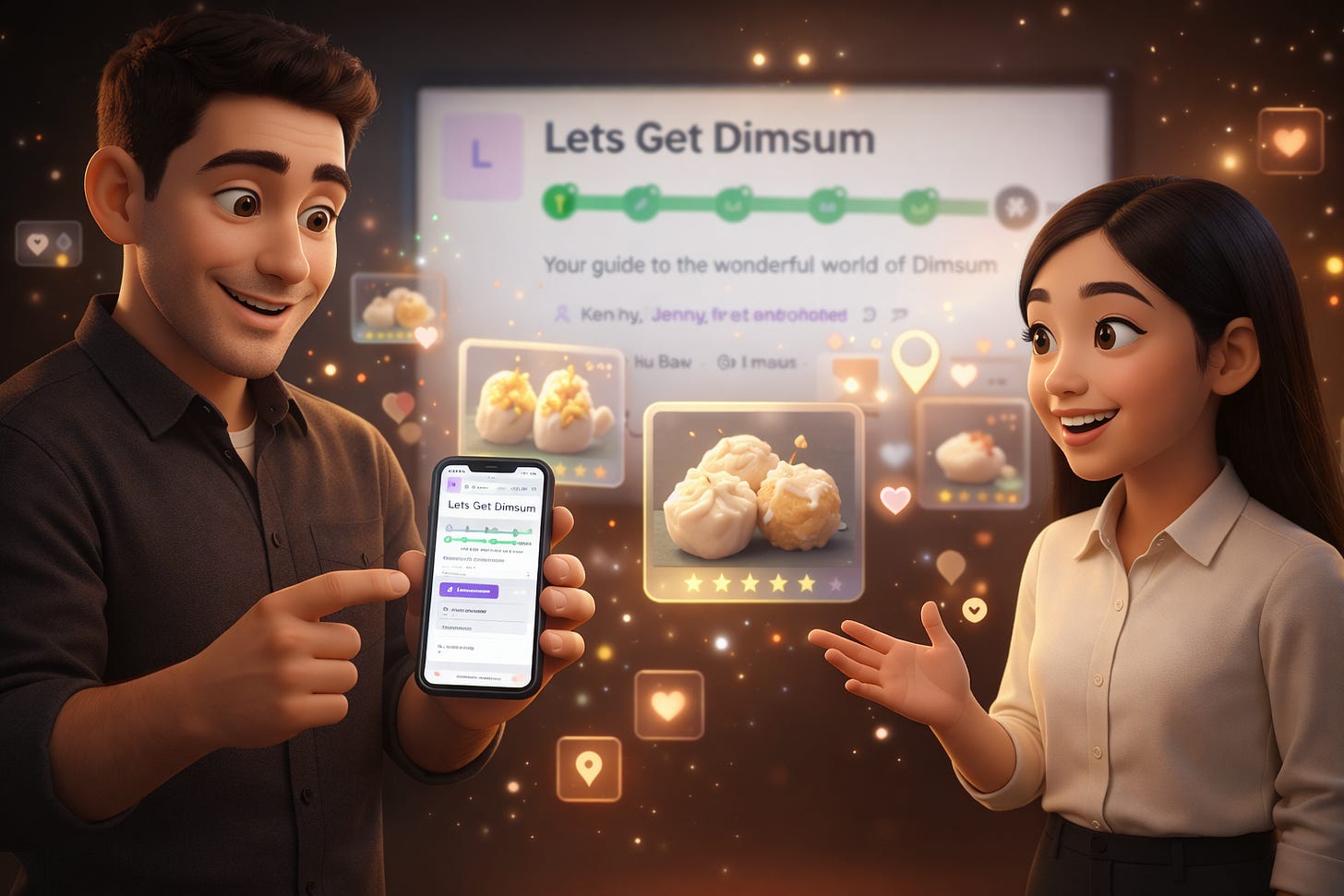
Have you ever needed an app so badly that you just… built it yourself? On an iPhone? In a week?
That’s exactly what Kenny did. And if you’re thinking “wait, I know that name” — you’re right. I featured Kenny back in August when he built ProudWork, his creator platform for filmmakers who were tired of bloated, expensive video hosting services.
Well, Kenny’s back. And this time, he took his mom and wife out for dim sum and came home with an idea that became a top-rated iOS app in 8 days.
When I first featured Kenny, he had just built ProudWork while traveling in Chiang Mai, Thailand. He’s a filmmaker with 13 years of experience producing content for conferences and creators. He’s the kind of person who’s been adapting his entire career — from photography to video, and now from video to building digital products.
ProudWork is still going strong with about 60 users, and Kenny’s actively working on scaling it. But here’s what makes Kenny different: he doesn’t wait. While most builders would focus on perfecting one product, Kenny saw a problem at a family breakfast and decided to solve it.
His wife Maria, who’s Italian, kept struggling at dim sum restaurants. No photos on the menu. No more carts rolling around. How is she supposed to know what to order? His mom was playfully giving her a hard time about it. And Kenny thought: “Why isn’t there an app for this?”
So he built one. Let’s Get Dimsum — a visual guide to dim sum dishes that now sits in the App Store with a 5-star rating and nearly 100 users.
But what really caught my attention wasn’t just that he built it. It’s that he built it as his first real iOS app, got the Replit team excited about his workflow, and managed to stay under budget on his Replit credits while building it.
You can explore Kenny’s Vibe Coding Builders profile to see all his projects and how he’s building in real time.
Origin Story & Motivation
Let’s start with ProudWork. How’s it doing now? Are you still maintaining or scaling it?
Yes, I still plan to scale it. It currently supports about 60 users, but there’s a small hiccup with one of my most important features (native hosting) that’s holding me back from fully pushing it out. It’s a common issue where the dev URL changes and the third-party SDK/API/webhook can’t latch on properly, which means I can’t test things accurately in the backend. I’ve seen this discussed in forums — seems to be a current limitation. I’ll get back to working on that shortly.
That’s the reality of working with third-party integrations. I hope everything will work out smoothly for you, Kenny.
Coming back to Dimsum, how did the idea for Dimsum come about? What made you want to build this specific app?
The origin story is available on the app footer :) The app idea came about from taking my mom out for her birthday breakfast dim sum. My wife is Italian and even though she’s been to dim sum dozens of times, each restaurant is different - some has the carts (which makes it easier) and menus that have photos. Now, more and more restaurants have removed the dim sum carts along with no photos on the menu. So how is she supposed to know? I wanted to build it for iPhone just to see if it was even possible. I had zero experience building any app but I read/watched YouTube videos and it looked like it was possible… so I just did it 😂
“So I just did it” — This is the builder mindset in four words. Zero iOS experience, just curiosity and willingness to try. How many of us talk ourselves out of building because we don’t have the “right” experience?
Can you share the story behind it? I noticed you kept it in the app itself — that’s really sweet.
It really came from my mom bullying Maria (my wife) that she doesn’t know the dishes by heart hahaha. I mean - she’s not Chinese nor is she American, how is she supposed to know! So we chatted on the table about how it would be great if there was an app people can use as a visual guide to know what dim sum dishes to order; Let’s Get Dimsum came to life! We chatted at night about the concept, how/where to get images and the name; Maria came up with it.
Family drama becomes a product origin story, I’m here for it! Also notice how quickly they went from table conversation to actual planning. Most people would just complain about the problem and move on.
Why build it for iPhone in particular?
I wanted to build it for iPhone just to see if it was even possible, I had zero experience building any app but I read/watched YouTube videos and it looked like it was possible… so I just did it 😂
“Just to see if it was even possible” is such a pure reason to build something. Get to work is just that simple!
Apple Developer Journey
A few weeks ago, you mentioned getting your Apple Developer Certificate. That’s a serious $99/year commitment. How was that experience?
It was smooth! If you’re even thinking about creating an apple app, apply for that dev account before doing anything else - it takes a few days to process and get approved (3 days in my case).
Pro tip right here: the waiting time for Apple approval can kill momentum if you’re not prepared. I learnt it the hard way building (and killing) my first app with Image Finder.
Was Dimsum your first use case with the certificate?
Yes! Now I’m building my second iOS app, integrating RevenueCAT into it for a paid feature!
Wait, second? He means third overall app if we count ProudWork. Kenny’s building pace is wild, but I get that kind of addictiveness ;)
How did you create those beautiful app preview images for the App Store?
Good ol’ Canva. Apple has all its guidelines on the submission preview :) The entire app, just like ProudWork was mocked up on Canva!
Canva for the win! You don’t need Figma, Sketch, or fancy design tools. But, I’m curious, is it legal to just use AI to vibe-generate them?
Since Apple charges nearly $100 per year, do you plan to publish more apps in the future?
Yes! On my second build now, which is a milestone video ticker that’s integrating with RevenueCAT. This will be my first time offering paid features since Let’s Get Dimsum is purely free!
He’s already thinking about monetization for the next app. Learning and iterating across projects, this is how you build a sustainable practice :)
Are there any catches and surprises you’d like to share with people who want to submit to the Apple app store?
Oh yes a few:
If you’re building with AI, you can place guidelines whether the app is strictly for iPhones and/or iPads (universal) - if you’re planning to make it for iPads, you also have to submit preview covers for iPads
If you’re planning to offer sign in with Google/third party - you also have to create a log in with Apple (I kept mine simple with email & password)
Make sure you read all of Apple’s guidelines, the first submission should be near perfect as it adds time having to revise
This is gold. Kenny learned these the hard way (he had to resubmit because of missing iPad previews) so you don’t have to. Save this list if you’re planning to ship to the App Store. And if you want to make sure your app is production-ready before submitting, check out my smoke testing guide.
Technical Deep Dive
You built the app on Replit, which is fascinating. What tools or frameworks did you use?
I kept this extremely simple: Replit + EXPO; Supabase for auth + db and Resend for transactional emails.
Look at this stack — all the tools vibe coders love. Nothing exotic, everything accessible.
👉 Download Let’s Get Dimsum on the App Store | View on Kenny’s Vibe Coding Builders Profile
Did you have to learn native iOS languages like Swift, or did you use something else?
Nope, just switched from Tailwind to StyleSheet (which is the preferred iOS language). It was good to learn!
From Tailwind to React Native StyleSheet is really not a huge leap if you’re already familiar with styling concepts.
I heard even the Replit team was surprised by your app. What’s the story behind their reaction?
Yes! I tweeted about Let’s Get Dimsum being on the App Store and I guess it was one of the very few if not the only one that has been shipped to App Store via Replit. They really haven’t pushed iOS build much (but their main mobile engineer during our call did say they’re heavily focused on it this month) which is why they were surprised I was able to launch it. I showed them my workflow, process and they were very excited to see it live and active!
When the platform creators are surprised you pulled it off, that’s when you know you’re onto something. Kenny basically pioneered a workflow that Replit is now interested in promoting. This is what happens when you build fearlessly in public and share your process. Reminds me of Alejandro’s viral Substack Wrapped — another builder who shipped fast and got noticed.
What’s stored locally vs. in the backend?
Locally - all the images (food) for the app. Backend - users can upload profile photos which gets stored on Supabase storage (this was recommended by Replit since using their object storage would need a backend server which runs 24/7 and would drive up the cost).
Smart architecture decision. Static assets locally to keep the app fast and free, user-generated content in Supabase to manage it properly. This is the kind of practical thinking that keeps costs down.
The app includes features like Trending Favorites and Top-Ranked Dishes. How do you manage those technically?
For top rated, it’s based on how many times each dish has been clicked “I love it.” For trending, it’s based on how many times each dish has been clicked “I’ve tried it” for the week.
The location and map features are impressive — did you integrate Google Maps, Apple Maps, or something else?
I integrated Apple MapKit! Which was surprisingly pretty easy.
Going native with Apple MapKit instead of Google Maps probably saved him integration headaches and costs. I learnt the lesson many times: the default choice is often the right choice.
How does your location algorithm work — keyword matching, or something more semantic?
It’s just by zip code - you’ll find the nearest dim sum restaurant 5 miles radius (I will make it 10 on the next one).
That’s so much easier than I’d thought! I was so dumb to worry about geolocation algorithms, no ML-powered recommendations. Simple is powerful.
How long did development take, and roughly how much did it cost you?
It took me about 2 days to mock up the front end, about a half day to connect Supabase and Resend; which was fairly easy since I’ve used them before. I launched the app from concept to market in about 8 days, 3 days of waiting for the apple dev account and an additional day for resubmitting (due to not having iPad preview covers). About $13 for the entire build and $10 for domain 😅 oh and $99 for the apple dev account of course; so $124 total to launch an app! Not too bad I’d say.
Let me break this down: 8 days total, $124 all-in. That includes 3 days of waiting for Apple approval and 1 day of resubmission. So really, about 4 days of actual building. This is what’s possible when you know your tools and don’t overcomplicate things! For more on keeping costs low, see my cost-effective AI building guide.
Did you exceed your Replit credits, or manage to stay within the subscription plan?
I actually was UNDER, about $4 under… so I started building a third app; it was a basketball related app but I had to shelve it quickly after seeing the licensing cost was upwards of 5 figures… Woops.
Haha, you just can’t let Replit take any advantage, do you? But seriously, sports licensing can cost 5 figures? Okay fine, let Replit keep those $4.
Launch, Users & Community
You already have active users and I saw I’m ranked #16 myself! How did you attract your first batch of users?
I’m quite active on social (IG, Twitter, Reddit & Substack) so used those channels to my advantage - it’s currently close to 100 users!
That’s incredible! Distribution through existing platforms, building in public, being active in communities… this is the playbook. You don’t need paid ads or a marketing budget when you’re genuinely engaged with communities.
You’ve got a rating of 5 stars. How did you collect reviews and build that early traction?
Well, two 5* ratings are from friends and my wife; if you like the app please feel free to rate it ☺️
Ha! Honest Kenny strikes again. He’s earning my 5 stars.
Future Plans & Business Vision
The app looks fully free right now with no in-app purchases. Is that intentional?
Yes! I don’t want to gatekeep Dimsum. Like the cuisine - it’s meant to be shared and enjoyed by all :) And I would really love seeing a dim sum renaissance since more dim sum restaurants are closing down due to high rent cost and inflation, which makes me very sad.
This hit me right in the feels. Kenny built this as a love letter to dim sum culture, not as a money grab. Sometimes the best products come from pure passion for preserving something you love.
Do you plan to monetize later, or is this more of a learning project?
For Dimsum it’s strictly a learning project and a bridge to the next app. I love building and seeing my projects live; I’m actively looking for a job so this would go well as part of my portfolio.
This is strategic thinking. Not every project needs to be a revenue generator. Some projects are learning vehicles, portfolio pieces, and proof of execution… I have a handful of those and they were really helpful for landing my first programmer job. Dimsum is Kenny showing he can ship iOS apps from scratch, that’s valuable regardless of revenue.
You mentioned possibly helping others build and publish similar MVPs. What’s your take on that idea now?
I’m still very interested in taking on clients in Q1 of 2026; with my 13yr experience as a video producer, graphic designer and ever expanding technical abilities - I think I would be able to help those who are looking to build an MVP or even more!
This is the natural evolution: domain expertise + building skills = service offering. Kenny’s 13 years in video production plus his proven ability to ship apps makes him uniquely valuable to other creators who need someone speaks their language.
If someone came to you wanting a similar iPhone app, what would be a fair price for you to build it?
I would say for an MVP, depending on complexities - $1,500. Working app with auth, database + backend - $5,000.
These are reasonable rates for someone who can ship in days, not months. Compare that to traditional app development quotes which start at $20k-50k. This is the vibe coding advantage: faster, cheaper, without sacrificing quality.
What’s next for Dimsum? More features, new apps, or something entirely different?
We are working on implementing pronunciations for each dish so users can tap the microphone button and it would speak aloud the dish name - just waiting on family members to be available to record! I’d like to get more into content, maybe launching a small YouTube series interviewing founders over Dimsum. Currently I’m working on a second app, which should be live by next week!
Audio pronunciations! That’s a brilliant idea to help people not just know what to order but how to say it. And I love the “founders over dimsum” interview concept. If this grows big, your family members’ voices will become familiar to so many people!
What’s your top 3 suggestions if someone is using Replit and wants to submit to the Apple app store?
Fonts are tricky, you’re not really able to install/load custom fonts - so use the native SF font that’s supplied by Apple for the first round instead of trying to fight it.
Watch two videos by Matt Palmer of Replit (which only takes you half way) but EAS production build and EAS submit will take you the remainder of the way.
One thing to catch is if/when your build fails; it won’t show up on your Replit console, you will have to go on Expo and see the fail logs; console will not be able to show/tell you.
Technical wisdom earned through actual battle scars. If you’re planning to ship an iOS app through Replit, screenshot these three tips. Especially that last one about checking Expo for logs, that could save you hours of debugging.
Connect & Explore
Kenny’s Platforms:
🚀 ProudWork.io — Creator portfolio platform for filmmakers and artists
🚀 Let’s Get Dimsum — Visual guide to dim sum dishes on the App Store
👤 Kenny’s Vibe Coding Builders Profile — See all his projects and journey
Follow Kenny’s Journey:
- 📝 The Juggle Is Real with Kenny Tjay — His Substack about freelancing and building
Interested in working with Kenny?
💼 Available for MVP builds and app development in Q1 2026
Simple MVP: ~$1,500 | Full app with auth/backend: ~$5,000
Here’s what strikes me most about Kenny’s return to Build to Launch Friday: he’s not just building, he’s building a practice.
When I first featured him in August, he had just shipped ProudWork while traveling Thailand. Now, just a few months later, he’s shipped his first iOS app, pioneered a workflow that got the Replit team excited, and is already working on his third project. All while maintaining ProudWork and actively seeking client work.
This isn’t luck. This is what happens when you combine domain expertise (13 years in film and content creation), technical curiosity (willing to learn iOS with zero experience), and relentless execution (8 days from idea to App Store).
But what really gets me is why he built Dimsum. Not for money. Not for traction. Not even primarily for learning. He built it because his wife needed it, because his mom was playfully giving her a hard time, because dim sum restaurants are disappearing and he wants to see a cultural renaissance. He built it because he saw a problem at a family breakfast and decided to solve it by dinner.
That’s the builder spirit I keep seeing in this community: solving real problems for real people, not chasing imaginary TAM in pitch decks.
The fact that Dimsum cost $124 total and stays free because “like the cuisine, it’s meant to be shared and enjoyed by all” — that’s someone building from abundance, not scarcity. Kenny knows not every project needs to be monetized. Some projects prove capabilities. Some projects serve communities. Some projects are love letters to cultures you care about.
And crucially, he’s learning to price his growing expertise appropriately. $5K for a full app with auth and backend is incredibly fair for someone who ships in days. Traditional development would charge 10x that and take 10x longer.
If Kenny’s approach resonates with you — building fast, learning publicly, adapting constantly, and helping others along the way — connect with him. He’s exactly the kind of serial builder worth knowing.
[ The Juggle Is Real with Kenny Tjay
Helping you build a freelance business that supports your creative and joyful life.
By Kenny - Your Freelance Friend
](https://kennytjay.substack.com?utm_source=substack&utm_campaign=publication_embed&utm_medium=web)
If you’re turning your expertise into products, building with AI, or helping others do the same, you belong here. Join the vibe coding builders community and get featured on Build to Launch Friday. Curious why it all started? Here’s the full story behind Vibe Coding Builders.
Your turn:
What family problem could you solve by dinner tonight?
What cultural tradition could you help preserve through technology?
What’s stopping you from building your first (or next) iOS app this week?
Kenny went from birthday dim sum drama to a top-rated App Store app in 8 days for $124. What will your builder story be?
— Jenny