Never Ship Mid: How He Built an AI Proposal Engine on a $500/Month Tool Stack
Build to Launch Friday: Meet Gamal, the systems alchemist who runs a one-man AI agency with a physical planner
Welcome to Build to Launch Fridays, where we meet the builders turning domain expertise into AI-powered products.
Every Friday, I’m spotlighting someone from the vibe coding builders collection who’s doing exactly what I believe is the future: using AI not as just another tool, but as a true collaborator to transform curiosity, passion, and years of professional knowledge into something scalable and ownable. No VC funding, no technical co-founders, no permission required, just domain experts who decided to build.
Today, meet — and the physical planner that keeps his AI empire running.

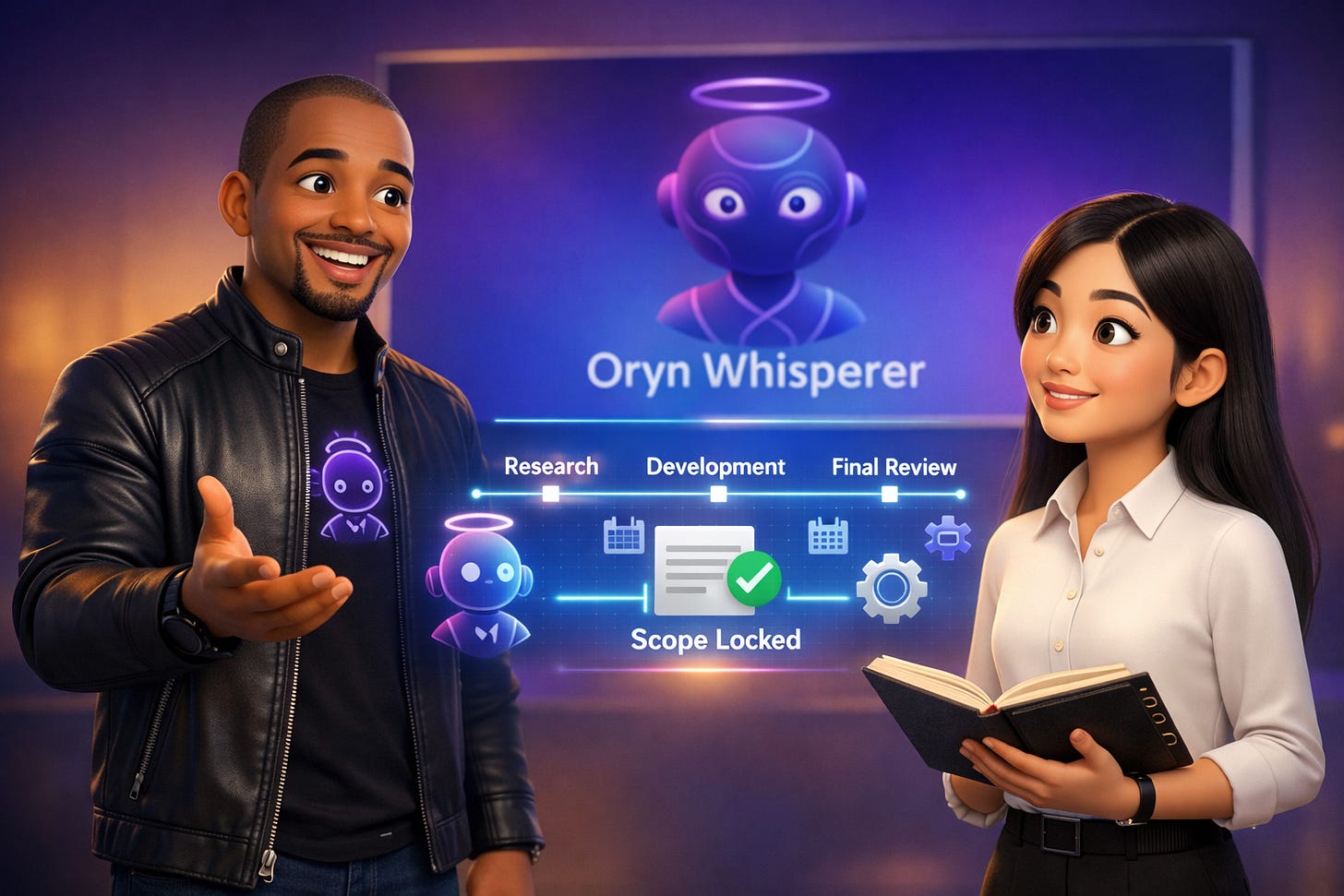
You know the part of consulting that nobody talks about? Not the deliverables. Not the strategy sessions. The part before any of that — the proposal stage. The back-and-forth. The “let me check with my business partner.” The scope that quietly inflates between the first call and the signed contract. By the time you actually start the work, you’ve already spent more energy negotiating the terms than building the thing.
Most consultants accept this as the cost of doing business. Some try templates. Some try CRMs. Gamal Jastram decided to build an AI that strips the emotion out of the process entirely — and he’s doing it while running the consulting business that inspired it.
Here’s the part that got me: the guy who calls himself “The Systems Alchemist,” who runs a full AI consulting agency, who spends $500/month on AI subscriptions — manages his entire life with a physical planner. Categories for each day. Written by hand. Executed, as he puts it, “with the surgical precision of a Navy SEAL Team.”
That contrast tells you everything you need to know about how Gamal thinks. Systems aren’t about the tools. They’re about the discipline behind them.
Gamal’s Vibe Coding Builders profile →
Quick Stats
Products: Oryn Whisperer (AI proposal engine) + Profit Mirror (business forecasting)
Monthly AI tool spend: $400–500
Newsletter: Cove Connect — 85 subscribers, 11 weekly issues
Coding background: Full-stack (HTML, CSS, JS, Python, Next.js) — still taking courses
AI stack: Antigravity + Claude Sonnet 4.5 (main); ChatGPT, Lovable, Perplexity
Build timeline: Oryn Whisperer started Jan 29 — Phase 4 in progress
👉 Visit Purple Cove Labs | View on Vibe Coding Builders
Meet The Systems Alchemist
“The Systems Alchemist” — that’s a distinctive title. You’re running Purple Cove Labs as a consulting business while shipping Oryn Whisperer and Profit Mirror. What does that actually look like in practice?
In practice it could have been a hassle, especially considering that I am a one-man agency (for now), but as a sucker for systems, I devised a rather simple and (ironically) non-technological one: I use physical planners to map out my days. I lock certain hours of every day for specific types of tasks. So, somewhere in my planner, you will see either “Projects & Practice” or “Purple Cove Ops”; the former is used either for practicing coding, testing a tool, or building a personal project such as the Oryn Whisperer, and the latter is for Purple Cove work.
A physical planner. Running an AI agency. I love this so much. It’s a reminder that the best system is the one you actually use — not the flashiest one. The tool doesn’t matter if the thinking is sharp.
What’s the story behind the “Systems Alchemist” title?
It’s not one I went looking for or even bestowed upon myself; it was the result of my ChatGPT 2025 wrapped. As I use ChatGPT on a daily basis as an assistant, and it has context of who I am and what I do, it generated this badge title. The title resonated, and I kept it. Now, I reckon it came to that conclusion since when I am building systems for essentially anything, whether it be for myself, my business, or my clients. I design the system and then just ask ChatGPT to put it in a Notion-ready document so that I may save it in my Notion library.
OK, his ChatGPT Wrapped is way more fun than mine was. Mine didn’t give me anything close to that. But that’s probably the best kind of personal branding — the kind you didn’t manufacture. When the AI you talk to every single day gives you a title and it actually fits, that tells you something about how deeply you’re using it.
You list “Full Stack” on your profile. What was your coding background before AI tools became part of your workflow?
Before AI coding tools came about, I coded (still do) using VS Code. I know HTML, CSS, JavaScript, Python, and Next.js (currently taking full-stack developer courses on Scrimba and Codecademy).
This is important context for what comes next. Gamal isn’t a “no-code founder who discovered AI.” He writes code. He’s still actively learning. And he still hard-codes components by choice. That changes how he uses AI tools — and how much he trusts them.
From Client Friction to Product Vision
Oryn Whisperer converts client intake into proposals. Where did that pain point come from? Was it your own consulting process?
Ouff! It came from my old career. Scope creep, undervalued work, timelines, and endless concerns from the client’s part. The back-and-forth before taking a decision and getting things going is what does it for me. Now, of course, the service provider or consultant needs to be crystal clear in their proposals, and the client has the complete right to ask questions considering they are the ones investing their money, but my pain point is the time this whole process takes, especially if the client is not the only decision maker. Oryn Whisperer came to mind as a solution that will, not only tailor the proposal based on the client’s intake, (their requirements, budget, timeline, etc.) but also based on the service provider’s policies (pricing, discounts if applicable, timelines, golden rules, workflows, offers, etc.). The client can review the proposal, read it or have the AI read it to them, ask the document questions, get satisfactory answers, and approve, discuss, or reject the proposal with one click right on the app.
👉 Visit Purple Cove Labs | View on Vibe Coding Builders
Now I know, this isn’t a product built from market research. It’s built from years of sitting through the exact frustration it’s designed to fix. The two-sided approach is what makes it interesting — the AI doesn’t just serve the consultant, it serves the client too. Both parties get clarity.
“Cove Connect” is on Issue #11. What role does it play in your business?
“Cove Connect” was created for different reasons but essentially to fulfill the same endgame: visibility. Since its creation, my work has been much more public than it ever was on mainstream social media. It does in fact play a big role in driving consulting leads, trust, and “proof-of-work” if we can call it that. Substack is its homebase, but I also post it on LinkedIn and Medium. I share the link on Instagram, WhatsApp and X (sometimes) and it has bore its fruits. I’ve had clients reach out to me after having read either one of my editions or following my Notes.
Eleven issues in, already converting readers to clients. That’s the newsletter-as-portfolio strategy working exactly as it should — your writing becomes your proof of work. It’s been such a pleasure to have accepted some of Gamal’s work on Medium. If you’re distributing on Medium too, I’d be happy to invite you to write for AI Builders as well. And the multi-platform push — Instagram, WhatsApp, X — that’s the content distribution strategy I’m starting to learn myself. Substack as the homebase, everything else as amplification.
The AI Arsenal
This is where it gets interesting. Gamal’s VCB profile lists more AI tools than any builder I’ve featured — but the reality is more focused than the list suggests.
Your VCB profile lists more AI tools than I’ve seen on any other builder. How do you decide which tool to use for what?
Maybe I took the question too literally in that field. I listed all the AI models and/or tools used at some point in the project. For instance, I mainly used Gemini 3 Flash Pro when building in Antigravity, but for certain backend designs, I switch to Claude Sonnet 4.5, as I find it to be more precise and think more like a backend dev than Gemini. I’ve only used Claude like that through Antigravity. As for the other tools, I just tested certain components with each of them, which is why I listed them. But in reality I use Antigravity as the main platform to build, and Perplexity for SOP prompt generation based on my input, which I then use as system instructions for a ChatGPT Project. That’s it. (Sometimes I’m a bit too transparent).
I appreciate the honesty. He listed everything he ever touched, but the real stack is three tools: Antigravity for building, Claude for backend precision, Perplexity for generating SOPs. That’s a system, not a subscription graveyard.
You’re using Lovable for Profit Mirror and Next.js/Supabase for Oryn Whisperer. Having tried both approaches, do you have a preference?
I find each to have their own particularities and use. Some builds don’t require the complexity of Antigravity and therefore I build them on Lovable (well, now Lovable is becoming more powerful by the day). I use Lovable essentially for simple builds whether it’s a landing page or simple app (my Purple Cove Labs page is built on Lovable). I would also use it for frontend builds, but I am now using Google AI Studio and/or Stitch for that.
This is what I’d do as well, use a commercial tool like Lovable for simple prototyping and landing pages, but move over to a git repo or local environment when you need extended refactoring. Knowing when NOT to reach for your most powerful tool is its own kind of systems thinking.
How long did it take from “I’m going to build Oryn Whisperer” to having something that actually works?
Something that should have taken a week at most is still in development since January 29th (yes, I have my time stamps) due to personal issues that required my undivided attention. Nothing technical though. I am planning to ship an MVP by next week’s end (February 20th).
Life happens, of course! And this is actually where I really appreciate AI-assisted coding. You can pick up at any time, and the AI picks up with you. It knows where you are and continues your work. With traditional coding, a 3-week interruption usually means re-reading everything, rebuilding your mental model, and losing a full day just getting back to where you were.
What did all this cost to build? With 10+ AI tools, that’s a lot of subscriptions.
In reality, the subscriptions I have are Google AI Ultra (Mainly for Antigravity), ChatGPT Plus, Lovable, n8n, Supabase, Google Cloud usage, OpenAI usage, Perplexity Pro. That is between 400 to 500USD monthly. (Sometimes it’s less).
$400–500/month is a lot. But actually, you could never employ any developer for $500/month — not even close. And this stack powers both his consulting delivery AND his product development, running 24/7. The math is calculated completely differently here.
Building With Precision
You’re building AI-powered products for clients while also building products with AI. What’s your process for catching the subtle errors AI introduces?
I built a whole “AI dev team” that fulfill this very purpose. I believe I mentioned that in my Note for your challenge in the AI Advent Calendar. Not only I write specific prompts with technical language and never allow the agent to build or act without me reviewing its implementation plan first, I have built different agents that manage different aspects of a build such as a researcher or a error-handling agent that only focus on fixing bugs, run tests, use CI/CD so every commit runs tests, linters and type checks etc, other agents that prioritize regression tests around high-risk areas (auth, payments, data integrity etc). And sometimes, whether for fun, practice or actual concern, I input code myself (considering I am fully aware of every step of the build using the implementation plan and phases documents in Antigravity).
He mentioned building this during our AI Advent Calendar challenge — love that he remembers, and I’m sure would be thrilled too. Specialized agents for research, error handling, regression testing, CI/CD — and he still writes code himself, not because he has to, but because he wants to. That’s real AI collaboration.
Would you have been able to build Oryn Whisperer before AI coding tools existed?
Yes. It would have taken much more time obviously, but yes.
You know, this is the first time I’ve heard someone confidently say yes — AI is the speed multiplier, not the replacement here. That distinction matters.
Has building these tools changed how you approach consulting work?
I am definitely faster and much more efficient now. Thinking differently was not optional with these new tools and new ways to operate. Things that would take months, now take a few weeks or even less depending on the endgame. Does this mean that I have completely abandoned my old practices? No, I still hard-code certain components myself. Nothing to do with trust, just personal preference.
“Nothing to do with trust, just personal preference.” This is the mentality we all ought to adopt. It’s not about replacement, but more about working together toward the goal, smarter.
Inside the Products
Oryn Whisperer has an “AI explanation layer that prevents scope creep.” What does that actually mean? How does it work?
Being an AI, that in itself the “appealing” side of a project negotiation or proposal process. The AI will be direct, specific and have strict instructions based on company policy. The AI cannot take a decision based on emotion, be manipulated or strong-armed into doing something that would not be beneficial for both parties. This being said, the business side of a project is secured through policy and an emotionless intelligence. Once Oryn Whisperer is integrated as an agency’s internal tool for project proposal processes and (eventually) management, the emotional part is stripped out. It acts as a “living” T&C.
I have mixed feelings here. On one hand, AI consistency in proposals is real — it doesn’t cave under pressure or forget its own policies. But AI can also be very mechanical. I can never get AI to talk exactly how I would talk, and persistence is actually the hardest challenge most people run into with AI-generated content. A “living T&C” is a clever idea, though.
The site says “Turn client notes into ready-to-send proposals in under a minute.” Is it actually a minute?
I actually need to modify this on the website and update it to the new version. This description was generated by Lovable and I never changed it.
Ha — caught by auto-generated marketing copy. This is a good reminder to always review what your AI builder puts on your landing page. The product evolved, but the tagline didn’t follow.
Profit Mirror is live on Lovable. Who’s using it?
For the time being, Profit Mirror is only being used for the client I actually built it for as a favor (They were a client from my finance days that didn’t know I had changed careers almost 3 years ago). I just took the opportunity to ship it, make it public and eventually develop it further so that business owners or project managers may look at breakeven point or profit margins at a glance based on quantity sold or pricing strategy.
👉 Try Profit Mirror | View on Vibe Coding Builders
Built as a favor for an old finance client, then shipped publicly. That’s how a lot of great tools start, solving one real person’s problem, then realizing others have the same one.
You’re in “Phase 4” according to your newsletter. What’s left to build on Oryn Whisperer?
Yes, Phase 4 is where we include monetization, automation and scale. We need to enable notifications, support multi-client and multi-team workflows, usage limits, plans and permissions, analytics. We still have quite some components to build on Oryn Whisperer such as the voice layer integration (maybe v2 or v3), training (agency policies, rules, constraints, voice style, preventing the intelligence to over-promise in edge cases etc), onboarding process for agencies, security and permissions... yup we still have heavy lifting to do.
I appreciate his honesty. This is how it goes for most of us — a work in progress in different phases, no hard deadline, just forward motion. We’re all entering a new building phase as things evolve.
What’s a feature you had to rebuild because the first AI-generated version wasn’t good enough?
The PDF generation feature! In fact the first version of Oryn Whisperer (The Client Whisperer by Oryn AI) was built using Lovable and n8n... It did not work out as I intended it (Lovable was not as powerful as it is now). It had a lot of issues going through the workflow with either HuggingFace or just OpenAI and then Vapi or ElevenLabs. But the PDF feature was oddly the hardest thing to implement.
PDF generation — the feature that sounds simple and breaks everything. Karen from our community had the same struggle with her carousel bot, and through her experience I actually got ideas for my own draft editor’s PDF download. It’s working much better now. If you’re hitting this wall, try Puppeteer or one of the dedicated PDF packages. It makes things so much easier.
Systems, Taste, and Advice
You’re building products that could power your own consulting practice while also selling consulting. What’s the endgame for Oryn Whisperer?
As previously mentioned, Oryn Whisperer will be the go-to tool for agencies, consultants, freelancers and businesses to manage the client decision, project proposal and management to reduce time between first contact and actual production, friction and provide clarity from the get-go to the client.
Clear vision: reduce the time between first contact and actual production. That’s a measurable outcome, not a vague mission statement.
What did building Purple Cove Labs teach you about your own taste as a builder? What are you willing to ship, where do you draw the line?
I learned first and foremost that my taste is not necessarily everyone else’s and by building projects during my courses, I had to go through building websites or apps exactly as the spec sheet demanded it regardless of how I saw it or the millions of ways I could improve it, was I given the latitude for it. While I am a systems builder, I draw the line at shipping something that is not aesthetically pleasing! We are not shipping anything that is not pretty or how Gen Z would say “mid”.
“We are not shipping anything that is not pretty or how Gen Z would say ‘mid’.” That’s a line I won’t forget. Having aesthetic standards as a builder isn’t vanity — it’s a quality signal to your clients.
What question would you love someone to ask about your AI consulting work that almost never comes up?
Why did you choose this particular career?
Interesting. The question behind the question. Everyone asks WHAT he builds and HOW. Nobody asks WHY this career, this path. I’ll leave that thread for Gamal to pull on in his newsletter.
You’re juggling consulting, two products, and a weekly newsletter. What’s your actual system for getting things done?
Yesss! And you would be surprised: it doesn’t involve Google Calendar, Notion or anything digital! I actually write everything down on a physical planner and set my days with categories: One for Purple Cove, one for learning, one for practice one for building, one for Substack (not everyday contain all categories). I write the specific task for the day or week and then proceed to execute them with the surgical precision of a Navy Seal Team (I just shared this very advice on a LinkedIn post).
The Systems Alchemist’s system is... a notebook. Categories: Purple Cove, learning, practice, building, Substack. Pen and paper. Executed with precision. Sometimes the most sophisticated system is the most analog one.
For someone thinking about building AI tools for their own consulting business, what’s your number one warning?
DO NOT BUILD WITHOUT REVIEWING YOUR CODE! If you are not technical, at least thoroughly read the implementation plan. Have another model explain what Lovable/Replit/Emergent or Antigravity/Cursor/Warp (Whichever you use) just told you it was going to do. Prompt your preferred model to explain things to you in non-technical terms and as if they were explaining them to a 5 year old. Yes, speed is good, but understanding your product is great! Build responsibly.
“Speed is good, but understanding your product is great.” That’s the line I want every builder reading this to take away. Use AI to go faster, but never skip understanding what you’ve built. Have one AI explain what another AI just did. That’s not paranoia — that’s production-ready thinking.
Connect & Explore
Gamal’s Platforms:
🚀 Purple Cove Labs — AI-powered systems built for business scale
🚀 Profit Mirror — Business forecasting: pricing, margins, and break-even at a glance
👤 Gamal’s Vibe Coding Builders Profile — See all his projects and journey
Follow Gamal:
- 📰 Cove Connect Newsletter — Weekly builds, systems, and AI consulting insights
More Build to Launch Friday Stories
Every Friday, I spotlight a domain expert who’s building with AI. Here are a few you might enjoy:
Trust Over Conversions — Another builder who turned client-facing frustration into a $10K product.
Delegate Everything — How Alex automated 30% of his e-commerce operations with AI — solo builder, similar tool-stacking philosophy.
Four Typos Was His System — Kamil built a prompt management tool for 2,000 users. Different product, same “build what you need” energy.
Fulfillment Over Profit — A former CTO who left to build what mattered. Gamal’s “why this career?” question echoes here.
Can’t Do Nothing — The AI Advent Calendar challenge that Gamal participated in — 37 contributors, 461 users, $31.
👉 See all Build to Launch Friday stories →
What strikes me most about Gamal is the coherence. Everything connects. The consulting work informs the products. The products serve the consulting. The newsletter documents both. And a physical planner holds it all together.
He’s not chasing tools for the sake of novelty — despite listing more AI tools on his profile than anyone in the community. When you push past the surface, the real stack is focused: Antigravity for building, Claude for precision, Perplexity for SOPs, and a pen for everything else.
The line that’ll stick with me: “Speed is good, but understanding your product is great.” In a world where everyone’s racing to ship faster, Gamal’s approach is a counterweight. Review the implementation plan. Have another model explain it to you. Write code yourself sometimes — not because you have to, but because you want to understand what you’ve built.
If Gamal’s systems-first, aesthetics-never-optional approach resonates with you, connect with him. He’s exactly the kind of methodical builder worth following.
[ Cove Connect | Build. Automate. Deliver. | Weekly
Weekly journal of AI automation and web development. Real code, workflows, tool reviews and actionable templates.
By Gamal Jastram
](https://coveconnect.substack.com?utm_source=substack&utm_campaign=publication_embed&utm_medium=web)
If you’re turning your expertise into products, building with AI, or helping others do the same, you belong here. Join the vibe coding builders community and get featured on Build to Launch Friday. Curious why it all started? Here’s the full story behind Vibe Coding Builders.
If any of this is useful, share it with one builder who’s thinking about turning their consulting into products.
Your turn:
Gamal manages an AI agency with a physical planner and won’t ship anything “mid.” What’s your non-negotiable standard as a builder — the one thing you refuse to compromise on?
If you’re a consultant or freelancer, what’s the most frustrating part of your proposal process? Would you trust an AI to handle it?
Gamal went from years of scope creep frustration to building the tool that strips emotion out of proposals — while running the agency that needs it most. What will your builder story be?
— Jenny
Why Subscribe · Build With AI · Templates · Builder Showcase