Delegate Everything: How He Went From Building AI Tools to Just Giving Jobs to AI and Automated 30% of His E-Commerce Operations
Build to Launch Friday: Meet Alex Willen, the e-commerce operator who’s systematically replacing himself with AI
Welcome to Build to Launch Fridays, where we meet the builders turning domain expertise into AI-powered products.
Every Friday, I’m spotlighting someone from the vibe coding builders collection who’s doing exactly what I believe is the future: using AI not as just another tool, but as a true collaborator to transform curiosity, passion, and years of professional knowledge into something scalable and ownable. No VC funding, no technical co-founders, no permission required, just domain experts who decided to build.
Today, meet Alex Willen — an e-commerce operator who’s documenting his attempt to make himself obsolete.
What do you do when you’re about to spend $2,000 on product photography?
Alex tried a new AI image model. It gave him a perfect professional photo on the first attempt. The photographer invoice never got sent. That moment crystalized something he’d been thinking about for months: if AI could do this, what else in his e-commerce business could it handle?
Alex is a former B2B SaaS product manager who now acquires and operates Amazon brands. His newsletter is called “The Automated Operator” with a tagline that gets straight to the point: “In which I document my attempts to use AI to fully replace myself in running my business.” He’s not joking. He’s about 30% there.
He started by building tools with AI. A listing image generator that saves him thousands in photography costs. An inventory management system that pulls data from Amazon APIs. Then something shifted. He realized he didn’t need more tools. He needed to stop being the operator and start being the context provider. Now he fires up Claude Code and asks “What should I be thinking about reordering soon?” It combines data and intelligence to answer like an employee, not an app.
This is a meta-story about where vibe coding leads when you take it seriously. Not just building faster, but fundamentally questioning what you should be building at all.
Alex has been shipping software since he was at computer camp learning C++. Now he’s shipping a different kind of product: a blueprint for what happens when domain expertise meets AI at scale. Check out his Vibe Coding Builders profile to see his full journey.
The Catalyst: When AI Replaced His Photographer
What does your day-to-day look like running e-commerce brands on Amazon?
The reason that I opted to buy brands that sell on Amazon specifically is because it provides so much infrastructure that there’s not a ton of day-to-day work. I check on my Amazon ads and tweak bids every 1-2 weeks, and I place orders with my suppliers as needed (typically every few months for each brand).
When I’m in the process of making a new acquisition, I’m busier - there it’s just a bunch of due diligence acquisition, and then post-acquisition I run a playbook of improvements. Those are mostly reviewing and improving ads, listing copy and listing images.
I know very little about e-commerce, but I keep hearing people get buried in logistics with terrible ROI. Makes sense why he’d buy brands already on Amazon’s infrastructure, just focus on what actually moves the needle.
The Listing Image Generator — an internal tool for your Amazon product photos. What prompted you to build that?
I’m going to assume your use of “prompted” in the question is intentionally punny - well played.
Every time a new image model comes out, the first thing I try is using it for product photography - take a picture of a product with my phone, send it to the model and ask it to turn it into a professional whitebox photo. None of the models were close until Nano Banana Pro, which gave me a perfect whitebox of a new product on the first try. Fortuitous timing, too, since I was about to spend $2000 paying my photographer to shoot it.
I gave this to Nano Banana Pro

...and I got this back! Note how the imperfections in the red stripes match the original perfectly — the fidelity is really unbelievable.

A bunch of the release content from Google about NBP highlighted that it was good at infographics, so since it had done such a good job on the whitebox photo, I figured I’d try the rest of the listing images. (For context, the best-converting images on Amazon are generally infographic-style, with written information about the product as well as actual product photos.) Again, I tried it and was blown away by the first result.

The detail here is great - I love the fact that it added frost to the ring. The icons are also really spot on; the fact that it came up with a fridge that has multiple rings in it to match the text saying to keep a few in your freezer is really impressive. This is honestly better than the quality of work I get from my designer, and I pay him $35/photo instead of the pennies I pay Google.
I generated another five images in Gemini Studio, but getting it to maintain stylistic consistency was a little annoying, plus waiting for the generations was eating up time. I figured with an app I could at least simultaneously generate all of the listing images to save time, so I started building.
The frost detail! This is quality work. It’s funny — people who don’t need hundreds of images think AI generation is expensive. But he was paying $35 per photo to his designer, or $2,000 to a photographer. Pennies vs thousands. Of course he built it.
👉 View Alex’s Vibe Coding Builders Profile
Building the Listing Image Generator
You were a B2B SaaS PM before. What was your coding experience before AI tools?
When I was a kid, I went to computer camp during the summer (I was an extremely cool kid), where I learned a fair bit of C++. I forgot all of the syntax, but I’ve always retained some understanding of the logic, which has been very helpful in my career as a PM. I never really wrote code in my job, but I had enough of a foundation to talk through the relevant technical decisions with my engineers.
The PM who understands logic but never shipped code. This is the perfect vibe coding origin story. I know some really good PMs (Elena and Karo from past BTLF features on AI Advent Challenge and StackShelf), and honestly, it feels like PMs are born for this.
“The Automated Operator” — your newsletter is about using AI to replace yourself. Is that serious?
It is. One of the reasons I started writing the newsletter is because I realized that my business is simple enough that AI really ought to be able to do most if not all of it, which makes for an excellent preview of the change I think a lot of larger businesses are going to go through over the next few years.
If I look at most of the individual tasks in my business - inventory management, advertising, financial reporting, and even analyzing businesses to acquire - SOTA models today are basically capable of doing all of them as well as I am. The task now is to take the intelligence available to me and actually apply it to those tasks. I started by having AI build tools to help me with some of those tasks, but with Claude Code I’m increasingly having it use those tools to handle the tasks itself.
In the long run (which is probably not that long at the rate AI is progressing), I’m going to build a harness for Claude (or whatever the other AI du jour is) to manage the business itself, rather than having me ask it to do individual tasks for me.
The one place I’m not sure AI can take over for me yet is human communication, and that’s a cultural issue, not a technical one. I’m not sure how my suppliers would react to me telling them my AI agent will be placing orders (though honestly I suspect they’d be fine as long as they get paid). I definitely wouldn’t send AI to meet with someone selling their business, if only because I need to build rapport with them before I make an offer.
But overall, I’d absolutely wager that AI will be handling the day to day operations of my business with minimal intervention from me in two years.
I questioned if asking this was too bold, but I’m glad I did. Like Alex, so much of what I do could be replaced — handling tickets, finishing sprint projects, gathering content, analyzing data, database lookups. And yeah, I’m increasingly having AI use tools to handle tasks themselves. Two years feels realistic when you see AI in action.
The Listing Image Generator. How long from “I should build this” to working version? Days, weeks?
It was a few days, only because I was at my in-laws’ for Christmas at the time and couldn’t just hole up and work a full day. If I’d been at home, definitely would’ve been less than a day.
Less than a day for a tool that replaced a $2,000 photographer. This is the time compression we’re living in.
You split roles: Gemini 3 Pro for content, Opus 4.5 for coding. Walk me through why that combination instead of using one model for everything.
I went with Opus 4.5 for coding just because there was so much hype on X about how well it was working in Claude Code and wanted to try it. At this point, for the kind of internal tools I’m building, I strongly suspect that any of the SOTA models would be perfectly sufficient to get them done.
The images had to be generated by Nano Banana Pro because there’s no other image model that can produce the type of images that I need. Since I was already using a Google API key, it just made sense to use Gemini 3 Pro for the content as well. I will say that G3P is much better than I am at prompting Nano Banana. I had trouble getting it to maintain stylistic consistency when using Gemini Studio, but with G3P writing the prompts in my app the results are much better. I don’t know if that’s because there’s some synergies between Google models or if any SOTA LLM would have great results. I’d love to test all the models and compare, but there’s too much other stuff on my plate to spend the time.
I agree — most SOTA models are probably good enough for internal tools. I’ve heard Haiku is great for this, though Boris just uses Opus for everything. Smart either way. Also, AI prompting AI. Gemini 3 Pro writes better prompts for Nano Banana Pro than he does. We’re at the point where the best way to use one AI is to have another AI use it for you.
The feedback loop where users can offer feedback and get an updated image — how hard was that to implement?
Trivial. I just asked Claude, and it was done. There was a little bit of iterating (e.g. at first it wasn’t maintaining the original style, so I had to ask it to include the original style reference image as an attachment and add some text to the prompt specifying that it should still match that style while making my requested changes), but the whole thing took less than an hour including testing.
“Trivial. I just asked Claude.” This is the new normal.
When AI Fails (And When It Doesn’t)
Has AI ever completely failed you during a build? A moment where you gave up and did it manually?
I have to say Opus 4.5 has not, and that’s really a noticeable departure from the past. The first big project I tried with LLMs was an inventory management system, and that was a good test case for understanding the limits of LLMs’ ability to write code. I first attempted it with GPT 4, and that managed to make the API calls to Amazon to pull my inventory and sales data, but once it hit a few thousand lines of code it completely hit a wall. Every time it’d try to add something new, it would break something else.
I tried again with Sonnet 3.7 and got farther, but before it could really handle projecting my sales for the next 12 months, the codebase got too big and it hit a wall. GPT-5.1 was the model that was finally able to build the entire thing, though I still did have to do some handholding along the way as it made some significant mistakes.
Opus 4.5 has basically never required my assistance with solving issues - I’m now just a product manager, not a product manager slash QA guy. The only thing I can recall it screwing up is that it initially used the wrong model names when building the listing image generator. For both Gemini and Nano Banana, it used the prior generation instead of Gemini 3 Pro and Nano Banana Pro, even after I was specific about the model names and even pointed it to Google’s documentation. Hallucination, or an attempt to sabotage my impression of a competitor’s model? We’ll never know.
“I’m now just a product manager, not a product manager slash QA guy.” This is the unlock. (I wrote about AI as manager recently — same shift.) It’s resonating to see someone else hit the same walls. Older models weren’t great, people gave up on them. But some had faith and kept trying. GPT-4 couldn’t handle it, Sonnet 3.7 got farther, GPT-5.1 finished it with handholding, Opus 4.5 just works. Now more people are seeing it — the progress is undeniable.
You’re trying to automate everything — bookkeeping, images, analysis. What’s something AI still can’t do well that you expected it to handle?
Web browsing. Right now I have a flow for evaluating prospective listings that I can’t automate because no model that I’ve tested (and I will caveat this by saying I haven’t tried Claude’s web browsing since Opus 4.6 came out - it’s tough to keep up with this stuff) is able to do a few pretty simple tasks that involve getting info from websites.
Inbound leads come to me via email, and a ChatGPT-written Google Apps Script filters those down to just the ones I might care about. For those, I go to the listing, screenshot it, download the P&L, and then screenshot the Amazon listings for the products that the busines sells. I give all of that to Claude along with a multi-page prompt that tells it how to analyze it, and I get back a full analysis of the business.
Ideally I wouldn’t have to screenshot pages and download files, but I haven’t yet found an agent that can handle the task.
Web browsing is still the gap. Another builder I talked to spent 10+ rounds nudging Manus agents to finish similar tasks — it’s doable but not reliable yet. Alex built a workaround instead: ChatGPT filters emails, he screenshots listings, Claude analyzes. Not waiting for perfect tools. This gap might close soon though.
From Tools to Analysts
“Trading my Vibe Coded App for an AI Analyst.” What happened there?
This is about the inventory management application I mentioned above. After I completed it with GPT-5.1, I still found myself going back to Google Sheets to project future sales and plan inventory purchases. The issue was that there were a ton of edge cases that weren’t handled well by my deterministic inventory projection system. I could’ve added a ton of one-off features to address them, but it was easier to just apply the context that I had in my head.
What I really needed wasn’t an app, it was an analyst that could take in that context and do what I was doing with it. Working with Claude Code, it became pretty apparent that it could do the job, so I gave it API access to my Amazon Seller account and had it write code to hit the APIs and pull down my inventory and sales data.
From there, I’ve been working with it like I’d work with a human analyst - I give it instructions on how I’d like it to project future sales and determine when to reorder, plus the context that lives in my head, and it does the job for me. Instead of going into an app, I fire up Claude Code and ask it what I should be thinking about reordering soon. It combines data and intelligence to do the job like an employee, not an app.
This is the shift. He built the tool. Then realized the tool wasn’t the point. The intelligence was the point. Why build a UI for edge cases when you can just talk to Claude like you’d talk to an analyst? I do something similar — for ad hoc questions, I ask AI to explore APIs and answer. If there’s a dedicated MCP, even better. Once I ask the same question several times a week, I build an n8n workflow. This is what changes when AI gets good enough to hold context and reason through problems.
Amazon listing images need to convert. How do you ensure AI-generated images are actually good enough to use?
Amazon actually has a built in A/B testing framework that’s perfect for this. It’s one of the reasons I decided to build an app - every time I complete a test, I want to be able to quickly spin up a new set of images to test against the winner.
So cool! Don’t trust AI blindly. Build the tool to make A/B testing fast, then let data decide.
AI hallucinates. When you’re automating parts of your business, how do you catch errors before they affect your Amazon listings?
Honestly, it’s been my experience that SOTA models don’t really hallucinate that much. Sometimes, when I ask it to generate images, if I don’t give it sufficient content for the full set of six it will start making up features, but more often than not, they’re actually correct. For a baby mobile, for example, it added several things that are true of mobiles in general but sound good as bullet points, like that it helps babies develop eye tracking.
The hallucinations are plausible and often correct. That’s almost more dangerous than obvious mistakes, but also more useful when you know how to verify.
How much of the code do you actually understand now versus when you started?
The first thing I ever vibe coded, before vibe coding was a thing, was a Python script to pull some data from Shopify and move it to Google Sheets. I understood most of that. I’ve never seen any of the code that Claude Code has written, and there is basically no chance I would have more than a rudimentary understanding of any of it.
Me too! I call it outcome-driven development.
The Product: Listing Image Generator
Walk me through how it works. You upload product photos, give it info… then what?
You give it product info (a general description, as well as specific features you want to highlight) and photos of the product. You then pick up to four different styles. I’ve got a dropdown with a bunch of simple options like “Clean & Minimal” or you can enter your own. Alternatively, you can upload a style reference image, and it’ll try to match that style.
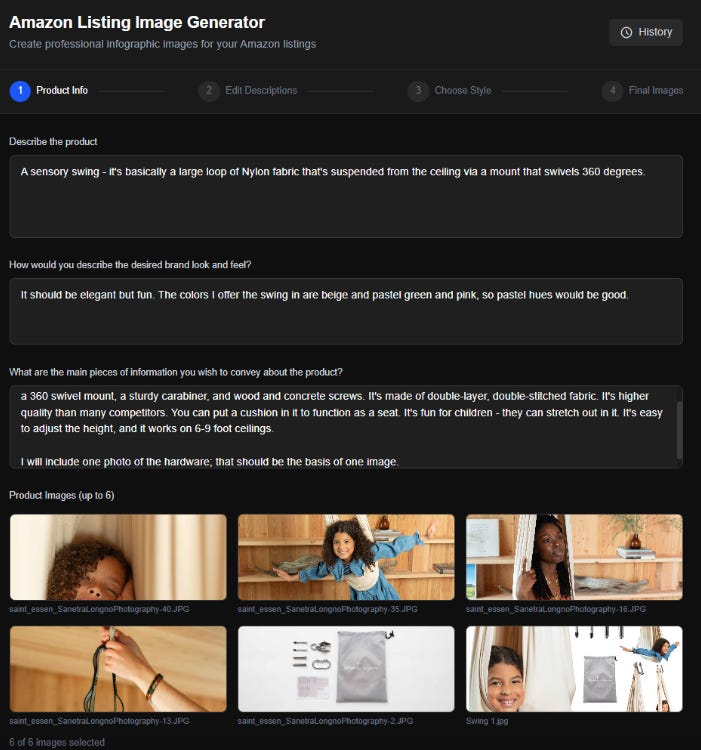
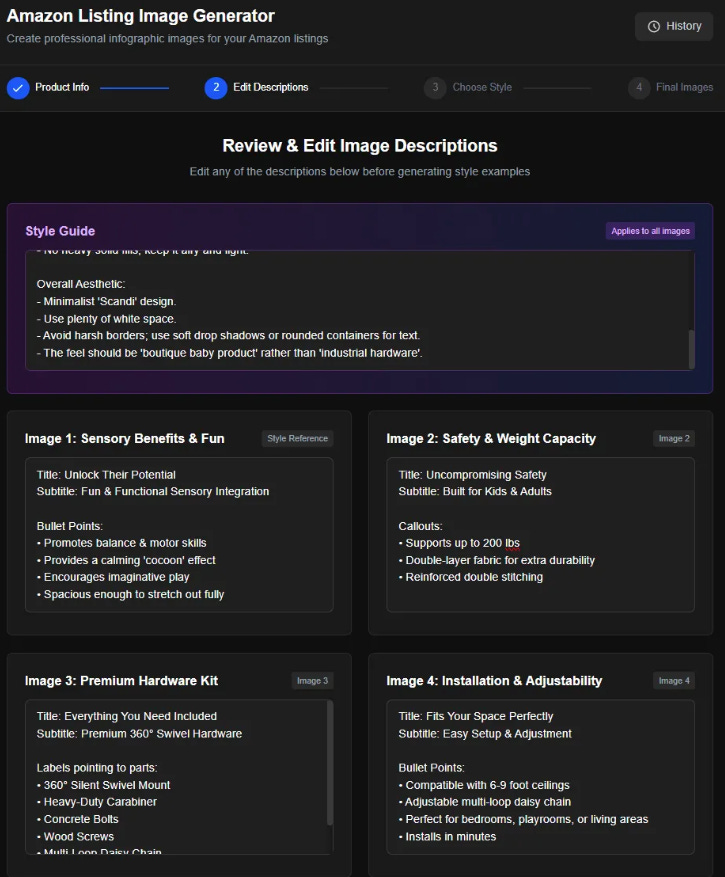
It then uses Gemini to generate content for six listing images. There are a few types of images it’ll always include if relevant (e.g. one that shows product dimensions, and one that shows the contents of the box if the product has multiple pieces), but beyond that I leave it up to Gemini. It also generates a full style description for each of the styles you’ve selected, including things like font styles, hex codes for colors and descriptions of illustration styles. You can manually edit any of those if you want, and when you’re happy with them you pick a single image to start with.
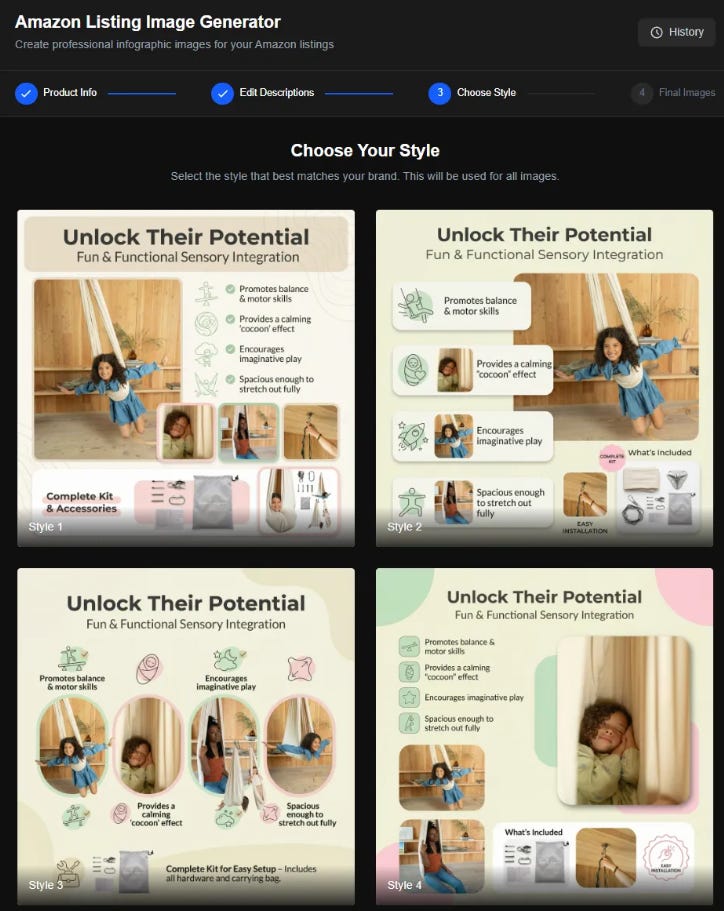
It generates four versions of that image - one in each style. If you want to make changes to any of them, you can give text feedback and recreate it. Once you’re happy with one of them, you select that one, and then it generates the full set of six images using that style. Again, you can add feedback and regenerate any of them.

This is where domain experience shines. You don’t know how to optimize the workflow until you’ve lived it. That’s what vibecoding.builders are all about.
What happened to the Listing Image Generator after the AI analyst came along?
Still in use! At the moment they serve two very different purposes. In the long run, though, I expect the listing image generator to just become another tool that the AI analyst (though by that time he’ll probably have been promoted to AI COO) uses. After I close an acquisition, I fire up an agent that runs through my playbook - goes through the ad account, rewrites listing text and generates new listing images.
“AI COO.” He’s not joking. The tool becomes part of the AI’s toolkit, not his.
The Real Cost of AI Automation
What do your AI experiments actually cost? Opus 4.5, Gemini 3 Pro, hosting, APIs — give me the monthly number.
Right now I’m on Claude Max at $100/month. The image gen stuff is insanely cheap even with heavy testing - I just checked and I’m at just under $100 for the past 90 days (and there’s some other experiments included in that as well). My email filtering script is at $9.45 for the last 90 days.
$100/month for Claude Max, $100 for 90 days of image generation including experiments, $9.45 for email filtering. He’s automating 30% of his e-commerce operations for roughly $150/month. Compare that to the $2,000 photographer invoice that never got sent!
As a former SaaS PM, would you have even attempted building internal tools before AI coding existed?
I’m very good at hacking things together with the tools available to me, and having worked at very early stage startups, that came in handy. It was a lot of Zapier automations and that kind of thing. At the last company I worked at, we had Retool, which was helpful. Nothing remotely comparable to what I do now, though.
Zapier and Retool were the ceiling. Now there’s no ceiling :)
Philosophy & Future
You went from “build tools with AI” to “just give the job to AI.” How has that journey changed your mentality about what’s worth building vs. delegating?
Honestly, the goal is to delegate it all. The shift has really been from having AI build tools for me to having it build tools for itself. No matter how many scripts and apps and automations AI builds for me, I’m still going to be the one running the business. If the goal is to have AI take things over, then I need to worry less about tools and more about providing it the context that I have. That means documenting what I do, how I make my decisions and the lessons that I’ve learned.
I also need to make sure that it has access to the systems I use. After I gave Claude Code an API key to access my Amazon Seller account in order to get inventory info, I found myself constantly asking it to use that for other reasons. A couple of days ago, I had to fill out a spreadsheet for a safety testing lab that’s certifying some baby mobiles that I sell. I handed that off to Claude, and because it has a context file about that brand and access to my account, it had no problem doing it.
Context, not tools. Access, not interfaces. This is the new architecture. I do this too — whenever people ask about my newsletter, a collaboration, my app, or services, I give it to AI. Its answers are better than mine.
You’re shipping fast for your own business. What did this teach you about your own taste?
I never trust my own taste in business. When I was a PM, I took my input from customers and data. When I buy businesses, I care about the numbers, not the actual products. One of my best successes is a leather handle cover for cast iron pans. I would never use it; that’s what kitchen towels are for.
Trying to automate my business with AI has reinforced that. As I think about my business, I honestly don’t think there’s any special taste that I have that’s somehow beyond the ability of AI to replicate. In general, I think that AI skeptics really tend to overindex on this idea that there is some intangible human characteristic that AI will never understand.
He sells a leather handle cover for cast iron pans. He would never use it. He doesn’t need to. The numbers tell him what works. This is the mindset that lets him hand work to AI without ego getting in the way. I use AI as a sparring partner constantly. The hard part isn’t using it, it’s knowing when to stop iterating.
What question do you wish people would ask about your AI automation experiments that almost never comes up?
It’s actually the last question in this interview. Read on!
You’re running e-commerce brands while running these experiments. What’s your actual system for getting things built?
I wish I had a system! I make sure the critical stuff like ordering inventory is taken care of first, but beyond that it’s a lot of to-dos on yellow notepads on my desk. I’ve got one list of small stuff, one list of AI stuff to build and one list of Substack articles to write. I try to alternate between doing boring stuff and tasks that I’m excited about. I am not always successful. I was supposed to call my insurance company first thing this morning, but I’m doing this instead.
Yellow notepads. Three lists. Alternating between boring and exciting. He was supposed to call his insurance company. Instead he’s doing this interview. I feel guilty reading this, and I do the same thing! Huge appreciation for the honesty. Glad I’m not the only one.
The Moment Everything Changed
“AI Just Took my Product Photographer’s Job” from November 2025 sounds ominous. What happened?
This was the first time I tried Nano Banana Pro and got back a flawless whitebox photo. Ever since GPT-3, I’ve been a believer that AI is going to fundamentally reshape the economy and our lives, but that moment with NBP was the single clearest demonstration of that change. I was about to spend a couple thousand dollars getting photographs taken, and suddenly a new model launch meant that I just didn’t have to do that anymore.
There are still people out there who are arguing against the impact of AI, and I genuinely cannot understand it. I know that it’s tricky to suss out its impact in large-scale economic data, but if you actually sit there and try to use it for real tasks, the impact is blindingly obvious. I have code that would have cost me thousands of dollars to have written by a human contractor. There are tasks that used to take me a few hours that now get completed when I type a slash command.
It is a genuinely unbelievable time to be alive! I’m glad you’re out here helping to tell the stories of people who are using AI, because there are few things more important right now than understanding what is happening.
This makes me so happy. He’s seeing what I’m seeing too. Yes, people should be skeptical and debate AI’s impact. But look at what it can actually do. Yesterday I updated broken URLs across 100+ articles after a massive URL change. Before AI? Days of tedious work. With AI? A couple hours using slash commands. Nobody enjoys that kind of work. Why not hand it over to AI?
How close are you to being “fully replaced”? What percentage of your e-commerce operations is now AI-automated?
That’s a great question, and I don’t fully know the answer. In terms of individual tasks, let’s say a very rough 30%. On the acquisition side, AI is doing most of the analysis, while I’m handling the negotiations. I still do most of the post-acquisition playbook work, though naturally AI is generating the listing images. Day to day, AI is doing most of the monitoring of the business, but I’m still the one placing the orders and managing the ads.
Most of that, though, is still AI-based tools that are making it easier for me to do the work. I’ve only just started the shift to AI being the one to actually do the tasks by itself with Claude handling inventory management. Once that’s done, the next step is to have AI take over the actual management - not just executing the tasks I tell it to, but understanding what needs to be done and getting it taken care of without my involvement.
An AI-run business would’ve seemed like pure sci-fi a few years ago, but I strongly suspect it’s not that far away.
30% now. Two years to full automation. He’s not speculating. He’s measuring. This inspired me so much I literally pulled out 2 old laptops and started designing my personal OpenClaw.
Connect & Explore
Alex’s Platforms:
📝 The Automated Operator Newsletter — Documenting the journey to an AI-run business
👤 Alex’s Vibe Coding Builders Profile — See all his projects and experiments
🐦 Twitter: @willenation — Follow his real-time experiments
Most builders I feature are racing to launch products, acquire users, find product-market fit. Alex is racing toward something different: making himself unnecessary.
That’s the natural endpoint of taking vibe coding seriously. You start by building tools to help you work faster. Then you realize the tools aren’t the point — the intelligence is. Why build a UI for every edge case when you can document your decision-making process and let AI reason through it? Why be the operator when you could be the context provider?
The shift from “AI builds tools for me” to “AI builds tools for itself” is profound. It means the destination isn’t a better set of productivity apps. It’s a fundamental restructuring of what running a business looks like. He’s not optimizing his workflow. He’s designing his own obsolescence.
What strikes me most is how methodical this is. He’s not betting on a future where this might work. He’s measuring progress toward 100% automation like it’s a product roadmap. 30% today, inventory management shifting from tool to analyst, two-year timeline to minimal intervention. Those aren’t aspirations. Those are milestones.
If Alex’s approach resonates with you, connect with him on Twitter or subscribe to The Automated Operator. He’s exactly the kind of systems-thinking builder worth following.
[ The Automated Operator
In which I document my attempts to use AI to fully replace myself in running my business
By Alex Willen
If you’re turning your expertise into products, building with AI, or helping others do the same, you belong here. Join the vibe coding builders community and get featured on Build to Launch Friday. Curious why it all started? Here’s the full story behind Vibe Coding Builders.
Your turn:
Are you building tools, or are you documenting context for AI to act on?
What percentage of your work could be handled by AI if you gave it the right access and instructions?
If you could delegate one entire role to AI tomorrow, which would it be and why?
Alex went from building tools with AI to designing his own replacement. What will your builder story be?
— Jenny