Can’t Do Nothing: How She Orchestrated 37 Contributors and 461 Users Into an AI Learning Event for $31
Build to Launch Friday: Meet Elena, the product manager who builds first and rests never
Welcome to Build to Launch Fridays, where we meet the builders turning domain expertise into AI-powered products.
Every Friday, I’m spotlighting someone from the vibe coding builders collection who’s doing exactly what I believe is the future: using AI not as just another tool, but as a true collaborator to transform curiosity, passion, and years of professional knowledge into something scalable and ownable. No VC funding, no technical co-founders, no permission required, just domain experts who decided to build.
Today, meet — the product manager in healthcare who built the AI Advent Challenge, a 25-day community learning event that pulled in 461 users, 37 contributors, and cost her just $31.

Have you ever built something so much bigger than yourself that you got sick from the effort, but couldn’t stop because the automation kept it running while you recovered?
Elena is a product manager by day, locked to Teams calls and healthcare product decisions. But building on the side isn’t a drain for her, it’s actually what energizes her. When most people would collapse after shipping one product, Elena ships another. And another. Each one becomes a boilerplate for the next, teaching both her and her AI partner how to avoid the same mistakes.
The AI Advent Challenge wasn’t just another product launch. It was a 25-door advent calendar where each day unlocked a new AI skill, featuring content from 37 different contributors. Elena orchestrated it all: the database architecture, the daily email automations, the contributor coordination, the design polish — while working her full-time PM job. She got sick right before the holidays, but the system she built kept running. That’s what happens when you automate what you’d hate doing manually on day 15.
I was honored to be one of the 37 contributors Elena brought together for this project. She gave me Door 25, the final door of the advent calendar. I’m so grateful for the opportunity to be part of something that brought so many creators together and helped hundreds of people learn AI skills during the holidays.
You can explore all of Elena’s work on Elena’s Vibe Coding Builders profile and see how she’s building an ecosystem of products, not just one-offs.
You & Your Products
What does your day-to-day work look like outside of building products?
My day to day is locked to a weekly schedule. I’m a product manager in healthcare, which is my primary job. You’ll see me always “in a call” on Teams. Building products outside my corporate role has been refreshing but also demanding. I’m constantly prioritizing one thing over another because time is the real constraint.
I relate to this so much. Day job always busy, but building on the side actually makes you more energized, not less. Same boat here.
You’ve shipped multiple products on Vibe Coding Builders. Can you give us a quick tour of what you’ve built so far?
Sure, and I’m realizing I need to add AI Advent Challenge there too. I’ve shipped Atomikas, a Product Leadership Assessment, and a Product Management Expertise Quiz. These earlier products became boilerplates for AI Advent. Each iteration taught me and Lovable how to be a better builder duo. I didn’t repeat the same mistakes with the next ones, and I focused heavily on security and privacy from day one.
I honestly wasn’t expecting her to mention security and privacy this early. But it’s so true that earlier products become templates for later ones. This reminds me of when programmers used to profit from selling boilerplates, now AI has changed that entire game. For essential practices every AI builder should know, check out my software engineering guide.
Is there a thread connecting those products to AI Advent Challenge, and what makes this one feel different or special?
The first products trained both me and Lovable. We learned how to work together, what works and what doesn’t. By the time I started AI Advent, I wasn’t making rookie mistakes anymore. This one felt different because I was collaborating with 31 contributors. It became bigger than just a product. It became a community event.
That makes me wonder… what were those rookie mistakes? (Keep reading.)
already did an incredible interview with you. Is there a moment from building AI Advent that didn’t make it into that conversation?
By the time Dinah interviewed me, I was getting sick. I had to push calls a week later and collaborations into 2026. People like Anna Levitt understood the burden immediately. But here’s what didn’t come up: I got sick right before the interview, so I had to use all of my energy for the interview and then step back. But emails were automated and notes were scheduled by then, which saved me during the holidays. By resting and letting the automation run, I kept collecting contributor changes for the final doors. We made it through the holidays just fine.
I didn’t even know she was sick, and she managed it so well! This is the reality of working full-time and building part-time. If Elena’s responses to your messages were delayed, it wasn’t intentional, she was overwhelmed. And for scheduled notes, I’m sure she’s using one of the notes scheduling tools. For my paid members, check the premium resources page for note scheduling tool dedicated for you.
Building with Lovable
Is Lovable your go-to platform? What initially clicked for you about it as a building partner?
Yes, it is. In 2025 I tested almost all the prototyping tools. Adalo, Softr, and others that probably don’t exist anymore. I was surprised by Lovable, Replit, V0, and Bubble. But I was looking for something specific: zero coding. I know that sounds strange as a software engineer, but I’ve spent years spinning up React projects the moment a tool felt limited. This time I wanted to avoid that sensation.
Lovable made it so easy to start with. There’s something special about how they’ve designed the first-time experience. That product has changed drastically to amaze you from the beginning so you feel the difference when you switch to other tools. Kudos to the Lovable team.
It’s become my go-to for prototypes and MVPs. What clicked was the conversation-first approach. I could describe what I wanted in plain English and watch it come together in real-time. As a PM, I’m used to writing specs and stories. With Lovable, I essentially did that and got working code back. The live preview showing changes instantly was game-changing. I didn’t need to context-switch between writing requirements and waiting for a developer sprint.
I had a similar experience. Lovable’s first impression is unbeatable, their design taste is really something. I wrote about it when building my personal website. Later, when Replit improved its design capabilities, I started switching because of its full-stack functionality. But for prototypes and getting started? Lovable is still number one.
Walk me through your typical interaction loop with Lovable. Prompt to generated code to tweaking to shipping.
My loop was roughly:
Describe intent: I need an advent calendar with 25 doors that unlock based on date.
Review the output: Check the live preview, look at the code if curious.
Refine with specifics: Make the snowfall slower, add a streak counter here.
Debug together: This door isn’t unlocking, can you check why? And also review the state of all doors.
Ship: Hit publish, connect domain.
Fix and reiterate.
The key was being iterative and specific. Big vague prompts led to misses. Small targeted ones were accurate. I broke big features into 4-5 smaller asks. Lovable also creates big plans and phases them based on criticality and what matters to you. This was introduced while I was scaling AI Advent Challenge, and it did wonders. Much more efficient and less mistakes.
That trick of breaking features into 4-5 smaller asks is exactly what I wrote about in my prompting strategies article. These two strategies changed how I vibe code.
Roughly how many rounds of back-and-forth did you go through for AI Advent Challenge, and how many credits did that translate into?
Based on my project history, I estimate 300-400 plus message exchanges over about 7 weeks. That translates to hundreds of credits. I was on a paid plan with about 31 dollars spent on Lovable total, so that covered Pro credits plus some usage-based charges. Most credits went to:
Initial architecture about 30 percent. UI iteration and polish about 35 percent. Bug fixes and edge cases about 25 percent. Content management features about 10 percent.
Seven weeks and 300+ message exchanges. That’s actually normal if you think about it—in traditional development, you might exchange 10 messages a day with a programmer, and that spreads across 30+ days. The difference is Elena did this part-time. And $31 total? That’s way cheaper than what other builders have spent. Thank you for being so transparent about the spending, it’s clear architecture and UI polish are the real investment areas. For more on keeping costs low, see my cost-effective AI building guide.
Here’s what I’ve learned: the building is part of the process. When you introduce new features, parts will break. Start mentally prepared for that kind of burn. I was initially frustrated with how Bolt introduced bugs while fixing others, but that’s just how iterative building works.
You mentioned burning through credits. What does that actually mean, and how much went to building versus fixing bugs Lovable created?
About 31 dollars on Lovable over the build period. I’d estimate 70 percent building, 20 percent refinement, and 10 percent fixing. Real bugs were mostly logic omissions, not broken code. The AI would build Feature A but forget to connect it to Feature B. Once you pointed it out, fixes were fast.
The bigger problem was with the actual door content. Some challenges were totally replaced or mixed between what Lovable had locally stored and what was in the database. Hard lesson, but it taught me something important: I was trusting that content was being stored right in the database, not kept in local state. Rookie mistake, I guess. It’s like forgetting to use WHERE in a DELETE FROM SQL instruction. You can wipe out your whole database in one line.
So true! AI builds Feature A but forgets to connect Feature B. I’ve encountered the same. And that “rookie mistake” about trusting data was stored correctly in the database? I would’ve made it too. Don’t even mention wiping the database in one line, I’ve had heart-broken experiences with that myself.
Your stack includes Lovable, Supabase. Can you break down what each part does and where it’s all hosted?
Lovable handles the frontend. That’s a React SPA hosted on Lovable’s infrastructure, auto-deployed. Lovable Cloud runs on Supabase for the backend. PostgreSQL database, authentication, edge functions. I built 4 of them: daily email notifications, unsubscribe processing, image proxying, and feedback requests. File storage for PDFs all lives there too.
Resend handles email delivery for daily door notifications. I use pg_cron for scheduled jobs that run every day at 8 AM UTC.
Everything is serverless and managed. Zero infrastructure to maintain.
Wait, I thought she was manually maintaining this. I didn’t know she built autonomous functions and set up all these different infrastructures. For readers new to this: React SPA means a lightweight single-page application that doesn’t need heavy backend support. Supabase is database-as-a-service that handles your backend. And she even mentioned Resend for email delivery. This isn’t a prototype, it’s a full-fledged production application. If you want to build something similar, my MCP second brain guide shows how to connect all these pieces.
The UI feels clean and intentional, not AI-generated generic. How did you approach the design?
Three things made the difference.
First, clear creative direction upfront. I specified “festive Christmas theme with warmth, not cluttered” from day one. Second, iteration, not acceptance. I didn’t just accept first outputs. If the snowfall was too fast, the colors too bright, or the spacing off, I said so explicitly. Third, reference constraints. Using Space Grotesk font, specific color palette, consistent card layouts.
Lovable is good at following design systems once you establish them. The key was being specific about aesthetics the same way you’d be specific about features.
On the frontend, I had to use Cursor at some point because I couldn’t make Lovable understand the curved snow-on-the-floor effect I wanted. I had it in my mind already, but the way to describe it with words just wasn’t landing. So I went hands-on for that one piece. In these scenarios, communicating in CSS is faster for me than in English.
This is so specific. And honestly, if I read “curved snow on the floor effect,” I wouldn’t understand it either. Kudos to Cursor for being able to do what words couldn’t.
Looking back, would you recommend someone on a tight budget use Lovable for a project like this?
Yes, of course! You can create a free account and start building with 5 free credits, iterating day by day. But building something specific like AI Advent Challenge has more constraints and a different level of complexity.
Total cost was about 50 dollars. Lovable was 31, domain was 10, Cursor and Claude were 0 for supplemental work. Time to functional MVP was less than 30 days. About 5 hours to the prototype I used to recruit 31 contributors.
If you’re comparing to hiring a developer, it’s 10 to 20 times cheaper. But you need to be comfortable iterating in public, understand you’re the PM and designer and QA all at once, and accept that some manual work happens when the AI misses edge cases.
For MVPs and prototypes with fewer than 1000 users, absolutely. For production apps with millions of users, you’ll want to layer in more engineering oversight first.
PM and designer and QA all at once is so real! Quick tip: when starting with Lovable, try building with one strong initial prompt. Chat with Claude or ChatGPT first, describe your feature, and ask it to rephrase so Lovable can follow it through.
What’s your biggest complaint about Lovable? If you could send one brutally honest piece of feedback to the team, what would it be?
The AI doesn’t maintain full context across long conversations. After 50-100 messages, it would forget decisions made earlier. Like building an unsubscribe feature that set consent marketing equal to false, but then building the email function without checking that field. The result was a working unsubscribe button that did nothing.
Also despite Lovable focusing on security, there’s room for improvement. Some security aspects come back when you’re 2 features ahead. If the app forgot that you were maintaining security standards from the beginning, it solves and creates functionality but walks over security like it’s nothing.
My brutally honest feedback: Lovable is incredible for fast building. It’s not good at maintaining. The AI needs better project-level memory. A way to say “here are the 10 architectural decisions we made” that persists across sessions. Right now, I’m re-explaining context constantly, and edge cases slip through because the AI doesn’t remember what it built last week.
The context window problem is so real. This is true even for professional coding tools like Cursor and Claude Code. I usually maintain a separate chat history file and point AI to it, plus a security file so AI can reference it properly. Memory management is now part of the builder’s job.
The Numbers
Our current snapshot from the database:
461 registered users, up from 90 at pre-launch. 1,084 claims, which are door completions. 37 contributors. 219 pre-launch signups. All 25 doors populated. 4 edge functions in production. 12 plus database tables with Row Level Security.
Outside of the Lovable project, the reaction has been incredible. Some contributors gained paid subscribers. Others gained visibility and different types of reach.
Take a look at the Mission page. I created it to be fully transparent with our audience and to provide a snapshot of our work together.
👉 Visit AI Advent Challenge | View on Vibe Coding Builders
Huge achievement. Truly blown away by how popular it got. No wonder everyone wanted to feature this project.
Launch & Collaboration
Congrats on reaching top 17 on Product Hunt. What did you do intentionally for that launch versus what happened organically?
I didn’t expect a massive launch on Product Hunt. I actually used the scheduling on the platform to start Monday at midnight, but it seems it was delayed. Mia told me about this, and it somehow affected the numbers. Honestly, I regretted submitting to Product Hunt. The spam started immediately. We both got hit with messages from people or bots reaching out about expensive Product Hunt outreach services. Incredibly sad that Product Hunt has come to this. The experience was really terrible.
That was totally unexpected. I’m sorry she experienced that. It also explains why she was impersonated later. I personally didn’t like the Product Hunt interface either, it doesn’t feel as polished as I’d expect. Glad she’s sharing this honestly with the audience.
On your Product Hunt page it’s you and , plus credits to Lovable, Supabase. How did you and Mia divide roles?
I invited all the contributors because they were part of it, but only Mia was more aware of the platform and kindly joined. She helped me understand how Product Hunt has changed some of its rules. I kinda regret not consulting her first on this matter, but it is what it is.
Mia is such a wonderful resource. I’ve learned a lot from her journey as well.
How much time did you devote to AI Advent in total, and how did that split between building versus coordinating with people?
Despite Lovable’s conversation numbers, I spent much more time coordinating people. Even 2 days before Christmas I was changing the wording on door 24. You see, all the interaction with Lovable was more than just deploying code. I asked the assistant to transform the whole project into specs, throw documentation, make analysis, and more. Because it became my actual technical partner who understood how everything was connected, the actual development was less than coordinating people.
This really resonates. It’s always the content, distribution, and coordination that takes more time than making the work. But you still have to build the work really, really well.
What’s the hardest part about running your newsletter, building a project like this, AND coordinating with contributors all at the same time?
At some point I got disconnected from my newsletter. I had notes with planned content for the last weeks of the year, but when I had to pause, I pushed many collaborations to next year. At the same time, the Lovable buildhaton SheBuilds happened. Before Christmas I developed 2 new products thanks to that event. It shook my schedule, for sure!
When she said I was her first collaboration of 2026, I had no idea how meaningful that was. Now I know!!! Looking forward to seeing those new products!
Impact & Reflections
AI Advent pulled in hundreds of visits and mentions. How did it feel on your side as momentum picked up?
Incredibly overwhelming in a good sense. Happy problems, you know? People started dropping in bugs, questions, and many started sharing their experiences and creating images. I still need to make a special page showing all of these as a snapshot when January ends. It was incredible.
I remember those days. Happy problems indeed. Can’t wait for that snapshot.
What’s the biggest unexpected win from AI Advent, and is there one message from a participant that made you think this was absolutely worth it?
The biggest win was seeing a huge positive reaction from the audience. I didn’t expect people to share the event like they did. Contributors and participants all of that was magical.
What got to me was reading about how participants were learning and improving their AI skills. On the other side, contributors reached out thankful for the exposure and opportunity. I started suggesting participants tag the contributors, and suddenly we had a web. It’s a network that focuses on learning and helping each other. One thread led to another.
I don’t have just one comment, I’m flooded by positive feedback!
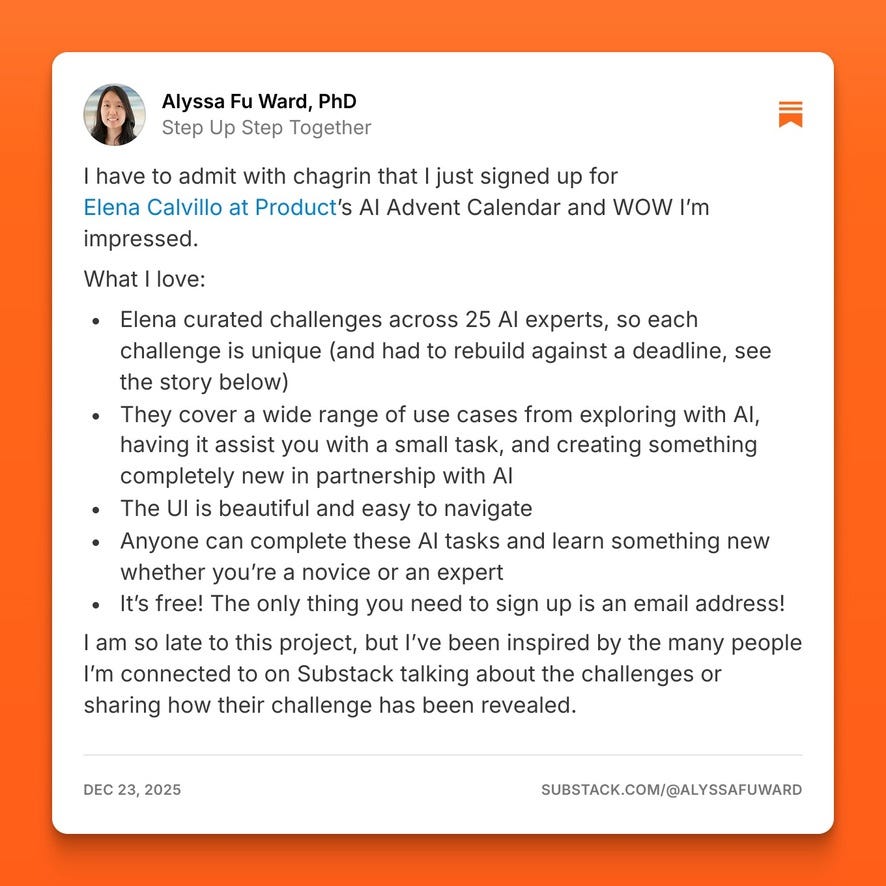
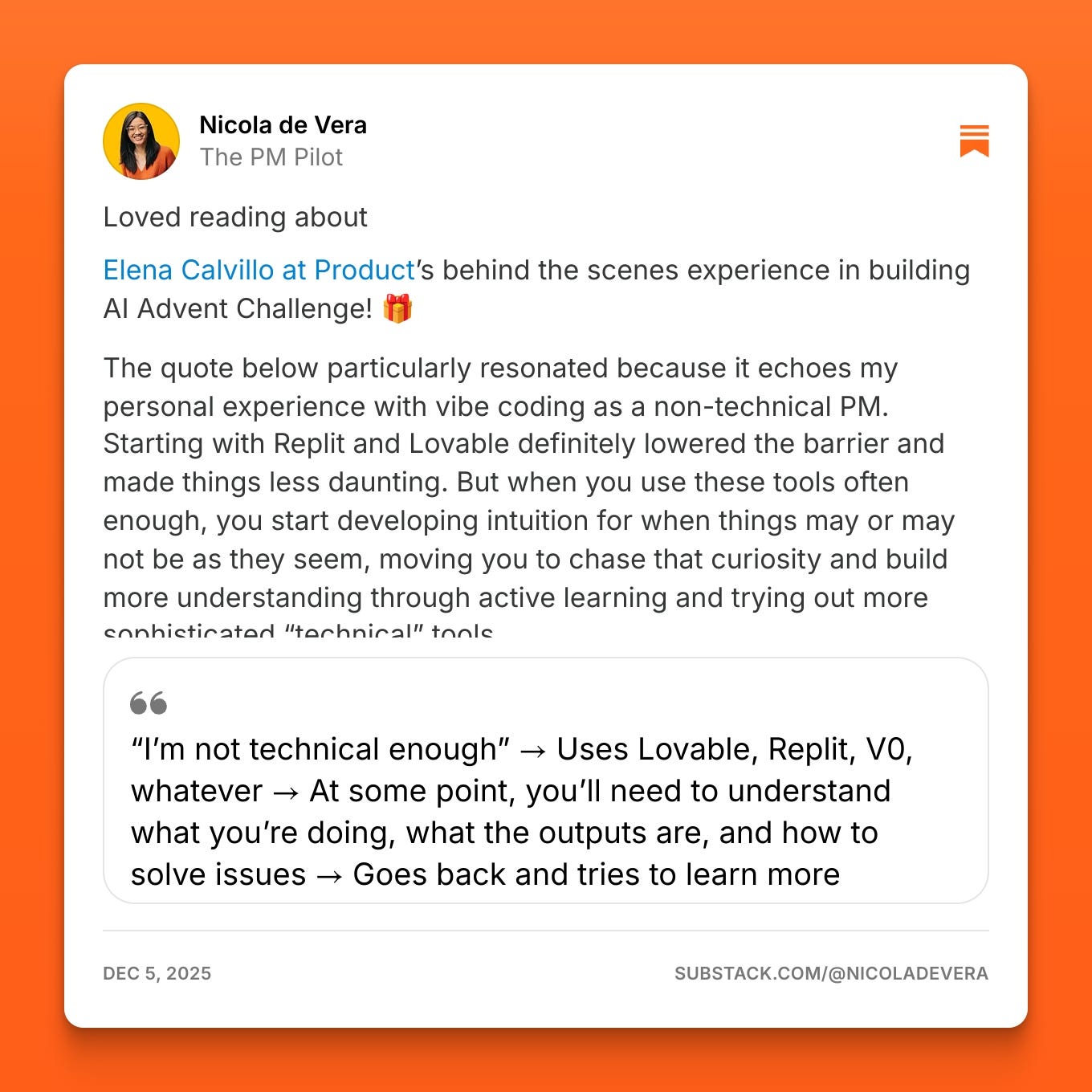
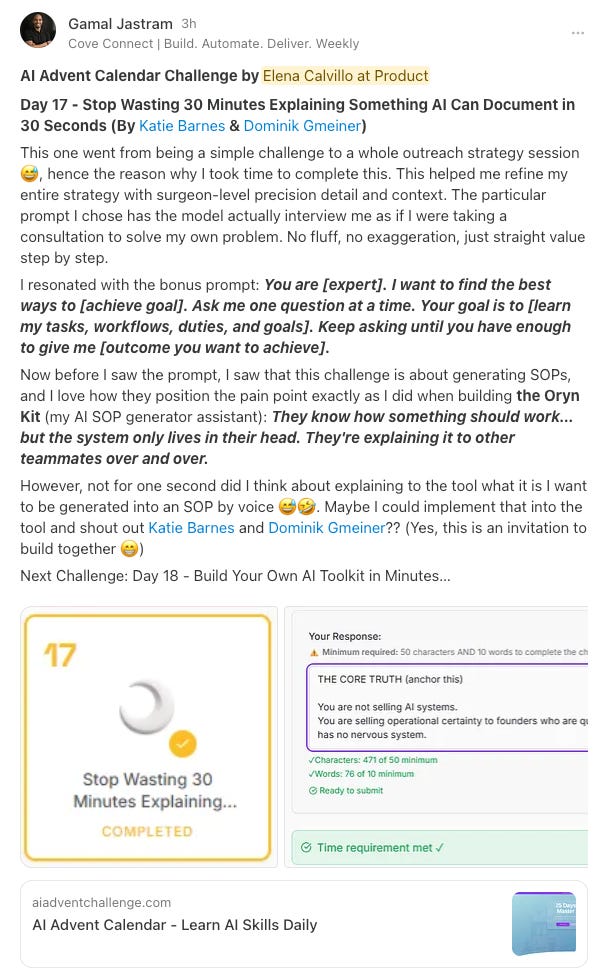
I love that the web of collaboration emerged organically! It’s the same feeling I get when joining group posts, inspiring people connecting with inspiring people. Congratulations.
With that attention came weird parts. Impersonation, spam, scammy messages. What did you run into?
There was this strange impersonation event. Someone was spamming my audience from one of my post comments with a fake account. I panicked. I was about to have dinner outside with my partner to unwind when I started receiving strange notifications. I told him, “I don’t know what’s going on. Someone is posting with a fake account of myself.”
I think he feared the look on my face.
Fortunately, I started asking for help with my network, and all of them responded incredibly!
When people know the real you, you’re backed up immediately. This energy relaxed my nerves. I changed my profile name. I’ll be making some adjustments this year so hopefully all of this makes sense later.
When people know the real you, you’re backed up immediately. So true. I’m glad the impersonation is gone, and the new profile name is awesome.
What did this event do for your confidence as a builder?
It supercharged me with so much energy. I realized I’ve always been a builder. That’s part of my identity. The daughter of an electronic engineer who became a software engineer, I’ve been deconstructing and creating since I was a kid. Even with the newsletter as a side project, nobody paid me when I opened Substack but I just can’t do nothing.
Having a job is one thing, but having my own thing is what matters to me.
This project reminded me that after all these years, that builder is still part of me and I’ll probably never get rid of it.
One thing I’d like to highlight that I didn’t mention in Dinah’s interview: I wasn’t highlighting myself enough in the challenge. People were entering but didn’t know who the protagonist of the app was. Days before the event went live, my partner said, “Why are you not in the homepage?” I said, “What do you mean? I created this. My links are at the footer.” Then he said, “But you’re not telling anyone that you built this. There’s no story. You’re highlighting more the people who contributed than yourself, the one orchestrating all of this.”
That hit a chord. He was right. This perspective helped me define the builder inside me and the things I’m about to publish next. This realization brought me some freedom, actually. The freedom of being more me publicly.
You really have to shamelessly promote yourself, because if you don’t, who else would? (Except for Elena’s partner, apparently!)
What did this build teach you about your own taste as a builder?
When I started my career as a frontend developer, I spent half a year generating good taste. It was rare to find frontend developers who cared about UX and web design trends. I was the opposite, and that good taste gave me my first job in tech because web designers were rare.
Now with AI tools, it’s so easy to come up with incredible designs, but they feel empty. It’s when we start playing with interfaces, changing colors, aligning elements, creating specific images, that things start feeling alive. My first designs of the AI Advent Challenge felt like a generic landing page made with AI. Then I edited elements myself, moving pixels, testing if they looked good enough to me. If not, I moved more pixels. It felt like the good old times. It felt right.
I believe people recognized that somehow.
Lots of AI products feel empty. Elena’s got much better taste, and gladly praises others’ taste too, not just interface design, but the care for the user, the functionality, the whole experience.
What question would you love someone to ask you about this build that almost never comes up?
I’ve received so many questions about tradeoffs and sacrifices, or how I balanced the time. Maybe more on a personal aspect. As a human being having an AI partner, what did this unlock? Ironically, all of this connected me more to my identity and the people I admire on Substack. I even got new friendships along the way. It opened so many opportunities for collabs, interviews like this, knowing others’ skills and what I can learn from them.
It’s been an inspiring journey for me too. I know a lot of the friends made here will be lifetime ones.
Beyond the product stack, what’s your personal productivity stack?
Things 3 for task management because of its simplicity. Craft.do is my vault for all my writing and documentation. Each product or idea gets stored there with its mission, values, specs, a detailed plan of how to execute, and user feedback. I try to collect as much as I can and store it there to find it easily later. With AI, I believe Craft will become like my second brain.
For building I’ll stick with Lovable. After the SheBuilds event, I’ve joined an incredible community of women who build around the world, and I can get early signals and insights there for my next launches.
Code editors like Cursor or Nova will stay around because I sometimes need to go to a more technical level to have things exactly like I want them.
Claude will be around, but this year I’m testing Gemini for the next 6 months to see if it becomes my new companion and replaces Claude plus Perplexity. We’ll see.
I’m so glad I asked this! When Elena shared her responses through Craft, I knew immediately it was hers because of the delightful background. And thank you for sharing the testing plans, I’ve been curious about Gemini too. I’ve always been a Cursor fan, but Claude Code has been gradually becoming my favorite because of its lightweight and autonomous nature.
Elena’s 7-Step Playbook for Builders
If you had to turn your process for AI Advent Challenge into a simple playbook that other builders can follow, what would the steps be?
Step 1: Start with the Data, Not the UI
Before touching any visuals, map out your data relationships. For AI Advent Challenge, this meant: What entities exist? Users, Doors, Claims, Contributors, Rewards. How do they relate? User claims door equals creates claim record equals updates streak. What needs protection? User data, admin functions.
Prompt pattern: I need a database for [concept] with [entities]. Users should be able to [actions]. Only admins can [admin actions].
Step 2: Build the Happy Path First
Get one complete user journey working end-to-end before adding complexity. User signs up, sees calendar, opens door 1, completes challenge, sees streak. Don’t worry about edge cases yet. Prove the core loop works.
Step 3: Layer in Gamification/Engagement
Once the core works, add the hooks that keep users coming back. Streaks for consecutive day tracking. Validation requirements like time on page or response length. Rewards and unlocks. Progress visualization.
This is where AI Advent Challenge spent significant iteration time.
Step 4: Automate What You’d Hate Doing Manually
Identify repetitive tasks and build automation. Daily email notifications. User onboarding. Analytics collection.
Key insight: If you’d dread doing it on Day 15, automate it on Day 1.
Step 5: Security as You Go, Not After
Don’t save security for the end. Each new table gets RLS policies defined immediately. Role-based access considered. Admin functions protected with SECURITY DEFINER.
The unsubscribe bug I just fixed? That’s what happens when you skip this.
Step 6: Content is a First-Class Feature
For content-driven apps, treat content management like a feature. How will content be added? Admin UI, database, files. Who contributes? 31 contributors with PDFs and profiles. How is it attributed? Contributor cards, links, multi-author support.
Step 7: Ship, Then Polish in Public
Launch with 80 percent polish. Use real user feedback to prioritize the remaining 20 percent. Demo mode for prospects. Pre-launch signups to build anticipation. Iterate based on actual complaints.
That’s the real playbook: Clear vision plus iterative prompting plus willingness to ship imperfect.
My Step 1 is exactly the same, maybe also add system design. When those are in place as foundation, it’s hard to go wrong. The RLS rules reminder hits home, I admit there are still some RLS rules I need to address… I’ve been kicking it down the road. And Step 6? The golden sauce! I used to think good logic was the key, but good product is just halfway there without good content supporting it.
Connect & Explore
Elena’s Platforms:
🚀 AI Advent Challenge — 25-day AI learning event with 461+ users
🚀 Mission Page — Full transparency on the project’s impact
👤 Elena’s Vibe Coding Builders Profile — See all her projects and journey
Building AI Advent Challenge wasn’t about shipping a feature-complete product. It was about Elena rediscovering the builder she’s always been—the daughter of an electronic engineer who can’t help but deconstruct, create, and iterate.
What strikes me most is how her PM skills translated directly into building. Writing specs became writing prompts. Managing stakeholders became coordinating 37 contributors. Understanding user journeys became designing gamification loops. The same skills, different medium.
Elena got sick during the holidays but her automations kept running. She was impersonated but her community backed her up immediately. She underpriced herself on her own homepage until her partner pointed it out. Through all of it, she shipped, and 461 users learned AI skills because of it.
If Elena’s “can’t do nothing” energy resonates with you, connect with her. She’s exactly the kind of builder who makes things happen regardless of circumstances.
[ Product Release Notes
Weekly AI product insights, and career strategies that help ambitious product managers stay ahead of the curve. Get practical templates, real case studies, and the strategic thinking that separates great PMs from the rest.
By Elena Calvillo at Product
If you’re turning your expertise into products, building with AI, or helping others do the same, you belong here. Join the vibe coding builders community and get featured on Build to Launch Friday. Curious why it all started? Here’s the full story behind Vibe Coding Builders.
Your turn:
What would you automate on Day 1 that you’d dread doing on Day 15?
If you had 37 people wanting to contribute to your project, how would you coordinate them?
Elena went from “I can’t do nothing” to 461 users, 37 contributors, and a 7-step playbook for building community-driven products. What will your builder story be?
— Jenny