Anthropic IPO: The 7 Most Important Questions, Answered
I read the Anthropic IPO filing as a Claude customer: where the money comes from, where it goes, and what changes for your plan and your limits.
"As a Claude user, what do you expect to change once it is a public company?"
Someone asked that on r/ClaudeAI this week. It got 439 points and 211 comments. The top reply got 758 points, and it was three words long:
"I expect enshittification."
A lot of Claude users feel the same.
On Thursday morning, Anthropic, the company that makes Claude, went public. In an IPO (initial public offering), a company sells its shares to the public for the first time, so now anyone with a brokerage account can buy Anthropic on Nasdaq. All week, the headlines kept landing on one number: a $104 billion loss in nine months.
So if Claude runs part of your work, it is a strange week. The company lost $104 billion, and your projects run on its tool.
Mine do too. I pay for the top plans of Claude and Codex, my scheduled jobs run on my Claude plan, and members use the Build to Launch MCP I built on Claude.
So when the headlines got loud, I opened the final prospectus, the document a company files before it sells shares to the public. It answers a good part of that Reddit question, in Anthropic's own words.
What people asked this week comes down to seven questions. We start with the money, because you can't judge the $83 price without it.

The seven questions:
Is Anthropic Making Money, or Did It Lose $104 Billion?
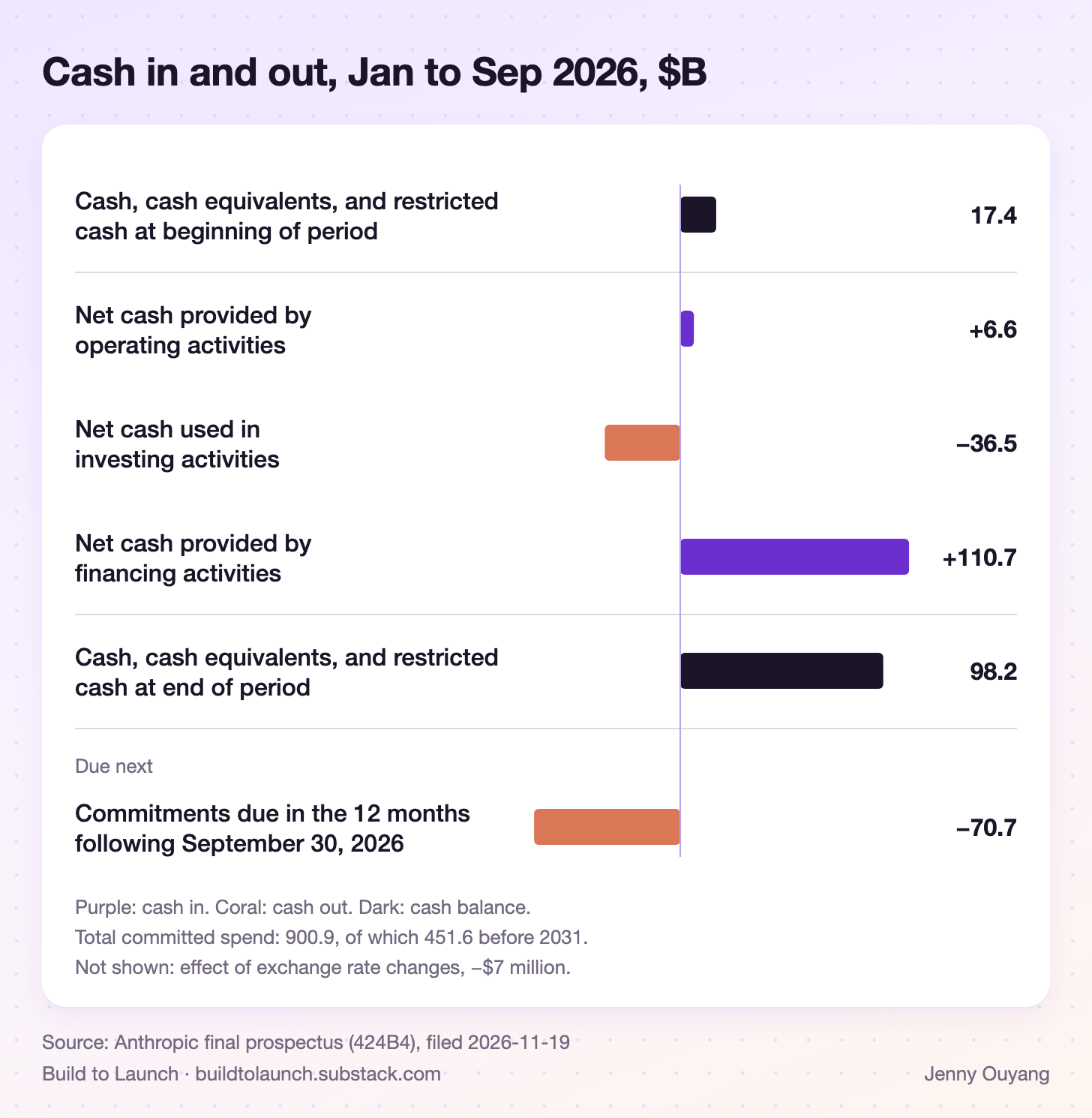
On paper it lost $104 billion. In real cash, the business took in $6.6 billion.
So how do you lose $104 billion and still end up with more cash?
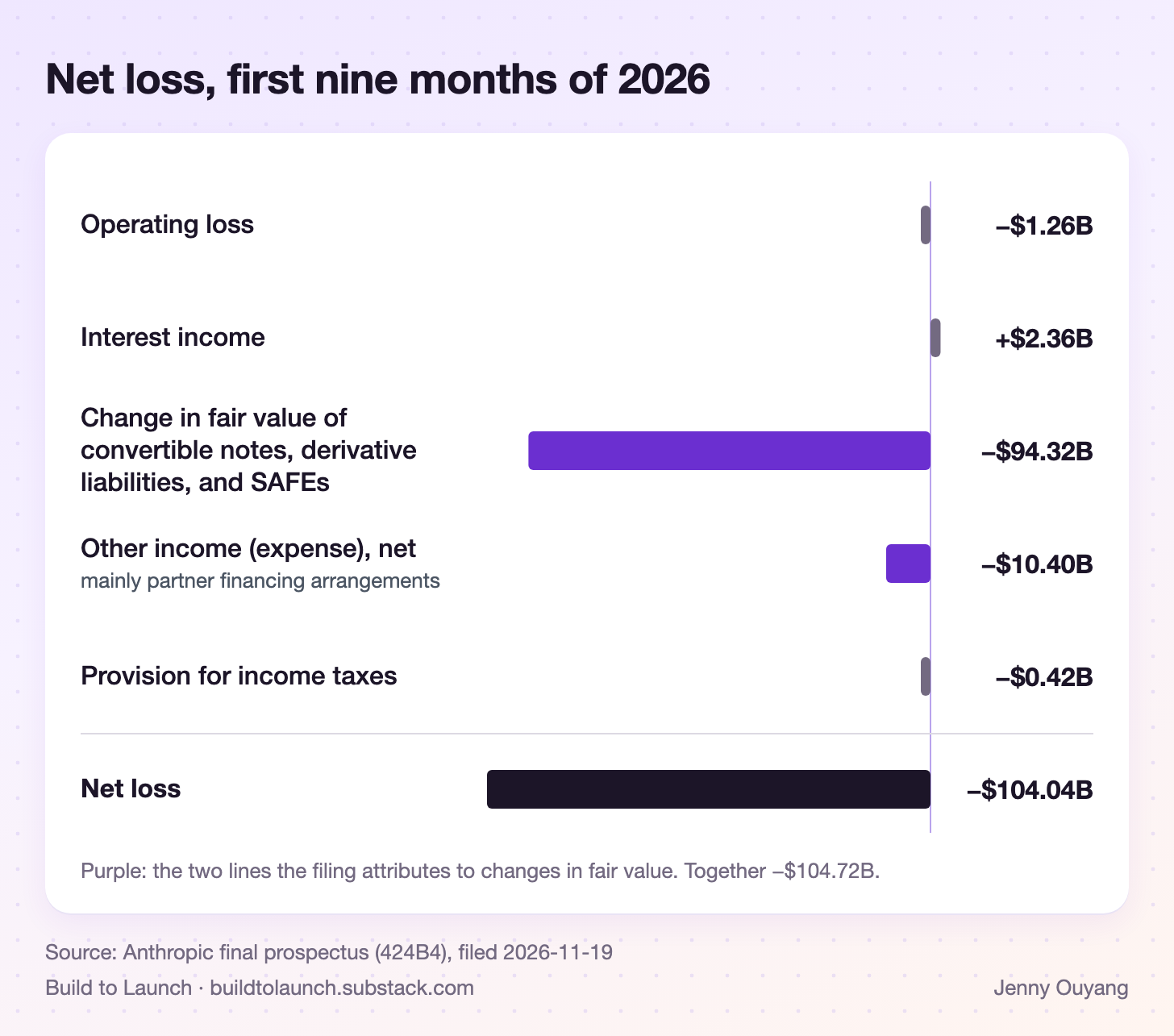
By the accounting rules, Anthropic lost $104.0 billion in the first nine months of 2026, in the final prospectus.
But most of that number never left the company as cash.
Two lines alone add up to $104.7 billion, a bit more than the whole loss. Both track what its investor and partner deals are worth today. Anthropic's value went up a lot this year, so those deals got more valuable for the people holding them, and the rules count that rise as a loss for Anthropic. Accountants call it a book loss: it counts as a loss, but no money moves.
The cash tells a different story. In the same nine months, the business took in $6.6 billion more cash than it paid out to run itself. A year earlier, it was the other way around: it paid out $2.0 billion more than it took in.
Two paper lines make up the loss
The $104.0 billion adds up from five lines in the filing's statement of operations. The five lines are:
Operating loss, $1.26 billion. Revenue minus the cost of running the company: compute, salaries, research, sales.
Interest income, plus $2.36 billion. Interest on the cash it holds.
Change in fair value of convertible notes, derivative liabilities, and SAFEs, $94.32 billion. A book loss on investor deals that turn into shares later. "Fair value" means what something would sell for today. More on it below.
Other income (expense), net, $10.40 billion of expense. A second paper loss, this time on deals with partners and an option Anthropic bought. The filing calls these "partner financing arrangements."
Provision for income taxes, $0.42 billion.
Together, the five come to the total loss, $104.04 billion.
The third and fourth lines are the paper losses. Interest income of $2.36 billion pulls the total back down. And neither line has a cash payment behind it in the filing.
Investor coupons grew as Anthropic grew
The biggest line, $94.3 billion, is easiest to understand if you picture a coupon.
Amazon and other backers put money in before the IPO, through convertible notes. Each one works like a coupon: it gives you the right to get shares later at a fixed price, or at the IPO price if that is lower.
Amazon's two notes convert at $2.0928 and $5.0478 a share. Compare that with the $83 IPO price.
Every time Anthropic's value went up, those coupons got more valuable for whoever held them. And under the accounting rules, Anthropic had to count that gain as its own cost. The filing says it in one line: "increases in our enterprise valuation drive increases in this expense." That cost stops once a note turns into shares.
So the biggest part of the loss grew because the company did well.
Anthropic also has its own way to count, adjusted operating income, and by that count it made $4.08 billion in the nine months. Anthropic picks the rules for that number itself, outside the standard accounting rules, so read it as the company's own view.
If you only keep one line of the loss, keep the operating loss: $1.26 billion. That is the part that comes from running the company.
And the $6.6 billion of cash still came in. That cash only means something if real customers are paying it. So the next question is who pays, and how.
Where Does Anthropic's Money Come From, and Will Growth Last?
Mostly from businesses that pay per token, and the growth is fast but already uneven.
Money comes in from two places: customers and investors.
Customers pay by use, investors in rounds
Customers first. From January to September 2026, revenue was $33.2 billion.
79% came from pay-as-you-go use, $26.3 billion. Those customers pay per token, for what they use. The other 21%, $6.9 billion, came from subscriptions, for people and for businesses.
If you pay for Pro or Max, you are in the 21% with me. If you or your company pay per token through the API, you are in the 79%.
About 44% of revenue came through cloud marketplaces such as AWS, where companies buy Claude inside their cloud account. Its top five customers brought in about 25%. No single customer brought in more than 10%.
Then the investors. In total, they had put $141.1 billion into Anthropic by September 30, 2026. $110.4 billion of that came this year alone, in three rounds:
Series G: $30.2 billion
A second Series G sale, to Google and Amazon: $15.0 billion
Series H: $65.2 billion
Heavy agent users pay the most
The two kinds of customer money work like a utility meter and a gym membership.
On a meter, the heaviest users pay the most, so revenue goes up when use goes up. At a gym, the member who comes every day pays the same as the one who comes once a month, and costs the gym far more.
Claude Code shows the meter at work. In the third quarter, Claude Enterprise users who did not use Claude Code spent under $75 a month on average. The top 5% who used Claude Code spent about 20 times that.
The gap comes from how agents work. An agent that works for an hour uses far more than a chat that answers in a minute. If you have watched Claude Code work on one task for an hour, you have seen it happen. In a normal week I run about 14 sessions across 6 projects, so I feel this gap myself.
Revenue grew about 13 times, but unevenly
Revenue also grew fast. A year earlier, for the same nine months, it was $2.5 billion. That is about 13 times more in one year.
Customers who stay also spend more. Net revenue retention (NRR) compares what last year's customers pay now with what they paid a year ago. That number was about 900% for Anthropic as of September 30, 2026.
Put simply, the same customers now pay about nine times what they paid a year ago. Well-known software companies were far below that when they went public.
When four well-known software companies went public, their filings showed Slack at 138%, Zoom at 140%, CrowdStrike at 147% and Twilio at 155%. Each company defines the number its own way, and Anthropic's leaves out its individual plans.
Anthropic itself expects the speed to drop. The filing says:
"[W]e expect our Run-Rate Revenue growth rate to decline over time, and it may decline significantly and more rapidly than we anticipate, as our revenue base increases, as the market matures, and as a result of other factors."
Run-rate revenue is Anthropic's own yearly pace, built from its most recent month; question 6 shows how it is counted.
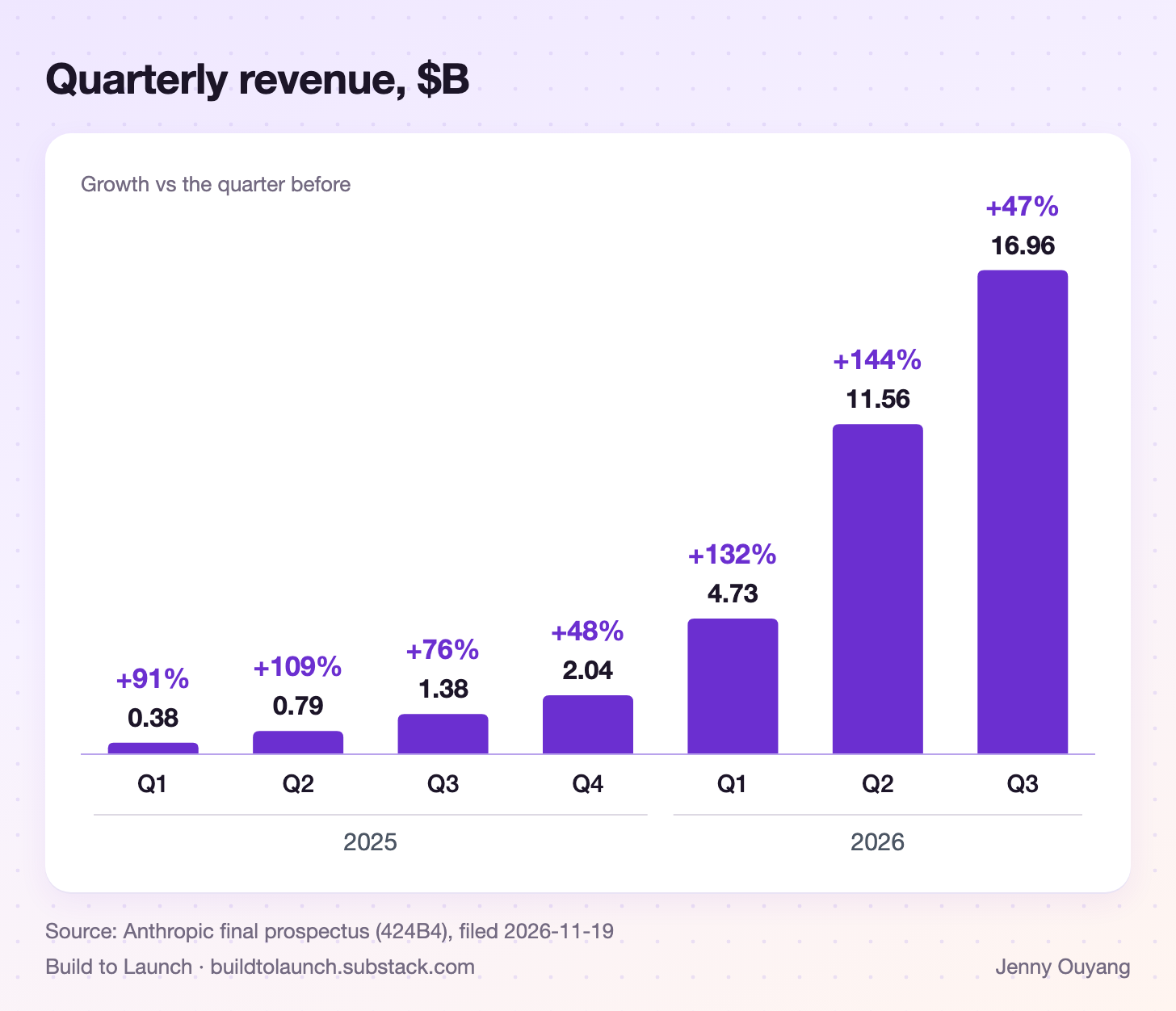
The quarters already show a bumpy path. Growth on the quarter before, from the quarterly tables:
End of 2025: about 48%
First two quarters of 2026: 132%, then 144%
Third quarter of 2026: 47%
One slow quarter does not prove a lasting slowdown yet.
Anthropic grew from $1B to $10B fastest
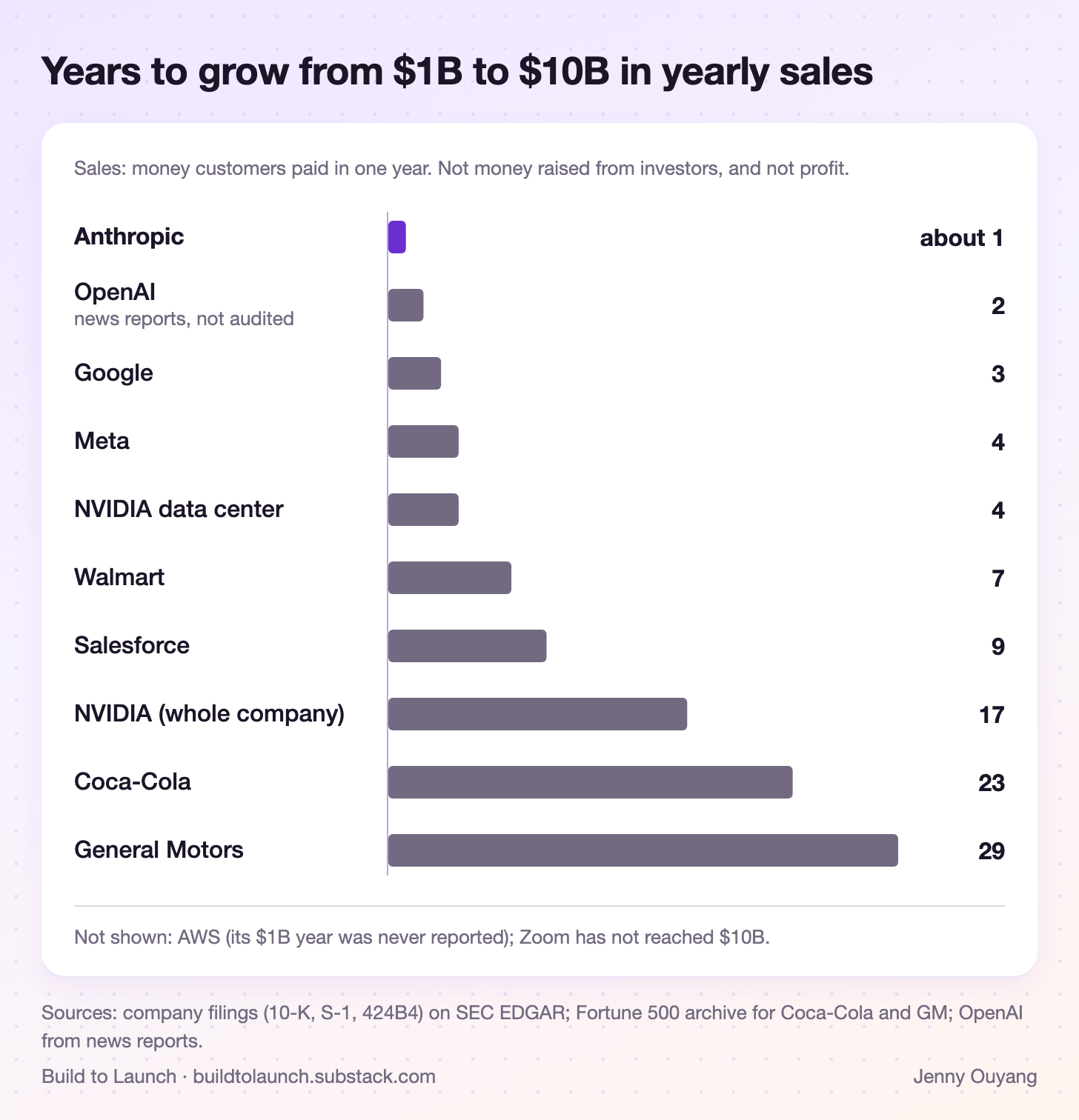
I wanted to see how fast that is next to other companies, so I counted the years each one took to go from $1 billion to $10 billion of yearly sales. Sales here means the money customers paid in a year.
Anthropic took about 1 year. OpenAI took 2, going by news reports, and Google took 3.
At the other end, Coca-Cola took 23 years and General Motors 29. All ten are in the chart.
Fast sales are not profit, though. Google, Meta and Walmart made a profit when they reached $10 billion, and Anthropic still shows a loss. To see why, you have to look at what goes out.
Is the Anthropic IPO a Sign of an AI Bubble?
The income looks real. The risk is the size of the $900.9 billion bill.
A bubble is when a price sits far above what the income behind it can support. I can't tell you whether all of AI is overpriced. What I can do is check one company against its own filing: what goes out, against what comes in.
Each revenue dollar now costs $1.04
Start with one dollar of revenue and follow it through the company's costs, by type, from the filing's expense note (my math).
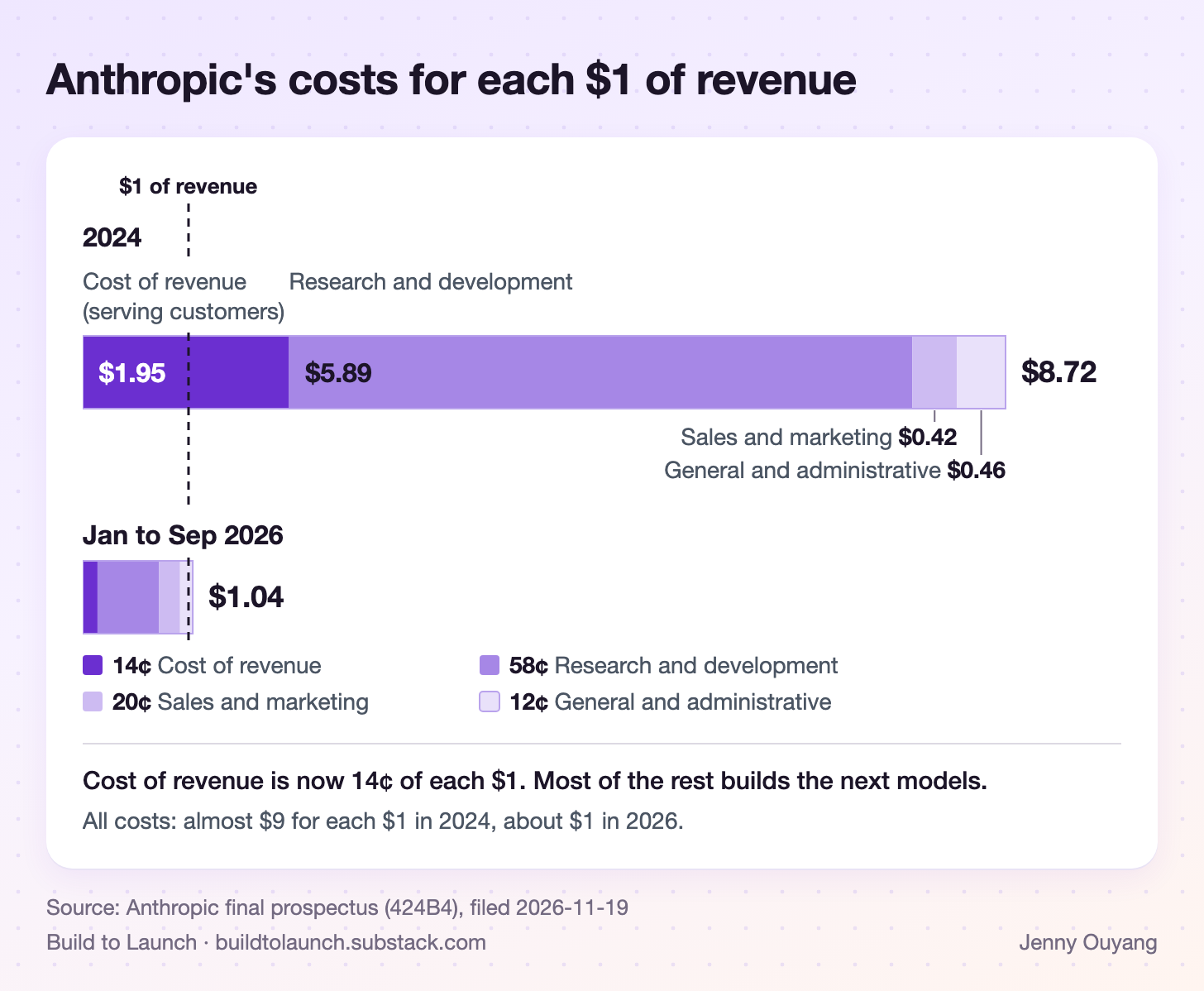
Serving paying customers now costs Anthropic 14 cents of each $1 of revenue, down from $1.95 in 2024 and $0.60 in 2025. Most of the rest goes into building the next models, and that brings the total to $1.04.
That means it still spends a little more than a dollar to earn a dollar. But the drop from $8.72 in 2024 is the number I would watch, more than the $104 billion.
Most of the $1.04 goes to compute of all kinds: about 57 cents. People, stock pay included, take about 15 cents. The filing does not split research into compute and people, so read those two as rough.
The bill is almost seven times the cash
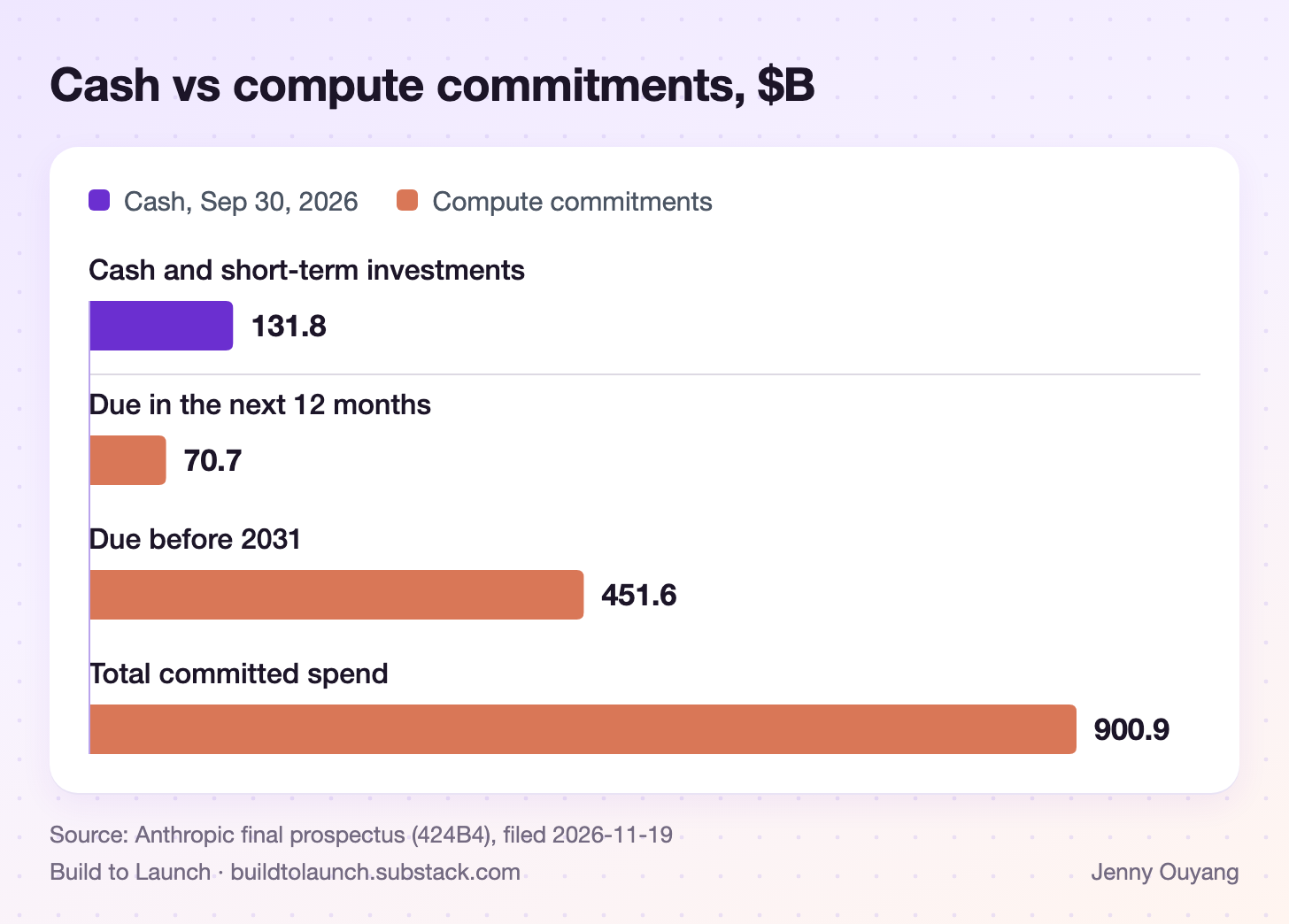
Then there's the bill Anthropic has already signed, and it's on another scale entirely: $900.9 billion of committed spend, "substantially all of which is related to compute and infrastructure."
That is from a company with $33.2 billion of revenue so far this year.
It comes due in three steps:
$70.7 billion in the 12 months after September 30, 2026
$451.6 billion before the end of 2030
The rest from 2031 to 2045
Much of it has to be paid whether the compute gets used or not. The filing talks about "take-or-pay provisions, and other terms that obligate us to pay for resources regardless of actual utilization."
On top of that, there's another $150 billion to $175 billion on deals with no fixed price, and about $186.2 billion that Anthropic can end or owes only under certain conditions.
On September 30, Anthropic held $131.8 billion in cash and short-term investments.
So the cash on hand covers about the first year of payments, and the signed bill runs for decades.
Suppliers who invested also get the orders
The worry you hear most is that the money goes round in a circle. Some of the same companies invest in Anthropic and sell it compute, so investor money comes back to them as orders. The filing has enough numbers to check it.
Eight companies on the supply side also invested: Google, Amazon, NVIDIA, AMD, Broadcom, Micron, Microsoft and TSMC. Together they put in at least $67.3 billion, through notes, funding rounds and the $26.0 billion private placement at the IPO. A private placement is a sale of shares straight to chosen buyers, next to the public offering.
Google put in about $33.3 billion, and Amazon about $18.0 billion.
Only five of the eight have direct supply deals in the filing: Google, Amazon, Microsoft, Broadcom and AMD. NVIDIA, Micron and TSMC sit further up the chain, as chip makers. NVIDIA's chips reach Anthropic through other compute providers.
How much of the $900.9 billion goes back to them comes out as a range (my math):
Google, Amazon and Microsoft, their named minimums: at least $278.5 billion, about 31%
Add Broadcom's equipment leases, if they sit inside the $900.9 billion: about $439.7 billion, about 49%
This part has limits. The filing does not say where Broadcom's leases sit in the total, and part of the three minimums may already be spent.
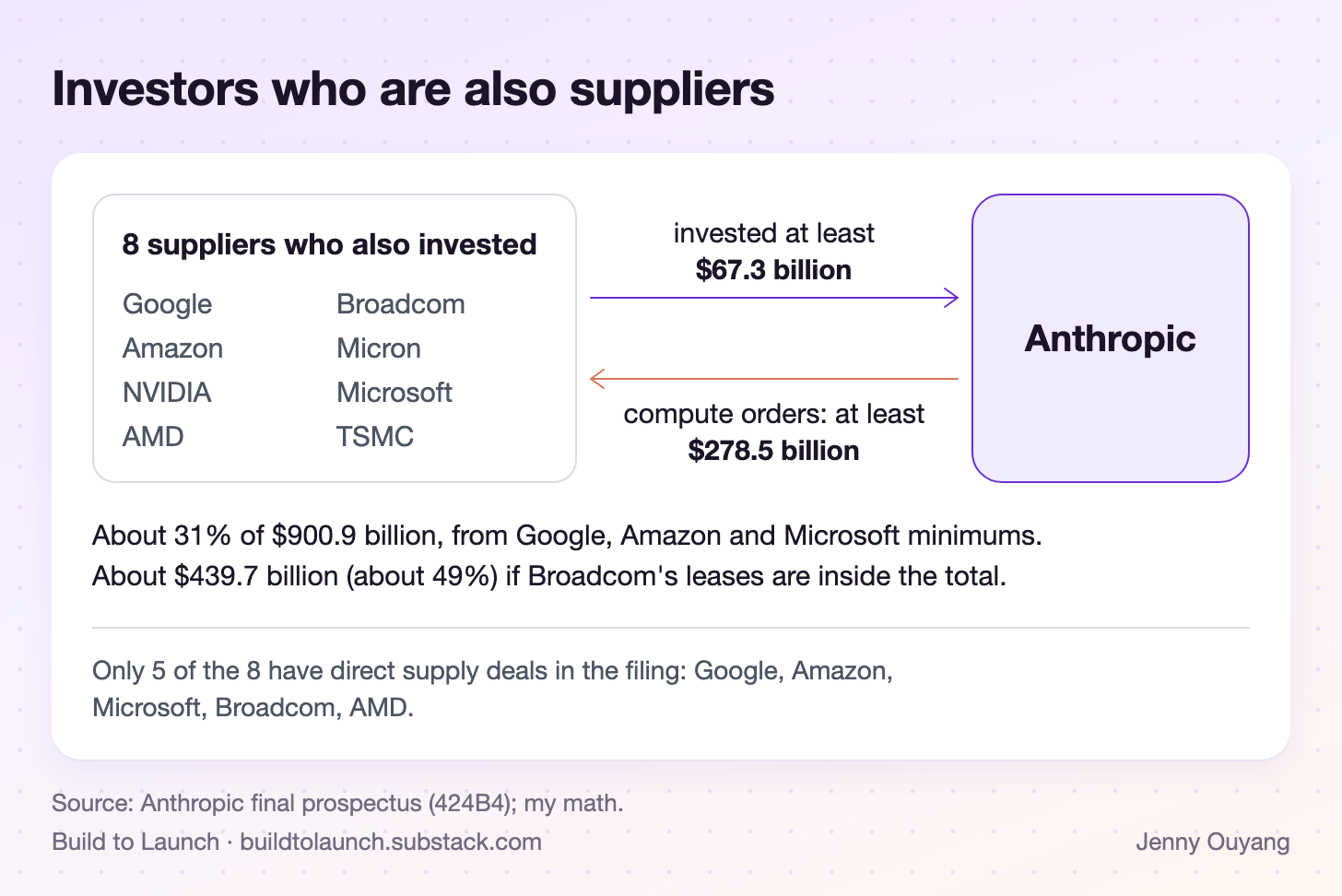
The loop is real. On my numbers, these suppliers are owed several times what they put in. Treat that as the high end, because part of the bill may already be paid. The bill still gets paid the same way: from customer revenue and new money.
Income looks real; the bill is the risk
My read: the income does not look like a bubble. It is real, and each dollar of it now costs about $1.04 to earn, down from $8.72. The risk sits in the size of the signed bill, which only works if revenue keeps growing into it for years.
What I took from the first three questions:
Most of the $104 billion loss is on paper, in two lines. The operating loss was $1.26 billion, and $6.6 billion of cash came in.
Money comes in from customers (79% usage-based) and investors ($110.4 billion this year), and revenue grows fast but unevenly.
A dollar of revenue now costs about a dollar to earn, and much of the $900.9 billion bill ahead must be paid even if the compute sits unused.
Why Is Anthropic Selling Shares Now?
Because the bill is bigger than the bank account.
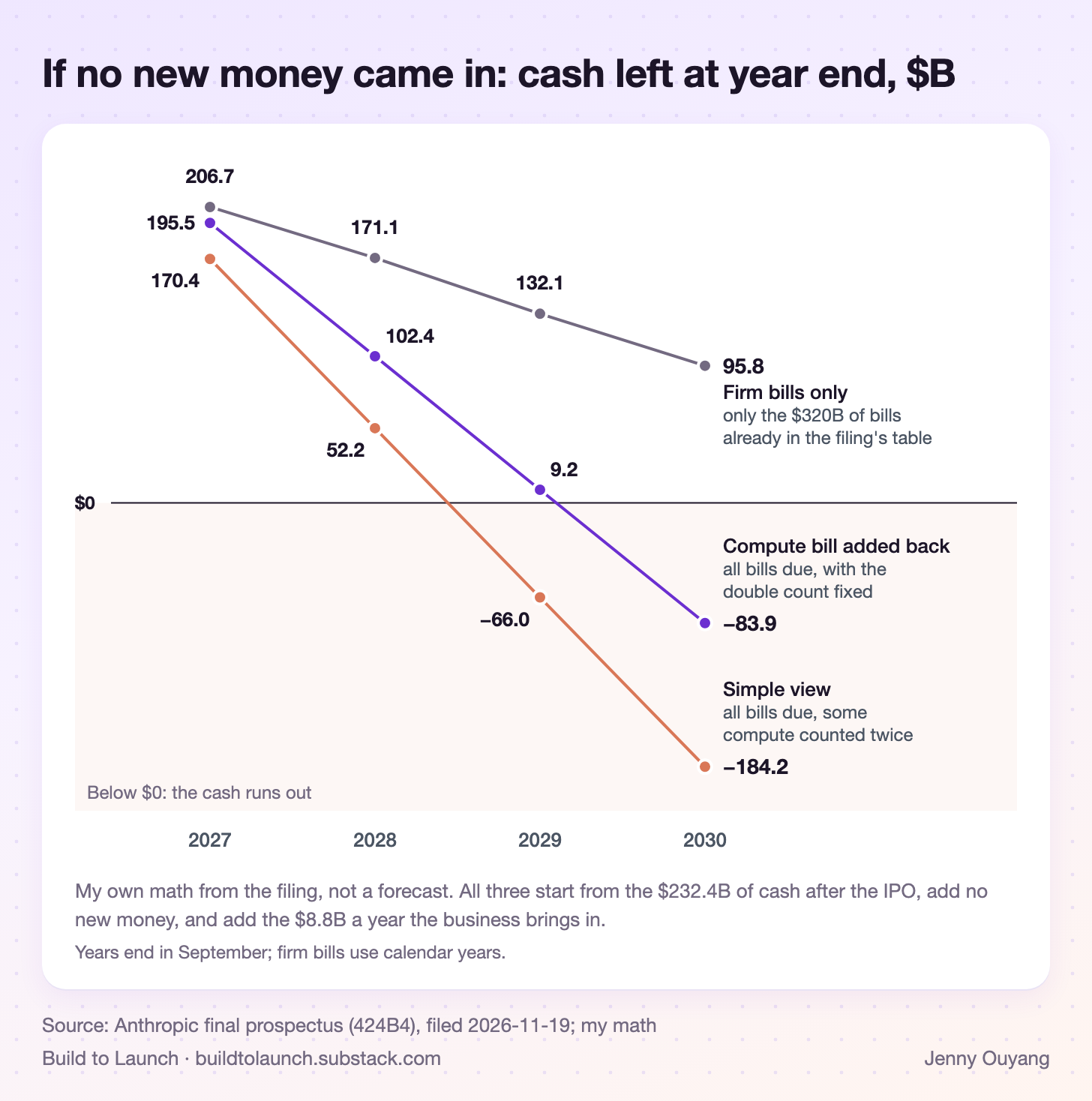
So if no new money came in, how long would the cash last against those bills? It depends on how you count.
In the simplest view, the cash runs out in the year ending September 2029. In the second view, it runs out in 2030. Count only the firm bills, and it lasts past 2030.
The three lines in the chart:
Simple view: every bill as it comes due, which counts some of today's compute twice, because the cash the business brings in already pays for it.
Compute bill added back: the same, with that double count fixed, about $25.1 billion a year.
Firm bills only: just the $320.0 billion in the filing's year-by-year table.
All three start from the $232.4 billion of cash and short-term investments after the IPO, add about $8.8 billion a year from the business, and pay $70.7 billion in the first year and about $127.0 billion in each of the next three. It is my math, not a forecast.
The filing gives no single date either. It only says its cash will cover "at least the next 12 months."
And that's with the IPO money already counted. The first two views still run out.
After fees, the IPO and the side sale to chosen buyers bring in about $104.8 billion. Among the uses, the filing names "investments in compute and infrastructure, as well as hiring and retention of highly skilled personnel." It gives no split.
The share count shows who gets the money. Of the 980,000,000 shares sold at $83, about 97.6% were new shares, so that money goes to Anthropic.
The other 23,648,646 came from the seven co-founders. Each sold 3,378,378 shares. That is about $280 million each, and $2.0 billion together.
Employees get shares too: stock units, shares promised as pay, become theirs on November 19. Anthropic pays the $4.3 billion of tax on them from the IPO money.
Most of the early holders agreed to a lock-up: a promise not to sell shares for a set time after an IPO. For most holders from before the IPO, it lasts up to 180 days. For the co-founders and some holders of more than 0.5% of the shares, it is up to 365 days.
The agreements have exceptions. Up to 315 million shares can be sold from the first trading day.
Buying shares does not buy control. One Class F share, held by a company the seven co-founders own, carries 50.1% of the votes when shareholders vote. A Long-Term Benefit Trust of "financially disinterested trustees" generally picks and removes most of the board.
Before any extra shares, the base IPO came to $81.34 billion. The banks hold a 30-day option to buy up to 147,000,000 more shares.
How Big Is the Anthropic IPO Next to OpenAI and SpaceX?
On one count it is the biggest IPO ever, and on reported numbers it brings in more than OpenAI.
That $81.34 billion is the biggest IPO ever, if you count only the shares sold before the banks take their extra ones. On that same count, SpaceX sold $75 billion. CNBC called SpaceX's deal "by far the largest IPO on record until Anthropic's share sale."
Other counts give other answers. SpaceX raised $85.7 billion in total after its banks used that option, and Anthropic's option is still open. And if you count the IPO plus the private placement, you get $107.3 billion, though a private placement is a separate kind of sale.
Anthropic out-earned OpenAI last quarter
OpenAI's numbers come from a different kind of source: internal documents that the Wall Street Journal reviewed. Forbes says it plainly:
"OpenAI's figures are adjusted numbers from internal documents, while Anthropic's come from a prospectus filed with the Securities and Exchange Commission."
For the same quarter, July to September 2026:
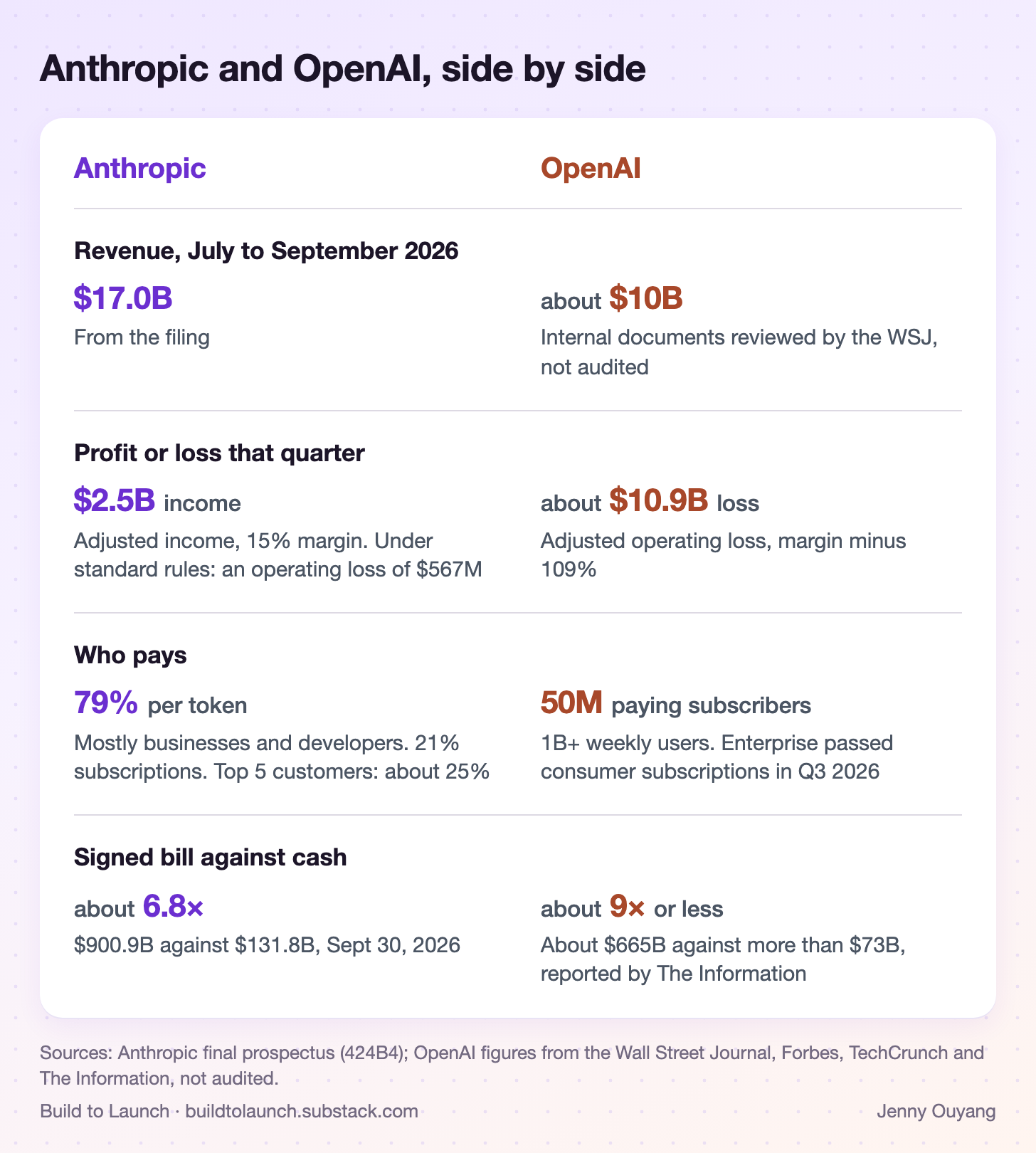
Anthropic: revenue $17.0 billion. Under the standard accounting rules, that was an operating loss of $567 million. On its own adjusted count, it made $2.5 billion, a 15% margin, or 15 cents of profit on each dollar.
OpenAI: revenue about $10 billion, up about 50% on the quarter before, and an adjusted operating loss of about $10.9 billion, a margin of minus 109%, so the loss was bigger than the revenue.
On those numbers, Anthropic brought in about $7 billion more revenue in the quarter. It also showed adjusted income where OpenAI showed an adjusted loss.
Anthropic sells to businesses, OpenAI to everyone
Who pays is different too. Anthropic's filing, for the period up to September 30, 2026, shows mostly businesses and developers.
Over 50% of the Fortune 500 pay it $100K+ a year, and 11,900+ customers pay that much. 79% of its revenue is per token and 21% is subscriptions, with 44% coming through cloud marketplaces.
Its top 5 customers bring in about 25%, none more than 10%, and it gives no user count.
OpenAI's side comes from news reports and company posts.
Businesses are now its largest source, since enterprise passed consumer subscriptions in Q3 2026 (WSJ via Forbes, Nov 11, 2026). It sells consumer subscriptions, business seats and the API, and has ads near a $1B run rate (TNW, Aug 14, 2026).
It has 1B+ weekly users (Forbes, Nov 11, 2026), 50M paying subscribers (TechCrunch, Feb 2026) and 9M+ paying business users (reported by Entrepreneur and others in Feb 2026, not confirmed in OpenAI's own post). How much its biggest customers bring in is not disclosed.
Both owe several times their cash
Then the bill against the bank account. Anthropic's signed commitments are about 6.8 times its cash and short-term investments on September 30, 2026, from its filing. OpenAI's are about 9 times or less: about $665 billion of commitments, as The Information reported in June 2026, against more than $73 billion of cash on March 31, 2026, also from The Information, as quoted by Creeta. None of the OpenAI numbers are audited, so read this as a rough match.
The reports do not split OpenAI's revenue into usage and subscriptions, so the meter-and-gym comparison does not work for OpenAI.
But size alone does not tell you whether $83 was a fair price.
Is Anthropic's $83 Stock Price Too High, and What Should You Watch?
It depends on which year of revenue you count, so four signals tell you more than the price.
During the roadshow, the weeks of investor meetings before an IPO, Anthropic set a range of $70 to $78 a share. Then it priced at $83, above its own range.
On Thursday, the first trade was $111.50. The stock closed at $97.17, up 17.07% on the IPO price.
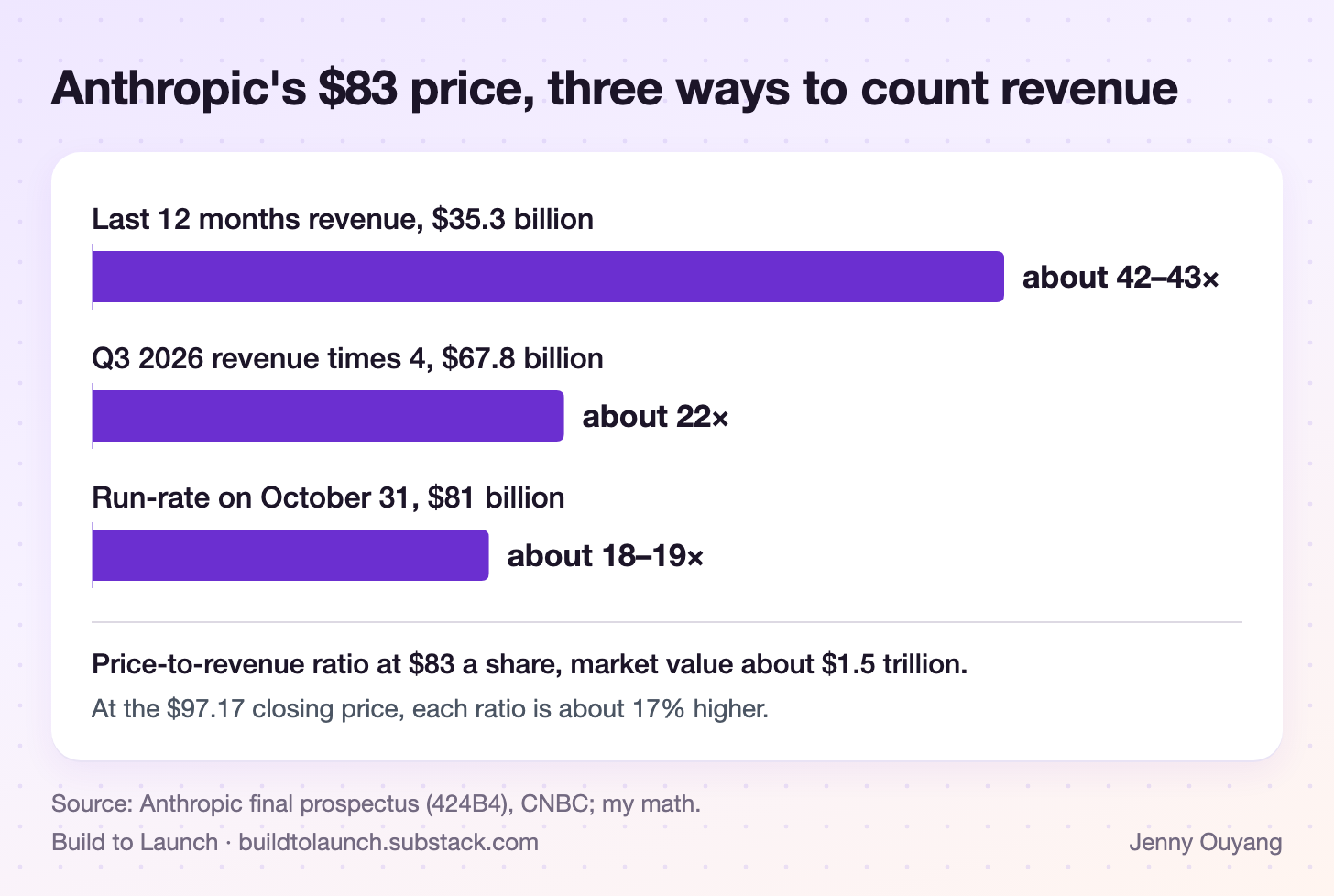
At $83, Anthropic's fully diluted market value was about $1.5 trillion. Fully diluted means it counts every share that options, notes and other rights can turn into.
Is that too high? The usual first check is price-to-revenue: market value divided by one year of revenue. A ratio of 42 means buyers pay about $42 for every $1 the company brings in a year. It depends on which year you count, and there are three ways to count it.
The last 12 months, Q4 2025 plus January to September 2026, filed with the SEC: $35.3 billion of revenue, about 42 to 43 times.
Q3 2026 revenue times 4: $67.8 billion, about 22 times.
The run-rate on October 31: $81 billion, about 18 to 19 times. The run-rate is Anthropic's own measure: the last 28 days of usage fees times 13, plus monthly subscription fees times 12.
All three use $83 and $1.5 trillion. At the closing price, each ratio is about 17% higher.
For comparison, the typical public software company traded at about 4.5 times its yearly recurring revenue in early November, and the ten highest-valued at about 16 times, by Meritech's count.
The first reading looks back over a year, and the last one looks at the most recent month. The gap between them is the growth.
If growth holds, the 42-times reading shrinks fast. If growth slows faster than expected, the 19-times reading looks kinder than it is.
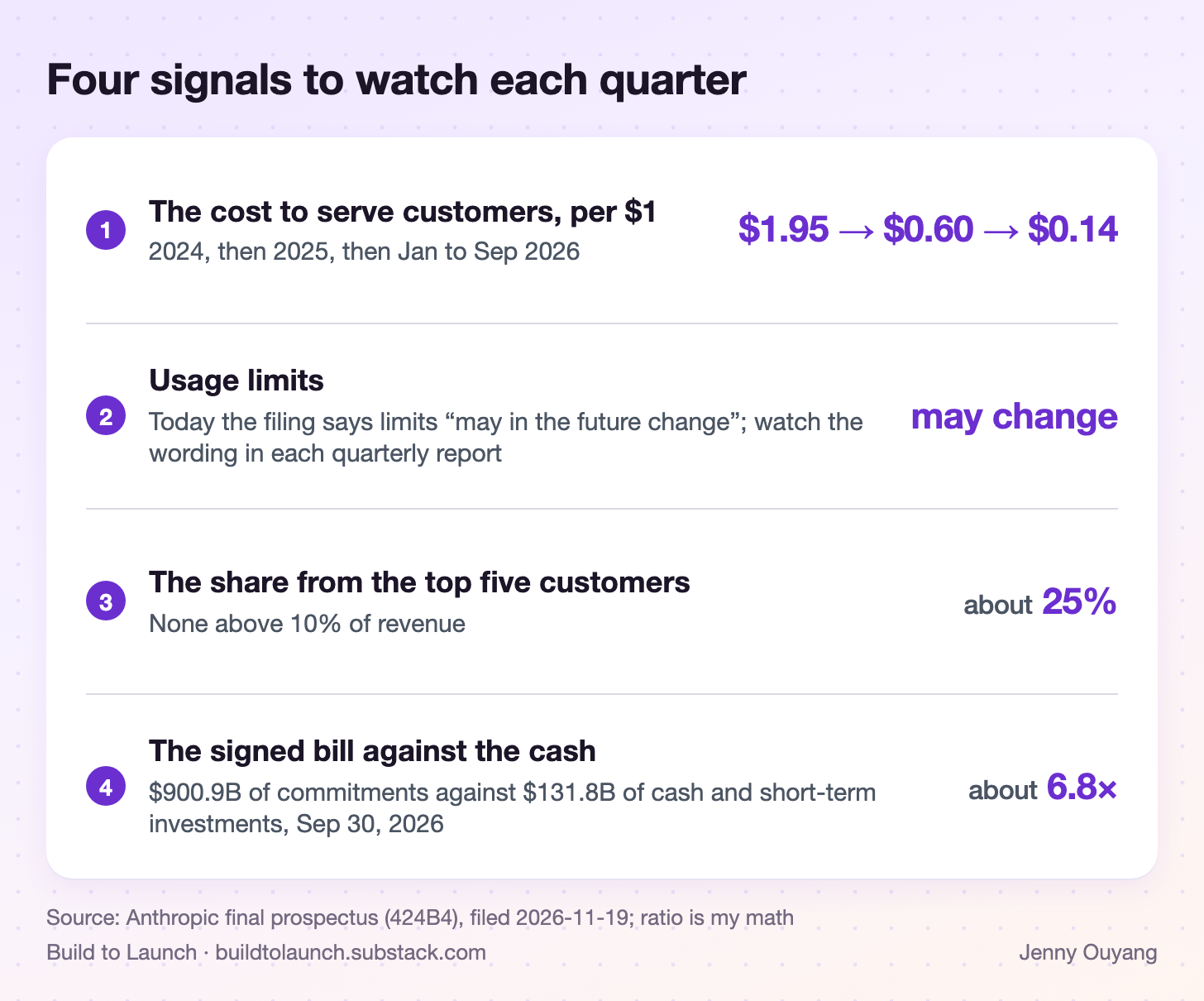
Which reading turns out right depends on the next few quarters. These are the four signals I will check in each quarterly report:
The cost to serve customers, per $1. It is down to $0.14, from $1.95 and then $0.60, as the cost chart shows. If it starts to rise, that pressure lands on prices and limits.
Usage limits. Today the filing says they "may in the future change." This is the line that names your plan, so watch whether that wording changes.
The share from the top five customers. It is about 25% today, with no single customer above 10%. If that share climbs, more of the business rests on a few big buyers.
The signed bill against the cash. Anthropic owes $900.9 billion against $131.8 billion of cash and short-term investments, about 6.8 times. If the next reports show this falling, the bill is getting easier to carry.
The first two signals matter for your Claude plan, whether or not you care about the stock. You can check both in a public report every three months.
What Changes for You as a Claude User, Builder or Worker?
Mostly good news for your plan, and one thing to plan around: limits.
So, back to that Reddit question. Will Claude get worse now? I found no sign of that in the filing. What it does say about the things you pay for is more useful.
Usage limits can move
This is the one to plan around. The filing says it plainly:
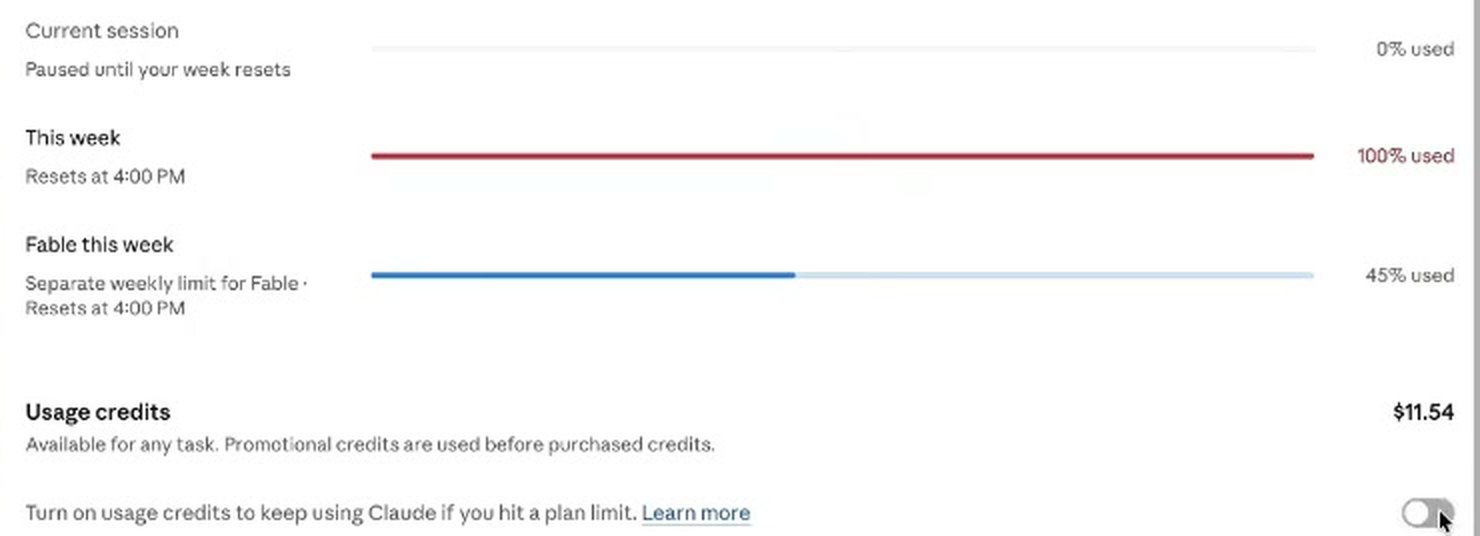
"We have also changed, and may in the future change, usage limits, rate limits, or model and product capabilities, which could adversely affect our reputation and the perceived value of our offerings."
On a Pro or Max plan, you are on the gym side: you pay the same every month, so when heavy use costs more, the limits are what move. I hit that wall on day one of my Claude automation sprint in September. My weekly limit was already used up, and my scheduled jobs did not run.
Prices may come down, and each task gets cheaper
The filing says "we may reduce the prices we charge for our models," and it names open-weight models, ones anyone can download and run, as a source of "pricing pressure on our offerings." It says nothing about Pro or Max plan prices.
Each task is already getting cheaper. Opus 5.5 does the same work for about 40% less than Opus 5, so the plan you pay for stretches further with each new model.
Older models may stay around longer
Anthropic writes that safety and welfare reasons "may lead us to limit or delay the deprecation of older models." So a workflow you built on one model is less likely to break the week a new one comes out. No version is promised, though, which is why my own setup is built to move between models.
Make your setup yours, so it moves with you
Claude already writes over 90% of the contributions to Anthropic's own codebase as of September 2026, and its engineers direct and review. That is where your work is going too, and the part that stays yours is how you set Claude up.
My skills and project instructions live in files I own, so they come with me between plans, models and tools.
The $104 billion loss is mostly paper. The cash is real, and so is your chance to get good at this while it is still early.
A note on how I made this piece. The Build to Launch MCP ran 17 live research tools inside Claude, across 12 platforms from Reddit and TikTok to Google search data, and Claude sorted 57 raw questions into 16 groups and ranked them. I picked the 7 chapters from that list, and the same tools are there for your own topic.
Where do you think Claude goes from here?
— Jenny