Build to Exit Strategy: How He's Teaching Builders to Sell Before they Build
Build to Launch Friday: Meet Josh, the digital business builder who shows no-code founders how to validate fast, build smart, and exit before burnout
Welcome to Build to Launch Fridays, where we meet the builders turning domain expertise into AI-powered products.
Every Friday, I’m spotlighting someone from the vibe coding builders collection who’s doing exactly what I believe is the future: using AI not as just another tool, but as a true collaborator to transform curiosity, passion, and years of professional knowledge into something scalable and ownable. No VC funding, no technical co-founders, no permission required, just domain experts who decided to build.
Today, meet — a digital business builder who’s spent years watching good ideas die in founders’ backlogs, and decided to do something radical: teach them to exit early, before the burnout hits.

What do you do when you’ve built something, validated it, but realize your heart’s already pulled toward the next idea? Most builders let projects die in a digital graveyard. Josh Davis built a marketplace instead.
With 15+ years winding through graphic design, web development, digital marketing, and startup investing, Josh has seen the pattern: founders burn out before they finish, or finish and then don’t know what to do with what they’ve built. His answer? Build to exit from day one. Don’t let your project die, position it to sell, even at $0 revenue.
Through No-Code Exits and ZeroAcquire, Josh helps solo creators and small teams validate offers fast, productize, and exit using no-code, AI, and creative financing. He’s documented founders selling pre-revenue directories, quiz games, and AI apps for hundreds to thousands of dollars. His community showcases 100+ builders with nearly $5M in monthly recurring revenue, featuring success stories from makers like John Rush.
The philosophy is simple but radical: if you build as if you’re going to sell it, you create better positioning, clearer value props, and actual momentum, even if you never exit. And if you do decide to move on? There’s a buyer waiting.
The Origin Story
Can you tell me a bit about your background and expertise?
I’m Joshua Davis, a digital business builder and investor. I specialize in helping solo creators and small teams validate offers fast, productize, and exit using no-code, AI, and creative financing.
My path kinda went like this: graphic designer → web designer → web developer → digital marketer → investing in websites and digital products. I worked both for small and large companies and myself throughout my journey so far.
In reality it looks more like this:
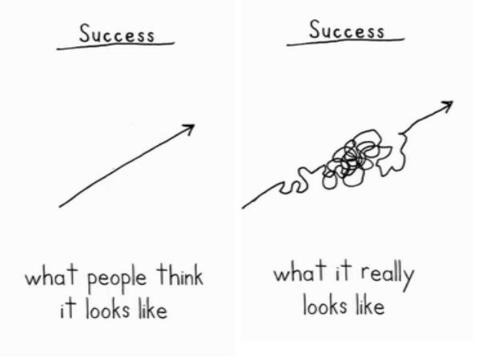
Yes, now I am starting to feel the same kind of path. The builder’s journey isn’t linear, it’s iterative, experimental, and full of redirects.
How did you get into startup investing, and how does your work as an investor function day to day?
I started by getting interested in Flippa and buying some small websites (spoiler alert: most small sites are scams). I learned a lot about how easy it is to fake traffic, users, links, and more. This created a stronger due diligence process and I started seeking out deals off-market that I was interested in.
Today it’s a mix of buying small projects in the AI / No-Code space and connecting other buyers and sellers.
Day to day I look through tons of listings and of course use AI to sort through a lot to fit my investing criteria.
Wow, this is wild to think about. Yes, it’s so easy to fake traffic, users, and links. But I honestly don’t know how you’re able to tell whether they’re fake or not. And that is kind of why I wanted to onboard everyone in Vibe Coding Builders, reach out to them, ask if they wanted to join the Build to Launch Friday series, and actually tell their stories.
You have two projects listed in Vibe Coding Builders — **No Code Exits** and **ZeroAcquire**. What’s the main idea behind them?
No-Code Exits aims to help people get started in no-code and finally launch their idea with a focus on building to exit. It’s much easier if you build your no-code project as if you were going to sell it rather than going back and doing a ton of work getting it ready to sell.
Very small projects and even just ideas can be sold. The most important part is positioning and providing value to the end user AND buyer. If the buyer can see potential they may buy the project with $0 revenue and / or 0 users. Which has been documented a few times on No-Code Exits.
If you’ve validated your idea and already have users, you may be able to exit your project before it’s built out. A proven idea even in its early stage can be valuable to other founders or companies.
Examples Josh shared:
Since I started my AI building journey, my mindset has been refreshed multiple times, and now you’ve refreshed my mindset again about how much and how easily things can be sold on just the idea alone, and how projects can be acquired even at the earliest stages.
Inside No Code Exits
What is the mission of No Code Exit?
No-Code Exits helps makers validate, build, and sell micro-startups fast.
Anyone curious about the details? I am definitely hooked.
What first catches my eye is the seven-day challenge. How does it work?
It’s pretty simple. It’s a free step-by-step guide to launch an idea in 7 days. A lot of people buy courses and don’t even get the idea out there. This doesn’t go into actually using the no-code tools or building it out which most people are not ready for.
It gets your idea out there and ready to be validated before you build.
That’s exactly the point. Don’t build until you validate.
How many people have joined or completed the challenge so far?
It’s brand new and still in beta testing so it’s only been announced in one post and only has a few people. Most courses (even paid) only 5% - 15% of people complete them or have success. I’m working on changing that by creating a series of small easy wins.
Yeah, I’ve attended a lot of courses myself, paid and free, and I do see that most people don’t really complete them (me sometimes). That completion problem is real, and it’s discouraging.
The community shows 100+ builders, 78 projects, and nearly $5M MRR—that’s huge! How did that growth happen? How did you help them?
The No-Code Exits is still a work in progress. Most of the $5M MRR is from a handful of featured guests on the platform that are making $1M+ per year. I’m still working on it and have created a separate success stories page where only the featured founders are listed.
I see it now. It’s just like how I invited and Marc Lou to Vibe Coding Builders — featuring the big wins to show what’s possible.
Who are the types of builders in your community—are they technical, non-technical, or already experienced with exits?
Almost all started out as non-technical. There are only a few that learned to code, most never learned to code and validated their idea and then built a team or used AI.
That’s actually a signal of the raw demand from people who hope to get started but just don’t really know where or how to start. And that’s exactly why platforms like this will be helpful.
I saw well-known names like John Rush. How do those big players fit into the community?
John Rush has been featured on the newsletter twice and I hope to gather more insights from him. The man is an animal with all the projects he works on at once.
Yes, I follow John Rush and his guidance and principles are wild. That level of productivity is inspiring.
You have pages like Submit a Course and a Partners tab. How do those partnerships work?
Partnerships are joint ventures. The main idea is a list swap. You provide something valuable to the No-Code Exits audience and No-Code Exits provides something valuable to your audience. They don’t have to be in the No-Code space. For example sales, negotiation, marketing all cross over and can be applied to building a No-Code product.
Genius. Now I see it. It’s how you work, you’re so helpful in offering promotion to others’ works, and that benefits every side because we have different audiences and you help others find the right people.
The Build-to-Exit Philosophy
What does “exit” mean to you? What are the most common ways people exit (selling, transferring, etc.)?
An exit is just removing yourself from the project. It doesn’t have to be for a dollar price even though this is the most common. Any time you hand a project off to someone else it’s an exit.
This is definitely a new term learned. I love how it reframes the entire concept—you’re not failing if you hand something off, you’re successfully exiting.
Who typically acquires these projects—individuals, startups, or bigger companies?
The deals vary. Smaller projects can be acquired by individuals and in several instances bigger companies bought a small tool and integrated it with their existing software / services.
I’ve encountered this several times in the ecosystem, but it feels so distant to me. It’s good to hear concrete examples that make it feel real.
What’s the fastest exit story you’ve seen? And what’s the average exit timeline?
It’s hard to say because some took a long time to launch and only put a few hours into it and others put full days into it and launched in weeks. I would say Hazel Lim was the fastest by creating a project with ChatGPT that she sold for $500 in 2 weeks from start to finish.
Wow! Creating a project with ChatGPT and you can already sell it for $500? That completely changes what’s possible for someone just getting started.
Since the launch in 2023 (and Product Hunt #3 ranking, wow!), how has the platform evolved? What’s the activity and vibe like today?
In 2023 AI was just getting started and AI can do a lot more today. I’m working on bringing in experts, guests, and collaborators that can continue to keep the community updated with the latest in AI and No-Code.
Yes, I agree. Even for today, it’s still so early in the stage for AI adoption. We’re all early adopters figuring this out together.
ZeroAcquire: The Marketplace
When did you build ZeroAcquire?
Still a work in progress.
How many people have you helped through this platform so far?
1 on 1 deals at this time (deals can take 6 months - years). I’m working on making this faster! That’s part of the reason I created it. It’s not going to be easy!
Yeah, it’s really hard. Deals I can imagine take a very long time. That’s why you probably have to work in parallel on many deals at once.
How do you even know who wants to buy what product, and why?
There are investors that have specific criteria to buy products. That’s why it’s so important to educate those building with No-Code to position their products as if they were to sell them, because they can and there are investors out there looking to buy.
This really reminds me of sales principles. You just gotta find your customer. Anything is sellable, but the medium to connect you with your customer becomes so important. You’re building that medium.
You also have **partner programs** listed here—are those the same partners as No Code Exit, or different?
These are different and aimed at affiliates, brokers, and investors. Basically those that want to help grow the platform for a piece of the action on deals.
I can’t believe it; Joshua is just so full of ideas and creative about partnering and working together with people.
How do partnerships generally work across your projects?
They were done through traditional affiliate programs or custom joint venture deals. Now I’m exploring using a new platform called OfferLab where you can connect and collaborate directly with me on any project.
Ah, yes, I need to go onto this platform and explore it more. I was trying to join but life has constantly been stepping in the way. Adding this to my list.
Tech & Building Process
How did you build the **No Code Exit** website? Which technology stack did you use?
The frontend is Lovable and backend is Supabase but all the code is actually on GitHub and other changes are made with a combination of several other LLM’s and IDE’s. My business partner is a developer and has created a proprietary AI Developer Agent system. This is producing cleaner, faster and better coding experience.
It will be launching soon. If you want on the waitlist go here: https://tally.so/r/nGWyqz
Same for **ZeroAcquire** — how did you build it?
All the projects are going to use my business partner’s proprietary AI LLM system. However the frontend was created initially with Lovable and backend with Supabase.
The consistency in your tech stack (Lovable + Supabase) shows you've found a workflow that works. Smart to standardize so you can move faster on new ideas. For more on keeping build costs low, see my cost-effective AI building guide.
Why Build to Exit Matters
Why focus on helping people build to MVP and then exit?
When people are just starting they need to get their ideas out there to get momentum. And then when they build something they may decide to move onto a different idea and instead of letting it die they can exit and give it to another person to grow.
This is such a healthy mindset shift. Your project doesn't have to be your life's work. It can be a stepping stone, a learning experience, or a handoff to someone who's a better fit to take it further. It reminds me of Kenny's approach — building fast, shipping, and moving to the next thing.
What does the **“[build to exit](https://nocodeexits.substack.com/p/most-of-you-are-stuck-with-ideas)”** landscape look like, and why do you believe it’s important?
I’ve seen a lot of good ideas die for a lot of different reasons but the ones that are preventable are the most frustrating:
Lack of validation
Lack of marketing or wrong marketing message
Wrong positioning / not knowing your audience
These three are so critical. And the “build to exit” mindset forces you to think about all three from day one because a buyer will ask those exact questions.
Why do people want to buy MVPs or early projects? What’s the value for buyers?
Early entry, early validation, and momentum. These are actually incredibly hard (which makes them valuable) and even large companies will pay for small projects with solid momentum.
With AI *almost anyone can code and get their idea out there. But how you do it is just as important.
When a project already has paying users the asking price is much higher. A project with $1,000 MRR can go for $60,000 or more. $1,000 x 12 months x 5x valuation. Most AI projects are going for 10x valuation right now.
These are the solid numbers I’ve read elsewhere, but hearing the complete story behind the scenes—the ideas, the concept, and the wisdom—is really helpful. It makes the numbers real and shows the logic behind valuations.
What advice would you give to someone building in AI today if their end goal might be an exit?
Start with a problem you have or that you see a large audience have and focus on providing the simplest solution to validate it. I go into more depth in the Free 7 day challenge.
Isn’t that nice? That sounds really practical and actionable. Follow Josh and join his seven-day challenge if you’re thinking about building with exit in mind.
What Strikes Me About Josh’s Journey
Here’s what hit me hardest about Josh’s story: he’s teaching builders to think like investors from day one.
Most of us build because we fall in love with solving a problem. We code late into the night, refine features, dream about scale, and then life happens. A new job, a new idea, burnout, a pivot. The project dies in our GitHub archive, half-finished, validated by nobody.
Josh’s “build to exit” philosophy flips that script. Instead of building until you burn out, you build as if you’re selling it tomorrow. That mindset shift changes everything: your positioning gets clearer, your validation happens faster, your value prop becomes concrete. You think about who your buyer is (whether that’s a user or an acquirer) from line one of code.
And here’s the magic: even if you never sell, you’ve built something better. You’ve created clear documentation, proven demand, structured your code for handoff, and positioned your product for growth. Those are the exact ingredients that make a project successful whether you keep it or exit it. If you’re building with exit in mind, my smoke testing guide can help ensure your handoff is clean.
Josh saw the pattern—good ideas dying preventable deaths—and built the infrastructure to save them. His $500-in-2-weeks story with Hazel Lim isn’t just inspiring; it’s proof that momentum matters more than perfection. His examples of pre-revenue exits show that validation trumps features. His emphasis on positioning reveals that clarity beats complexity.
If Josh’s approach to turning MVPs into sellable assets resonates with you, connect with him. He’s exactly the kind of strategic thinker worth knowing, someone who sees opportunities where others see abandoned repos.
[ No-Code Exits
Join 13,895+ using AI and No-Code to go from 0 to $ by Learning Every Week from Real Founder Success Stories.
](https://nocodeexits.substack.com?utm_source=substack&utm_campaign=publication_embed&utm_medium=web)
If you’re turning your expertise into products, building with AI, or helping others do the same, you belong here. Join the vibe coding builders community and get featured on Build to Launch Friday. Curious why it all started? Here’s the full story behind Vibe Coding Builders.
Your turn:
Have you ever built something you were proud of, but eventually abandoned? What if you’d positioned it to sell instead of letting it die?
Josh went from buying scam sites on Flippa to building a marketplace where validated ideas find new owners. What will your exit strategy be?
— Jenny
What’s New in Vibe Coding Builders:
writing g8n joined with StackCoach AI, uPoll.live
writing robopulp joined with Plot Buddy
added his new fav Substack Wrapped (stay tuned for his Build to Launch Friday session in 3 weeks!)
Have an exit story or considering building your next project with sale in mind? Share it in the comments, I’d love to hear how the “build to exit” mindset is reshaping your approach.