Fighting Content Slop: How She Turned Marketing Frustration Into a 400+ User Strategic Content Platform
Build to Launch Friday: Meet Mia, the strategic marketer who built the anti-slop tool the internet actually approves
Welcome to Build to Launch Fridays, where we meet the builders turning domain expertise into AI-powered products.
Every Friday, I’m spotlighting someone from the vibe coding builders collection who’s doing exactly what I believe is the future: using AI not as just another tool, but as a true collaborator to transform curiosity, passion, and years of professional knowledge into something scalable and ownable. No VC funding, no technical co-founders, no permission required, just domain experts who decided to build.
Today, meet — the strategic marketer who spent over a decade wrestling with the fundamental problem of internet content and decided to build the solution herself.
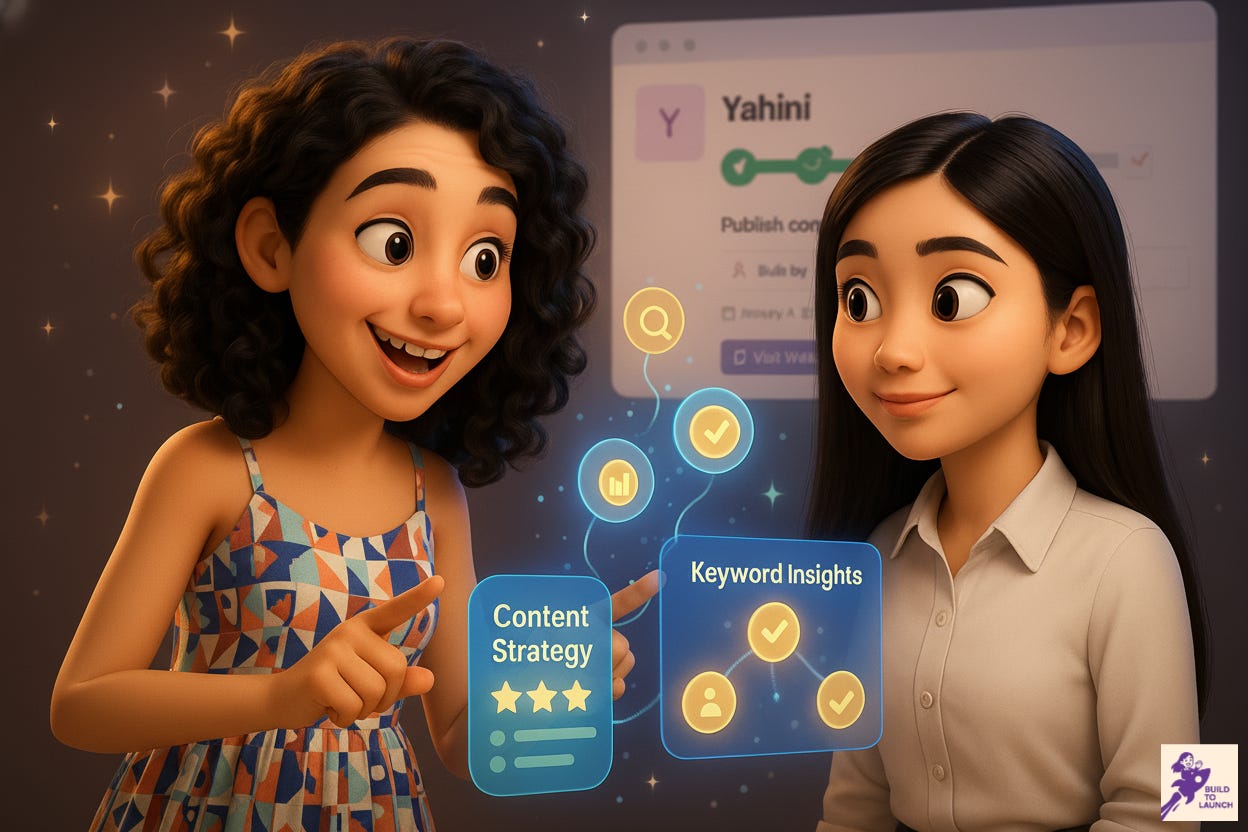
Ever feel like you’re drowning in a sea of formulaic, soulless content that passes for marketing these days?
That’s exactly what Mia sees it! Being a marketer with three degrees (Film, Marketing, and Security & Diplomacy — I wonder how she even managed it!), she spent over a decade running a successful boutique content agency. But success wasn’t enough when she watched the internet fill with what she calls “slop” — beautifully written but utterly useless content that’s making us all dumber.
Instead of complaining, she built Yahini, a strategic content platform designed to force both humans and AI to think more deeply. With her husband as co-founder (who taught himself to code from scratch), they’ve created something that goes beyond typical AI content tools - it’s a system that understands strategy, nuance, and strong points of view. The result? Over 400 users, a 17% free-to-paid conversion rate, and a tool that’s actively reducing online slop one strategic content brief at a time.
Background & Strategic Foundation
Can you tell us a bit about your background? How many years of expertise do you have in this space?
I’ve been in marketing for over a decade, but I’ve never been one to follow a straight path 🙂 My journey has been more of a weird cocktail. I have three degrees - in Film, Marketing, and Security & Diplomacy and each one gives me a ridiculously unique lens on what I do: great communication that’s about narrative and structure (which is why I believe prompt engineering is basically just screenwriting in disguise :D), a strategic “spine” for creative instincts, and great skills for analyzing incredibly complex systems, which is exactly what AI is.
I agree that prompt engineering and screenwriting are fundamentally the same. Since both are about crafting precise language to elicit specific responses and emotions. In fact, as AI evolves, nearly everything utilizing it comes down to prompt engineering — whether you’re coding, designing, or generating ideas.
Before creating Yahini, what were you doing?
I used to run a boutique content agency. We were super successful - had great clients, did interesting work. But I was also deeply frustrated. The agency became my personal way of wrestling with the fundamental problem of the internet (and AI): a sheer volume of soulless, formulaic slop that passes for content. Yahini started as our internal tool to help us think more strategically and creatively. It was my way of building the tool I wish existed - something that understood strategy, nuance, and strong POV.
I wish I knew her before I started my online “business”...
What led you to create this product?
I was tired of the marketing world’s obsession with shallow fluff over actual substance. To me, a beautifully written but utterly useless piece of content is a far greater sin than a brilliant but clunky one. The internet is drowning in it, and I believe we’re all getting dumber because of it. So together with my husband (and co-founder), we decided to build a tool that forces you to use your brain, your own perspective. It’s a strategic content platform designed to help you and your AI think more deeply.
LOL. Yes, I encounter those beautiful but useless pieces all the time. But to be fair, they are not THAT useless. It’s just when people realize there is no soul behind this beautiful piece, they just naturally feel disconnected.
And what are you working on right now, alongside this?
I also write my newsletter, ROBOTS ATE MY HOMEWORK. It’s where I share my unfiltered thoughts and teach people how to use these new tools with intelligence and a bit of artistic flair 🙂 I also build specialized AI agents that help with marketing.
Love the newsletter name!
I’m curious — how did you come up with the name Yahini? Is there a story behind it?
Tons of fun brainstorming sessions, but it’s just a play word on Tahini!
Simple and memorable — I really should work on it, my apps always fall onto several-word names like QuickViralNotes, SubstackExplorer, VibeCodingBuilders...
Building the Product
Yahini feels like a full-fledged product — how long did it take you to build?
It’s funny, in the AI world, everything feels like it’s built overnight. We spent about 10 intense months on the first version. My co-founder taught himself to code from scratch right before vibe coding became a thing. Now, even though we’re not fully vibe-coded, we absolutely use AI in our dev process.
Ten months is significant time investment, shows they were serious about building something substantial, not just a quick AI wrapper.
What coding tools, frameworks, or platforms did you use?
We’re running a modern, serverless-first stack that’s built for speed (and sanity, LOL). The main components are VSCode with Kilo for development, Cloudflare Workers for our serverless functions, and Supabase for our database and backend services. The front end is a mix of Remix and React + Vite.
Love these tech choices. Serverless for cost control, modern React stack for performance. They clearly thought this through strategically.
What technical issues did you run into, and how did you resolve them?
Tons of bugs at the beginning, both in terms of code, and in training the AI! Our biggest challenge was a fundamental tension in building an AI product: performance vs. cost. We had to figure out how to deliver near-instant insights without our server costs spiraling, which would force us to charge absurd prices. This is what led us down the serverless route with Cloudflare Workers. It gave us the ability to scale on demand, manage costs, and ensure the user experience was fast and fluid.
This is exactly the kind of real-world problem solving that separates builders from casual projects. We really have to think about business sustainability from day one.
It’s rare to see a newly built, vibe-coded site also provide an API. How did you manage to set that up, and why do you think people might need it?
I love that you noticed that, because it’s not an accident. We put a tremendous amount of effort into building a flexible backend architecture for Yahini itself. When you build the foundation that way, exposing it as an API becomes a natural next step. We also used a fantastic tool called Unkey that made the practical implementation (managing keys, analytics) incredibly smooth. As for why people need it? It comes back to one of my core philosophies: I hate one-size-fits-all playbooks. A good portion of our user base want to integrate Yahini into their own workflows. The API is for them.
This is sooo brilliant! When I use a service, I often think about integrating it to n8n workflow or Claude custom mcp. This building for flexibility from the start is a hard decision to make, but rewarding down the road. Truly respect their thoughtfulness on taking this step.
I noticed when I tried competitor or Substack URLs, Yahini gave me an error. Does Yahini only accept certain types of URLs? Which ones work best for people to submit?
Yahini is designed to analyze business websites and professional online presences that have a distinct brand. We block generic, non-custom-domain WordPress sites, Shopify templates, and similar platforms for a very simple reason: we are actively protecting users from getting bad results. Being a newsletter platform itself, we also blocked Substack as Yahini doesn’t create content strategies for newsletters, but for blogs.
Now this intentional limitation makes sense, and they’d rather do one thing excellently than everything poorly.
Traction & Community
You’ve got strong testimonials from credible sources — how did you get those? Did they bring you customers?
We’re systematic about getting reviews. We personally reach out to our most dedicated users, and we also encourage reviews on platforms like G2 by offering a small thank you, like a free project credit. Getting people to write a review is INCREDIBLY difficult, but it’s a fight worth fighting. We didn’t yet get customers through these platforms, but it builds a lot of credibility.
I take their word for that. I never really asked for testimonials, partly because I felt intimidated to do so. But I seriously should start doing that!
Did launching on Product Hunt or other platforms bring in actual users?
Nope! We got a massive spike in visibility and great media coverage, but no paying customers. I see those platforms for what they are: a stage for performance, not a marketplace for committed users. We got exactly what we wanted out of it, but I would never confuse that initial hype with building a real customer base.
Such refreshing honesty about Product Hunt! I believed the same, and thus never bothered with listing on Product Hunt. Too many builders chase vanity metrics there instead of real business results.
Do you have active users right now? How many are paid vs free?
We currently have over 400 users, and growing. It’s a mix of early beta supporters, lifetime users, and a growing number of monthly and yearly subscribers. We’re not a freemium product. You can test the platform but it doesn’t have a free version. The model works perfectly for us: our free-to-paid conversion rate is around 17%.
17% conversion rate is incredibly strong! And I respect the no-freemium approach, it forces them to deliver real value immediately.
How’s growth going so far?
Steady, strong, and intentional :). We’re bootstrapped and investing across paid ads, organic content, and a lot of collabs and partnerships.
Great! Sounds like we fall into this organic content / collabs zone :)
Content & Expertise
Yahini also has a lot of valuable content on AI, content strategy, and keyword research. How much effort did it take to produce all that?
Content is about 30% of our marketing focus, but honestly, that number is misleading because we have an unfair advantage: we use Yahini itself to build most of our content. Everything from our articles on AI strategy to our keyword research is born from our own tool, which lets us move with incredible speed and strategic depth. We’ve systematized this process across all our channels, so our content engine is a well-oiled machine. We’ve been having some issues on the technical SEO side but once we solve those, I expect organic traffic to spike.
This reminds me of the fact that 90% of Claude Code is written by Claude Code. The meta-level genius of this approach!
How much of your domain expertise did you distill into the product itself?
You could say about 90% of my domain expertise is baked directly into Yahini, and you wouldn’t be far off. We trained the AI, fed it the strategic playbooks, narrative frameworks, and the deep understanding of content we’ve spend over a decade developing. And this wasn’t built in a vacuum - we worked with other top-tier content specialists to enrich the AI’s knowledge.
Now it is the power of domain expertise, she didn’t just build a tool, she built her brain into the tool.
Beyond Yahini, how else do you help people achieve success with your expertise?
My focus is for now entirely on Yahini and scaling it, so I haven’t taken on a one-on-one client in about 2 years. That said, the teacher in me is very much alive and well :D I love to teach people to think and write with more clarity and impact, to find their unique voice.. I channel almost all of that energy now into my newsletter.
Competition & Differentiation
On G2, SEMrush is listed as a competitor. What’s Yahini’s unfair advantage compared to SEMrush?
That’s a fun one cause SEMrush is definitely not a direct competitor, they’re a huge SEO platform, while we’re a content strategy tool. Our real competitor isn’t a single tool, it’s actually personalized workflows built by business owners, like - a messy collage of ChatGPT prompts, spreadsheets, half-baked processes. Our advantage is what I call the “Three Layers of Intelligence” – First, Yahini deeply understands your unique brand, features, pain points, audience, etc. Second, it analyzes the live market data, what’s working in your industry, what you can do better. And third, it applies proven strategic and narrative frameworks over top of that. And the result is a cohesive, prioritized keyword strategy plan ready to go, and super targeted content briefs.
The “Three Layers of Intelligence” is such a clear way to explain their value prop. And she’s right, their real competition is chaos, not other tools.
Do you plan on running paid campaigns to compete?
Already doing it! We invest heavily in strategic collabs. We have a fantastic partnership with platforms like “There’s an AI For That,” which gets us in front of exactly the right audience, and that’s been a significant source of fantastic customers. We also partner directly with niche Facebook groups and other communities where smart marketers are already talking.
Love it! Heard great things about “There’s an AI For That”, and that’s the next important thing to do on my list!
Success & Risks
What does success look like for you with this project?
Definitely not a billion dollar valuation 😀 Success would be healthy, sustainable growth. Success is waking up every day knowing we are tangibly reducing the amount of “slop” online and helping real people build real brands with a real point of view. Anything else is just vanity.
I love this definition of success - mission-driven and sustainable rather than hype-driven.
How much funding or cost went into building and hosting Yahini?
We are 100% bootstrapped, and most of the initial capital came from the profits of the content agency. But the real investment was paid in time.
Since the platform relies on intensive API calls, how do you manage the ongoing costs?
This was baked into our business plan from the very beginning. Our entire platform is built on a serverless framework and allows us to serve tens of thousands of users at a fraction of the cost of traditional infrastructure because we only pay for what we use.
Are you worried it might not take off? What’s your mental preparation for the worst possible scenario?
Pack our bags and flee to a non-extradition country??? Haha. The real answer is, we’d pivot. But even in the worst imaginable market, I think Yahini would still keep running. It’s a tool we built initially for ourselves, and we use it every single day.
That is so true! There’s something reassuring about building something you’d use regardless of commercial success.
the most likely scenario?
Growing steadily and sustainably. Keep the team lean, agile. There is so much room for growth, but we will do it on our terms, maintaining our profitability and our sanity.
the best possible scenario?
Best possible scenario is still the most likely one above :)
I love this answer and attitude. Best to put away all sorts of expectations and got your priorities straight first.
Reflections on AI & Future of Builders
How did AI’s rise impact your original career?
For years, in my agency life, I sat in (virtual) rooms with clients who had been conditioned by the internet’s hunger for volume. The conversation was always about “more content, faster, cheaper.” They were, in essence, asking for the soulless output of a primitive AI long before ChatGPT. When AI finally exploded into the public consciousness, it was TERRIFYING. The market was suddenly flooded with slop. But it didn’t make me obsolete, it did the opposite. It made my role as a strategist more important than ever.
This is gold. The terrifying feeling is so real, I’m sure everyone on the job market felt it. And it takes a lot to acknowledge that AI is not built to replace our expertise, but it will inundate generalized voices.
A lot of domain experts are now realizing they can build their own AI-driven applications. Do you think people with your background have an advantage in doing this?
Definitely. People with a deep background in strategy, brand, and narrative have a monumental advantage right now, but not just because we’re “domain experts” The key is that we’re experts in codifying a point of view.
Really glad to hear that kind of confidence from Mia, and I hope to hear more from others with domain expertise. Because that’s exactly what makes people with years of experience so powerful in the AI age.
What strengths or difficulties do you think vibe-coded builders in particular face?
The strength is pure, unadulterated creative velocity. But, and this is a HUGE but, the primary difficulty is the lack of architectural thinking. You can’t vibe code your way to a scalable database, a secure API, or a backend that doesn’t crumble under pressure.
Brutally honest and so important for builders to hear. Velocity is amazing, but architecture matters for real products.
Speaking of vibe coding — I’m actually hosting a 3-part AI workshop series with one full session dedicated to exactly this approach. If you’re interested in diving deeper, check out the AI Builders calendar, and build & launch your AI app.
What strikes me most about Mia’s journey is her crystal-clear mission: fighting the “slop” that’s drowning the internet. She didn’t just complain about low-quality content, she built the antidote. Her three-degree background gives her this unique lens that combines narrative structure, strategic thinking, and systems analysis. That’s not accidental; that’s her superpower.
But what really impresses me is her sustainable approach. No freemium model, no venture capital chase, no billion-dollar exit dreams. Just steady growth, happy customers, and a product that genuinely makes the internet a little bit smarter every day. With over 400 users and a 17% conversion rate, she’s proving that you can build a meaningful business by solving real problems, not just chasing metrics.
If Mia’s anti-slop mission resonates with you, connect with her. She’s exactly the kind of strategic thinker worth knowing.
[ ROBOTS ATE MY HOMEWORK
The newsletter that treats AI like your smartest intern, not your replacement. Get battle-tested workflows and proof that robots can, in fact, eat your homework.
By Mia Kiraki 🎭
If you’re turning your expertise into products, building with AI, or helping others do the same, you belong here. Join the vibe coding builders community and get featured on Build to Launch Friday. Curious why it all started? Here’s the full story behind Vibe Coding Builders.
Your turn:
How are you fighting the “slop” in your industry? What expertise could you codify into a tool that forces people to think more deeply? Have you considered that your biggest competitor might not be another product, but the chaotic workflows people currently use?
Mia went from running a successful agency to building a strategic content platform that actively makes the internet smarter. What will your builder story be?
— Jenny