SEO for AI: How to Make Your Product Discoverable by LLMs
How No-Code Sites and Substack Posts Can Become Invisible to AI (Unless You Fix This)

How often do you use Google Search?
Now, how often do you find yourself searching via ChatGPT, Perplexity, Claude, or Gemini?
I’ll never forget the moment I casually asked ChatGPT, “Is there any tool that does analytics on all Substack newsletters?”
And there it was, in the answer, my own scrappy little app. A project I’d barely promoted. It had a few dozens of users, tops. Yet somehow, ChatGPT knew about it.

My first reaction? Excitement.
My second? Utter confusion.
How did an AI, supposedly trained on data up to a certain cutoff, find my obscure tool? Why my app? What had I unknowingly done right?
As a builder, part of my launch checklist has sometimes included basic SEO, write good copy, submit to directories, share on socials. But this moment cracked open a bigger question: how do you actually make something searchable by AI today?
I started wondering:
How does AI search work?
Does traditional SEO still apply?
What about my writing on Substack or Medium—can that be discovered by AI tools?
Are the AI-powered website builders and no-code platforms helping or hurting discoverability?
That surprising ChatGPT result sent me down a rabbit hole. I started dig into months of experiments, app launches, and figuring out how AI systems actually index and recall content.
This article is the result of that deep dive.
It’s a long one, so feel free to jump to what interests you most:
How AI Search Actually Works
Why AI Can’t See Your Web App—And How to Fix It
Optimizing Your Substack and Blog Posts for AI Discoverability
1\. How AI Search Actually Works?
We’ve grown used to Google returning a list of links. But AI tools like ChatGPT, Perplexity, and Claude don’t just search, they answer. And how they do that is fundamentally different.
Let’s break down how AI search actually works, and what it means for making your content findable.
1.1 The RAG System Behind Every AI Answer
At the core of most AI search engines lies a concept called Retrieval-Augmented Generation (RAG). If you’ve read my earlier article on the topic, this will sound familiar.
Think:
LLM = Expert with broad knowledge
Retriever = Research Assistant fetching current, relevant information on demand
When you ask a question, RAG kicks in:
The retriever fetches "relevant" pages based on semantic similarity
The filter determines which sources are "trustworthy"
The generator synthesizes an answer using that information.
You’ve seen this in action when Perplexity cited a niche blog post, or ChatGPT with browsing dug up something obscure in real time.
The key insight for builders: RAG systems don't just find your content—they decide if it's worth citing. Understanding this pipeline helps you optimize for each stage.
1.2 AI Doesn’t Crawl the Web Like Google—It Borrows
One of the most surprising things I learned while digging into AI search? Most AI tools don’t actually crawl the entire internet themselves.
They borrow.
Here’s a comparison on how a few popular tools discover and retrieve data:
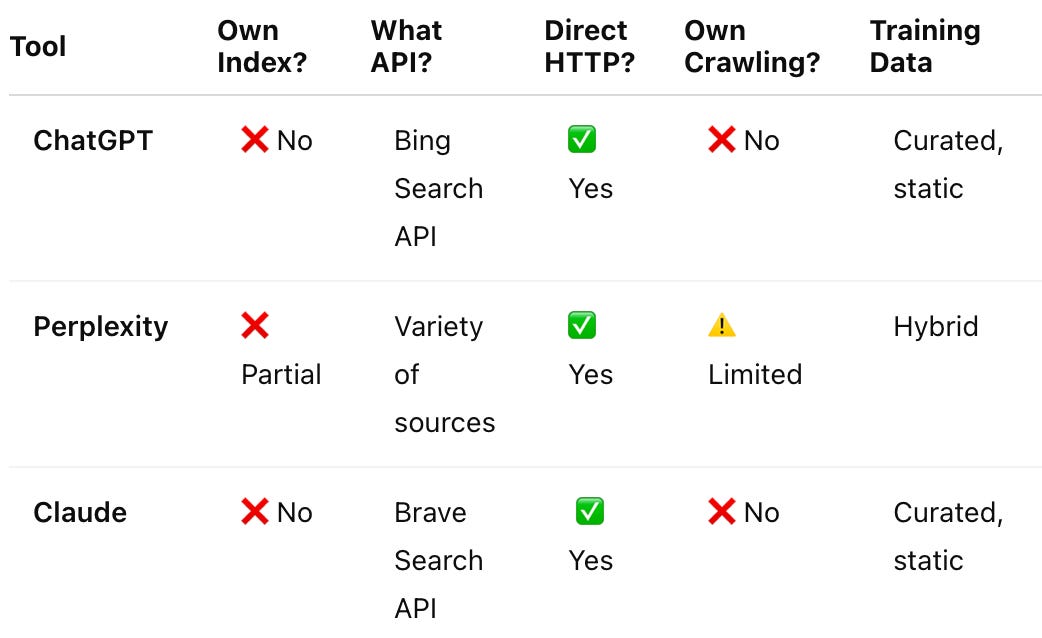
🧩 ChatGPT (with Browsing)
Uses Bing’s search index. It doesn’t crawl; it borrows from Microsoft’s infrastructure.🧠 Perplexity
A hybrid model. Part Bing index, part lightweight direct crawling, plus its own re-ranking logic. It pulls, filters, and cites in real time—great for recent and long-tail content.☁️ Claude
Relies on curated datasets and may query external APIs—but it does not crawl the open web directly.(Gemini)
Powered by Google’s internal infrastructure—different class altogether, not compared directly here.
Takeaway: If your content isn’t indexed by Google, Bing or another partner, it’s likely invisible to these AI systems. They’re not finding you unless someone else already has.
Turns out I’m not just lucky, broader data reflects it too. In a recent SEO study analyzing 10,000 finance/SaaS query-answer pairs, there was a strong correlation (~0.65) between websites ranking on Google’s first page and being mentioned in LLM-generated responses, while Bing showed ~0.5–0.6 correlation. Another analysis of 400+ high-intent keywords found that ranking in Google’s top 3 resulted in a 67–82% chance of being cited by AI tools like ChatGPT and Perplexity. That’s not anecdote; it’s systematic impact.
1.3 The Infrastructure Powering This New Era
So what happens after retrieval? AI search tools don't just return a list of links. They orchestrate a complex pipeline behind the scenes to produce that polished answer.
Let’s take Perplexity as a lens, since they’ve been relatively transparent about their system.
When you ask a question, Perplexity doesn’t just run a single search and return a few links. It spins up what’s basically a multi-agent team behind the scenes:
🧭 Planning Agent – figures out how to break your query into smaller pieces or follow-up searches.
🔍 Search Agents – run live queries across APIs like Bing, Brave Search, Google, and even niche sources like Tavily.
📊 Filtering Agents – review the results, sort them by semantic relevance, and discard low-signal noise.
✍️ Generation Agent – finally, this one synthesizes everything into a coherent, conversational answer—with citations.
All of this happens in seconds. And the entire process is powered by:
Massive GPU clusters
Vector databases that store semantic embeddings
API connectors to real-time sources
Multi-agent planning logic to handle conversation context
It’s not just a chatbot sitting on top of Google, it’s a mini research team, operating multiple systems at compute scale.
1.4 Why AI Search is So Different (and So Expensive)
Let’s compare the two approaches:

Think of it this way:
Google is like flipping through a card catalog.
AI is like asking a smart librarian: “What’s the most overlooked book on this topic?”
Why It Costs More
Semantic Matching
LLMs convert your query into multi-dimensional vectors and search for meaning, not keywords. More accurate, but compute-heavy.Conversational Memory
Follow-up queries are contextual (“How about for freelancers?”), which adds complexity and state management.GPU Infrastructure
AI search runs on expensive, parallelized compute. That’s why features like browsing often sit behind paywalls.
AI search isn’t just a better version of Google. It’s a whole new system, with new rules, new tech, and new expectations for content visibility.
2\. Why AI Can’t See Your Web App—And How to Fix It
This article continues for members
Join Build to Launch to read the full article, access all cohort content, and connect with other AI builders.