This Claude Code Prompt Reverse-Engineers Any Creator's Business. It Feels Illegal.
I ran it on Alex Hormozi and Justin Welsh: their offer stack, content strategy, tech stack, and exactly what to steal. And how you can get the most of it.
Most people follow creators they admire.
They read the posts. Watch the videos. Buy the course. Maybe try to model them.
But following is passive. You see the output. You don’t see what’s underneath it.
The newsletter, the YouTube, the free book. You consume all of it. What you don’t see: the funnel those pieces feed into, the tech running the operation, the offers they actually make money from, the frameworks they teach versus the ones they quietly use to sell.
The result: you copy the surface layer. You start posting daily because they do. You add a lead magnet because they have one. You pick a pricing tier because theirs looks about right. None of it connects to the underlying logic, because you never saw the underlying logic.
That’s what I built for “Creator Scout”. One creator. One prompt. One brief covering every layer of their business, from domain age to offer stack to what’s actually worth stealing.

What’s inside:
See what a complete scout brief looks like: Hormozi’s TL;DR and “What to Steal” section, free
How to run Creator Scout: MCP trigger phrases, the full prompt to paste, and which depth level to pick
How the prompt works: tools and techniques behind each of the 9 layers and 8 phases
Three use cases: competitor research, mentor prep, collab vetting
Hi, I’m Jenny 👋
I build AI systems and tools, then share how I did it. I run the Practical AI Builder program, for people who already use AI and want to build real things with it. Check it out if that sounds like you.
If you’re new to Build to Launch, welcome! Here’s what you might enjoy:

What a Creator Scout Brief Looks Like
Before the how, here’s the what.
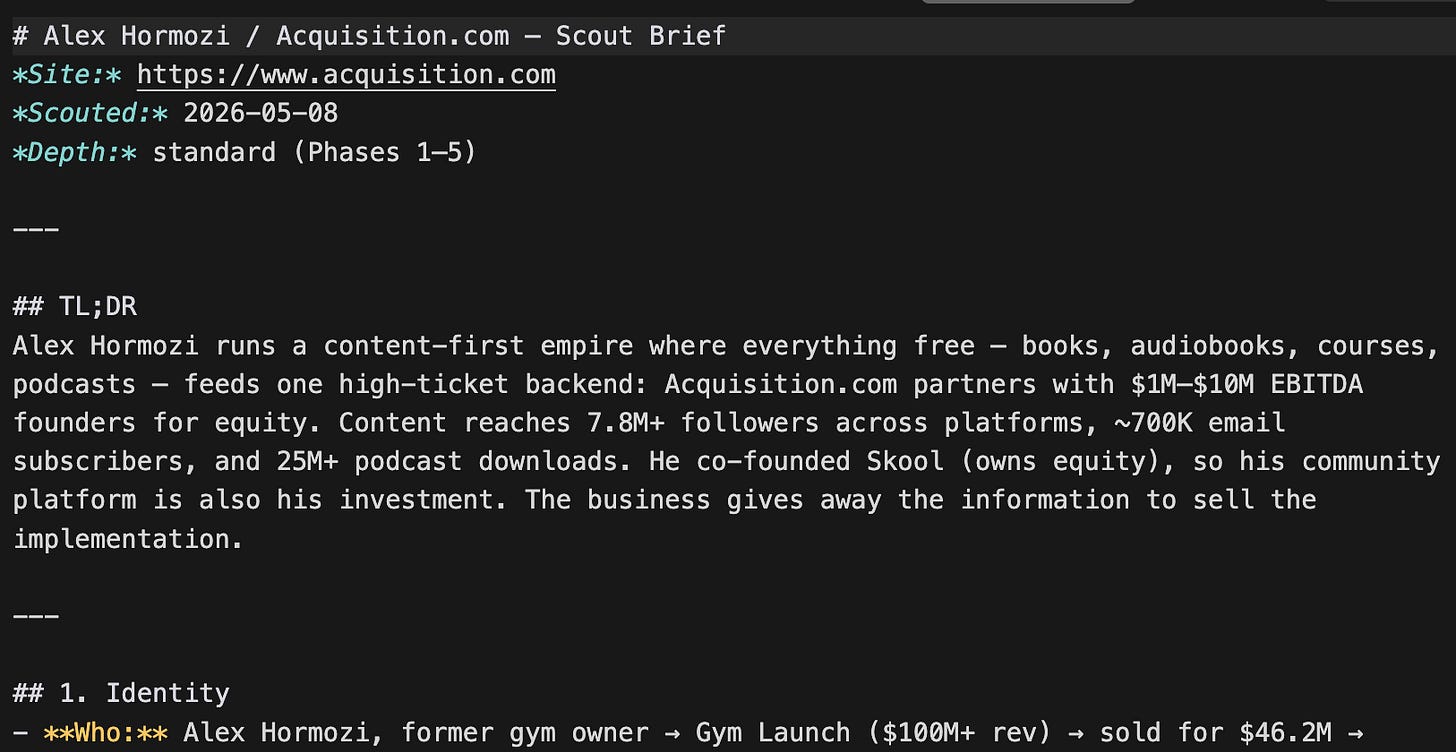
This is from the Alex Hormozi brief, generated from acquisition.com at standard depth:
Alex Hormozi runs a content-first empire where everything free — books, audiobooks, courses, podcasts — feeds one high-ticket backend: Acquisition.com partners with $1M–$10M EBITDA founders for equity. Content reaches 7.8M+ followers across platforms, ~700K email subscribers, and 25M+ podcast downloads. He co-founded Skool (owns equity), so his community platform is also his investment. The business gives away the information to sell the implementation.
The full brief runs through 11 structured sections: identity, offer stack, marketing engine, SEO posture, tech stack, IP and frameworks taught, social proof playbook, Wayback findings, what to steal, what to avoid, and open questions.
The “What to Steal” section is where most of the value sits. From the Hormozi brief:
Give the book away free as infrastructure, not a lead magnet. Permanently free audiobooks build authority faster than any paywall.
The Value Equation as a teaching framework. One visual formula that readers screenshot and share.
Consent-based phone capture on lead magnets. The Scaling Roadmap collects phone with explicit consent. Most creators only capture email.
Revenue-qualify at the top of the funnel. “$1M+/yr revenue minimum” on the public page filters serious buyers before any sales call.
Radical proof specificity. “$46.2M exit,” not “mid-8-figure exit.” Specificity signals honesty.
Named systems for everything. Grand Slam Offer, Value Equation, Mozi Media Content Method. Named systems are more memorable and more shareable than unnamed advice.
Six moves worth examining before you copy anyone’s strategy.
The sections below includes:
the full Creator Scout prompt, what each part does and which depth to run
full access to Hormozi and Justin Welsh scout output
plus the complete how-to for running Creator Scout on any creator you want to study
How to Run Creator Scout
This article continues for members
Join Build to Launch to read the full article, access all cohort content, and connect with other AI builders.