Spotlight: Jenny Ouyang & the Rise of Vibe Coding
Inside the rise of Vibe Coding Builders, the platform redefining who gets to build software.
For decades, software carried an unspoken caste system. “Real” developers wrote code in the dark. Everyone else was just playing with toys.
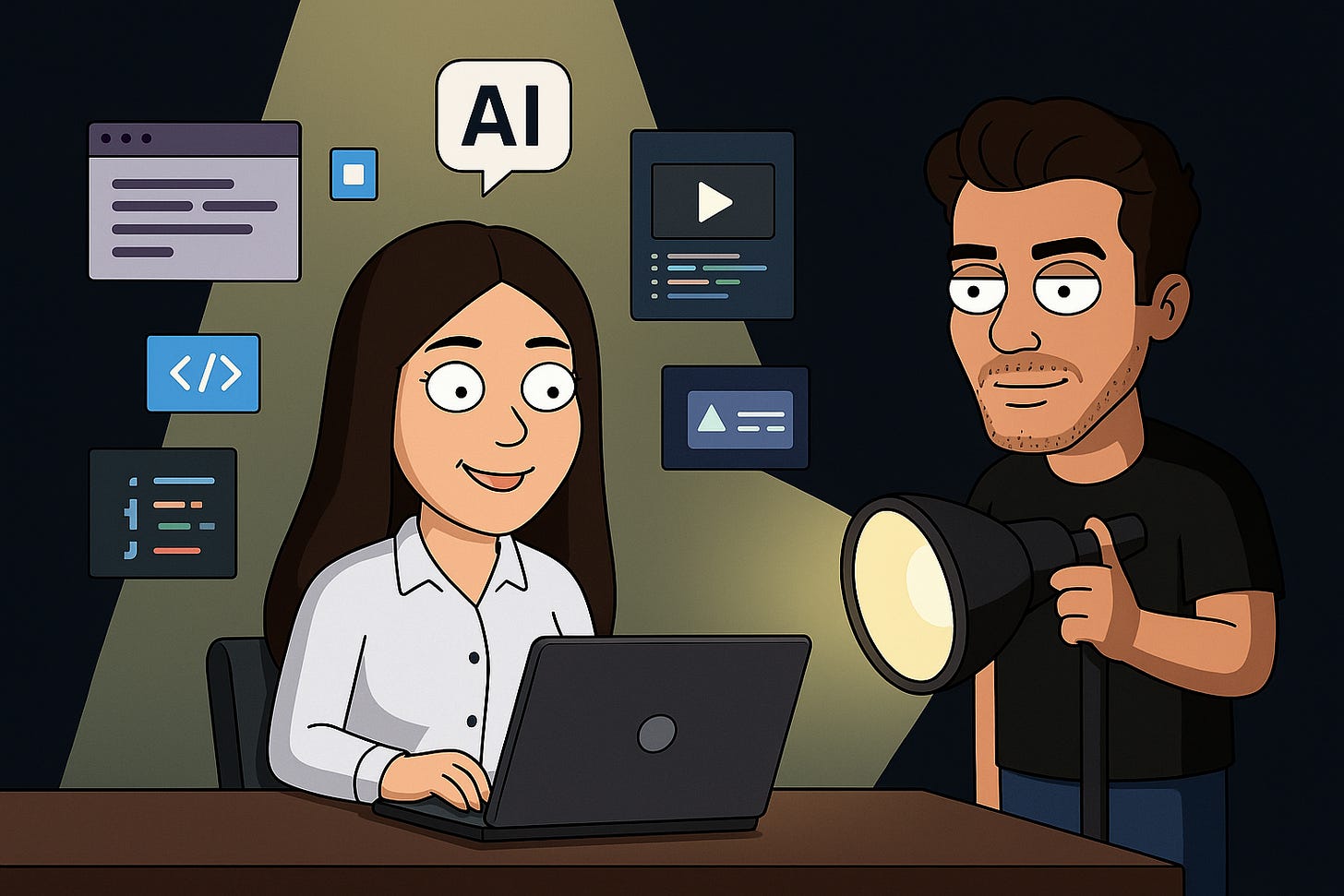
Then AI arrived and nuked the hierarchy. Suddenly, garbage men were shipping apps, lawn care professionals were automating workflows, and my cousin could build a product faster than PMs could schedule a sprint.
That is exactly why I’m starting this Spotlight Series. This is where I sit down with the people who are bending the rules of creation and ask them how they’re actually doing it. Less TED Talk, more barstool conversation.
The goal is simple: document how new products are born in the AI era.
Which brings me to the first feature: . She’s building Vibe Coding Builders, a community for people who use AI as part of their process but don’t quite fit into the “proper developer” box. While traditional dev spaces clutch pearls over the phrase “vibe coding,” Jenny is already giving those builders a home.
The Origin
Before we get into the weeds, I asked Jenny to give me the big picture. Who she is, what she’s building, and the problem she is trying to solve.
Q: Who are you, and what are you building?
A: I'm Jenny Ouyang, and I'm building the Vibe Coding Builders community at vibecoding.builders. It's a platform where builders who build with the assistance of AI can list themselves, showcase their projects, access learning resources, and learn from each other. Think of it as the missing home for people who are building real applications with AI assistance but don't fit into traditional developer spaces.
I'm also the author behind Build to Launch, where I write about turning AI-powered prototypes into production-ready applications. My background combines technical product building with a deep curiosity about how AI is changing what's possible for non-traditional developers and domain experts who want to build their own solutions.
Q: What sparked the idea?
A: The idea sparked from my own journey building production apps with AI. I'd built projects like Image Finder, Quick Viral Notes, and Substack Explorer, with the help of AI. I was very happy to accept me being a vibe coder because AI did most of the heavy lifting. But when I read online, I noticed the existing developer communities were somewhat hostile to anything labeled "vibe coding."
Meanwhile, I was getting messages from domain experts, such as lawyers, doctors, real estate analysts, who were excited about building their own tools but felt intimidated by traditional coding spaces. They had deep expertise in their fields and genuine problems to solve, but nowhere to showcase their AI-assisted solutions without judgment.
That disconnect inspired me that: we needed a space that celebrated building with AI, not apologizing for it. A place where people's innovative solution matters more than their coding pedigree.
Q: How do you explain this to different people?
A: For non-technical folks: "It's like LinkedIn for people who build apps with AI help. Instead of coding everything from scratch, they use AI tools to bring their ideas to life way faster. Think domain experts building custom solutions for problems they actually understand."
For builders: "It's a platform for AI-assisted development that treats AI as a real tool, not something to be ashamed of. We focus on actually shipping stuff, not just prototypes. The community connects domain expertise with technical implementation—results matter more than coding purity."
Notice the split. To outsiders, it’s “LinkedIn for AI builders.” To insiders, it’s a place where results matter more than purity tests. Both sides get it instantly.
The Struggle
Q: What’s been your toughest moment so far?
A: The toughest moment has been managing the explosion of ideas and opportunities that came with building the community. Once I started Vibe Coding Builders, everything connected, from content creation to collaboration opportunities, promoting builders, managing submissions... It sparked more possibilities than I had time to execute properly.
The challenge intensified because I was juggling this alongside my personal projects and articles that needed attention. I had to learn to say no to good ideas so I could focus on the most impactful ones.
Q: What did you underestimate going in?
A: I underestimated how much resistance the term "vibe coding" would create among technical people. Even developers who actively use AI assistance refused to associate themselves with the label. They saw it as diminishing their "serious coder" identity.
The irony is that everyone's doing some form of vibe coding now, but the stigma runs deep. Traditional developers worry it makes them look less skilled, while domain experts just embrace it because they're not hung up on coding purity. I learned that the most engaged community members are those who care more about solving problems than protecting their technical status. The future belongs to people who solve problems well, no matter how much AI they use.
This one made me laugh. Of course, the internet couldn’t just let “vibe coding” live. Labels are threatening. But Jenny makes a valid point: the people solving real problems aren’t the ones worried about labels.
The Wins
Q: What’s the proudest milestone so far?
A: The milestone that made me think "this is working" happened during my Build to Launch Friday series. I was featuring domain experts from the community, and the comments started coming in: "I can relate so much. I'm a domain expert too, and this is exactly what I hoped I could do for myself."
When you create something people feel at home in, you know you're solving a real problem.
Q: Any surprising use cases?
A: The most surprising use case has been builders treating the platform as a confidence booster rather than just a showcase. People aren't just listing their projects, they're using it as proof that their AI-assisted work is legitimate and worth celebrating.
I've also been experimenting with custom tools in a private section: learning path generators and personalized product building journeys. The goal is to help people navigate from idea to shipped product based on their expertise level. It's still in testing, but early feedback suggests this could become the platform's added value for turning domain experts into confident builders.
Q: What sets you apart in such a crowded space?
A: We're the very few platforms that encourage AI-assisted building instead of apologizing for it. While other communities debate whether vibe coding is "real" development, we focus on real-world impact. Our strength is bridging domain expertise with technical implementation; so we don't care if you're a "proper" developer, we care if you're solving genuine problems. That mindset attracts builders who prioritize shipping solutions over protecting coding status.
It’s a simple dividing line: other communities debate definitions. Jenny’s focuses on outcomes.
The Vision
Builders see farther than they admit.
Q: Where do you see this in 3–5 years?
A: In 3-5 years, I see this becoming the go-to place for AI-assisted builders. Not just where you showcase stuff, but a complete learning and collaboration hub where domain experts actually ship real applications that work.
The flywheel effect will be powerful: established vibe coders mentoring newcomers, sharing real-world patterns for security and scaling, creating tools that solve problems we can't even imagine yet.
Q: What’s the bigger mission here?
A: The bigger mission is democratizing software creation. Right now, we have this explosion of people building applications with AI assistance, but existing platforms like HackerNews, ProductHunt, and Reddit are often protective against anything labeled "vibe coding."
I want to create a place where people focus on solving problems, not arguing about technical purity. Where domain experts can turn their knowledge into tools they're actually proud of and use. Where success is measured by impact, not how fancy your code looks. Ultimately, it's about helping people turn their expertise into apps that actually matter.
It’s not about winning arguments online. It’s about giving people permission to build what they need and be proud of it. That’s how industries change.
Q: What does success mean to you personally?
A: Success means when people think of me and this community first when they want to talk about building products with AI help. When someone builds their first real app with AI and wants to share it, they come here.
More importantly, I want people to feel at home here. That moment when a domain expert realizes they don't need to apologize for using AI, that their solution matters more than their coding background. Success is when builders stop hiding the fact that they used AI and start celebrating what they actually built.
That answer says it all: success isn’t about vanity metrics. It’s about people feeling at home while they build.
Behind the Builder
This part always tells me more about a builder than any roadmap.
Q: What tools or resources have been indispensable?
A: Cursor IDE has been a lifesaver for both building and writing, that's where I prototype ideas and draft articles with AI help. Having kids during the day actually helps my productivity; the time constraint forces me to be more focused during evening work time.
The constant back-and-forth with AI keeps me inspired on different topics. I also rely heavily on my Build to Launch newsletter as a feedback loop, I share ideas, get responses, then iterate. Community conversations often spark the next feature or article I want to write.
Q: Who inspires you?
A: I have a lot of people that inspire me. The builder I look up to is Sabrina Ramonov, she’s got incredible impact and generosity, that open-mindedness paired with growth is rather inspiring to me right now. I've also learned a ton from Substack creators like and . Watching them engage audiences and promote their work taught me approaches I never would have figured out from my technical background.
Q: What advice would you give someone starting out?
A: If someone is just starting out, I would say just go ahead and try everything. You will stumble over a lot of failures and there will be a lot of depressing moments and obstacles, and that’s totally fine. You will eventually find your unique way out, that’s something no one can teach. I'm still figuring things out myself and running into problems all the time, but I learnt to handle it better over time.
Direct, honest, and painfully accurate. Fail, feel miserable, keep going. That’s the only way forward.
How to plug in?
Every Spotlight ends the same way: if you want to dive deeper, here’s where to go.
Q: Where can people try your product, follow your work, or get in touch?
A: Visit the Vibe Coding Builders community at vibecoding.builders to showcase your projects or discover what others are building. Follow my newsletter Build to Launch at buildtolaunch.ai for weekly insights on AI-assisted building and production-ready development.
This Series isn’t here to recycle pitch decks or hand out “changing the world” merit badges. It’s here to study the new products taking shape and the builders who make them real. is one of those builders.
With Vibe Coding Builders, she’s not chasing validation; she’s creating a space where innovative projects speak for themselves.
That’s the point. New products tell us more about the future than panel debates or trend reports ever will. The people building them are rewriting the norms in real time. Jenny’s platform is an early glimpse of what that future looks like: communities where ideas turn into tools, and where builders finally see their own impact in the hands of real users.
💬 Enjoyed the reading?
We’re the team behind whatisthat.ai, the AI discovery platform (beta) built to cut through the noise. If you found this useful, pass it on. Share it, forward it, spread it. Every share helps us grow and puts real insights into more hands. 🙏
More From Me
If you liked this, you might like these too:
The Style Bible: A Creator’s Guide to Building Voice with Precision
Opinion: AI to Mars? The Dumbest Smartest Idea That Might Just Work
I Built My Entire AI Consulting Agency on Replit and Here’s What Happened
The SEO Tool Power Rankings: Giants, Gainers, and Global Oddities